'Companions' ease pain of China's bustling, bamboozling hospitals / Photo: Jade GAO - AFP
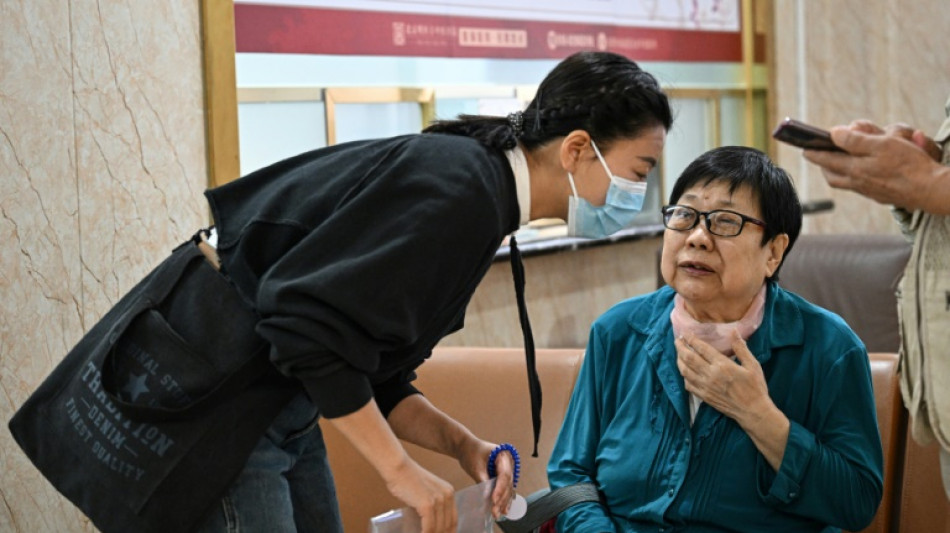
At a bustling Beijing hospital, Tian Yigui hands over some of his elderly wife's paperwork to Meng Jia, a "patient companion" hired to help navigate China's stretched and bureaucratic healthcare system.
Yawning funding gaps and patchy medical coverage have long funnelled many Chinese people towards better resourced city hospitals for much-needed care.
Sprawling, overcrowded and noisy, the facilities can be exhausting for patients and their families, especially the elderly.
The problem has fuelled the rise of patient companions, or "peizhenshi", a lucrative and unofficial service in the country's growing gig economy.
Tian, 83, said most Beijing hospitals were "overwhelmingly confusing".
"We have to go up and down all the floors, wait for elevators, wait in lines... it's really troublesome," he told AFP.
Elsewhere at the People's Liberation Army General Hospital in the Chinese capital, patients faced long queues, myriad check-ins and a whirl of digital payment codes.
Hospital aides wearing bright red sashes rattled off directions into headsets as hundreds of patients filed through the colossal lobby.
Armed with a sheaf of papers at a traditional Chinese medicine ward, Meng breezed through check-in before joining Tian and wife Gao Yingmin in a consultation room.
Leaving Gao to rest in a waiting area, Meng then brought Tian to a payment counter before explaining to the couple how to pick up prescribed medications.
For a four-hour service, patient companions like Meng charge around 300 yuan ($40).
It is worth every penny for Gao, 78, who is undergoing treatment for complications from throat surgery.
The helpers are "convenient, practical and (give us) peace of mind", she said, straining against a breathing tube.
"We no longer have to worry... they do all the work for us."
- 'Real need' -
Hundreds of advertisements for patient companions have sprung up on Chinese social media in recent years.
Authorities appear to allow the companions in hospitals because they are broadly in line with the government's promotion of health services for seniors.
Meng, 39, had no medical background before enrolling in a weeklong training programme run by Chengyi Health, an online platform that connects patients and companions.
Founder Li Gang, a former anaesthesiologist, said "there's a big knowledge gap when it comes to medical care".
Large Chinese hospitals can have over 50 clinical departments, each with numerous sub-specialities.
That means many people "don't know how to go to the doctor", Li said.
While some young people -- such as expectant mothers -- hire companions, some two-thirds of Chengyi's clients are aged 60 or older.
Trainee Tao Yuan, 24, said he left his job at an internet company to pursue a vocation "more valuable than money".
A generation born under China's now-abolished one-child policy are approaching middle age and caring for their elderly parents alone.
Increasing work and family pressure had left them with a "real need" for help, Tao said.
- Ageing nation -
China's healthcare system has long struggled to tackle deep-seated regional funding gaps and inconsistent access to equipment and medical staff.
Limited treatment options, especially in rural areas, push many patients into municipal hospitals for comparatively minor ailments.
"It's a perennial structure problem," said Wang Feng, an expert on Chinese demographics at the University of California, Irvine.
Working adults have no time to take elderly parents to hospital, while technology cannot yet replace human caregivers, he said.
China "will have a larger... demand for personal assistance" as the elderly account for an ever bigger proportion of the population, Wang said.
Authorities are betting big on the "silver economy" -- products and services for older people, which totalled seven trillion yuan ($970 billion) last year, according to the nonprofit China Association of Social Welfare and Senior Service.
The figures are a bright spot in an economy struggling to maintain strong growth and robust youth employment.
Xiao Shu, who asked to be identified by a nickname for privacy, told AFP he made around 10,000 yuan ($1,400) per month –- a tidy wage in China's competitive capital.
But the former dentistry worker said there were limits to the service.
The 36-year-old once refused to take a client's nearly 90-year-old father to a post-surgery check-up.
"If something happened to him, who would be responsible for it?" he said.
X.Blaser--NZN