Zürcher Nachrichten - 'Bleak' future for seals decimated by bird flu, scientists warn

EUR -
AED 4.256969
AFN 73.026624
ALL 95.949668
AMD 436.29849
ANG 2.074968
AOA 1062.937298
ARS 1612.956254
AUD 1.648622
AWG 2.089361
AZN 1.97515
BAM 1.955793
BBD 2.330592
BDT 141.989509
BGN 1.981339
BHD 0.437098
BIF 3425.188147
BMD 1.159146
BND 1.479895
BOB 7.995972
BRL 6.159011
BSD 1.157196
BTN 108.180626
BWP 15.778945
BYN 3.510788
BYR 22719.261378
BZD 2.327292
CAD 1.591102
CDF 2637.057544
CHF 0.913917
CLF 0.027244
CLP 1075.745893
CNY 7.982348
CNH 8.005172
COP 4253.385281
CRC 540.49813
CUC 1.159146
CUP 30.717369
CVE 110.264618
CZK 24.515015
DJF 206.059287
DKK 7.48519
DOP 68.689762
DZD 153.294785
EGP 59.995792
ERN 17.38719
ETB 182.369469
FJD 2.566871
FKP 0.87126
GBP 0.86899
GEL 3.147128
GGP 0.87126
GHS 12.613956
GIP 0.87126
GMD 85.201694
GNF 10142.964899
GTQ 8.863969
GYD 242.099162
HKD 9.082199
HNL 30.628894
HRK 7.547552
HTG 151.809475
HUF 393.739159
IDR 19654.711213
ILS 3.60393
IMP 0.87126
INR 108.971952
IQD 1515.894754
IRR 1525001.44174
ISK 144.047519
JEP 0.87126
JMD 181.799371
JOD 0.82188
JPY 184.582853
KES 149.909481
KGS 101.364887
KHR 4623.983998
KMF 494.955743
KPW 1043.080849
KRW 1744.874492
KWD 0.35536
KYD 0.964297
KZT 556.328075
LAK 24848.914008
LBP 103633.441366
LKR 360.978751
LRD 211.759267
LSL 19.520632
LTL 3.422657
LVL 0.701156
LYD 7.407974
MAD 10.813063
MDL 20.15193
MGA 4824.983303
MKD 61.639787
MMK 2434.137979
MNT 4156.167228
MOP 9.340468
MRU 46.32084
MUR 53.912319
MVR 17.920835
MWK 2006.593056
MXN 20.746631
MYR 4.565921
MZN 74.073751
NAD 19.520632
NGN 1572.092184
NIO 42.579853
NOK 11.093021
NPR 173.089401
NZD 1.985179
OMR 0.445696
PAB 1.157196
PEN 4.000686
PGK 4.994983
PHP 69.723065
PKR 323.078682
PLN 4.282755
PYG 7557.973845
QAR 4.231485
RON 5.101986
RSD 117.449594
RUB 96.003268
RWF 1683.694173
SAR 4.352195
SBD 9.33305
SCR 15.877645
SDG 696.647132
SEK 10.831104
SGD 1.486609
SHP 0.86966
SLE 28.486057
SLL 24306.724357
SOS 661.297712
SRD 43.45349
STD 23991.981659
STN 24.499915
SVC 10.124965
SYP 128.128397
SZL 19.526932
THB 38.14522
TJS 11.114462
TMT 4.068602
TND 3.417588
TOP 2.790945
TRY 51.295112
TTD 7.850973
TWD 37.135217
TZS 3008.589588
UAH 50.693025
UGX 4373.984863
USD 1.159146
UYU 46.629839
UZS 14107.951178
VES 527.05282
VND 30499.449254
VUV 138.346896
WST 3.161587
XAF 655.95473
XAG 0.017031
XAU 0.000257
XCD 3.13265
XCG 2.085493
XDR 0.815797
XOF 655.95473
XPF 119.331742
YER 276.576393
ZAR 19.85325
ZMK 10433.709028
ZMW 22.593922
ZWL 373.244535
  • RBGPF

    -13.5000

    69

    -19.57%

  • BCC

    -1.5600

    68.3

    -2.28%

  • CMSD

    -0.2420

    22.658

    -1.07%

  • GSK

    -0.5300

    51.84

    -1.02%

  • BCE

    0.0600

    25.79

    +0.23%

  • RIO

    -2.5000

    83.15

    -3.01%

  • RELX

    -0.4600

    33.36

    -1.38%

  • NGG

    -3.5400

    81.99

    -4.32%

  • JRI

    -0.3900

    11.77

    -3.31%

  • CMSC

    -0.2000

    22.65

    -0.88%

  • RYCEF

    -1.2600

    15.34

    -8.21%

  • BTI

    -1.3500

    57.37

    -2.35%

  • AZN

    -5.3300

    183.6

    -2.9%

  • BP

    -1.0800

    44.78

    -2.41%

  • VOD

    -0.0900

    14.33

    -0.63%

'Bleak' future for seals decimated by bird flu, scientists warn
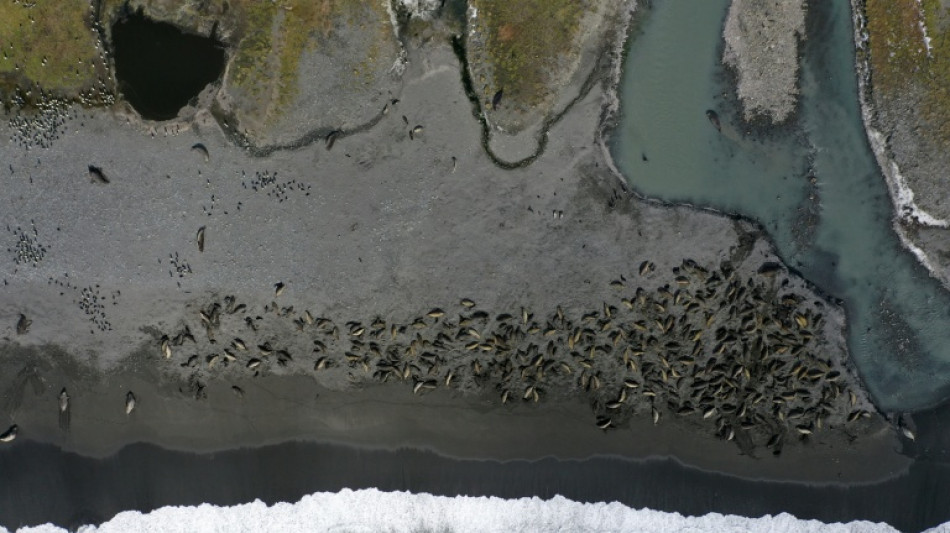
'Bleak' future for seals decimated by bird flu, scientists warn / Photo: Handout - BRITISH ANTARCTIC SURVEY/AFP

'Bleak' future for seals decimated by bird flu, scientists warn

The world's largest species of seal has been devastated by bird flu, which has wiped out half of all breeding females at a key wildlife haven near Antarctica, scientists warned Thursday.

Text size:

The remote island of South Georgia is the home of a majority of all southern elephant seals. Males of these blubbery giants can grow up to two metres (six feet seven inches) long, weigh nearly four tonnes (8,800 pounds) -- and have a distinctive elephant-trunk-like proboscis on their face that earned the mammals their name.

Bird flu arrived on South Georgia in 2023 during an outbreak that has seen the virus spread across the world like never before, killing millions of birds and infecting many mammals, including several humans.

Earlier this year, scientists warned that bird flu had sparked the worst die-off on record for southern elephant seals when it spread among a population on Argentina's coast in 2023.

In a study published in the journal Communications Biology on Thursday, a UK team of researchers gave the first estimate for how hard South Georgia's seals have been hit.

"It paints a pretty stark and harrowing picture," Connor Bamford, a marine ecologist at the British Antarctic Survey and lead author of the study, told AFP.

According to the last count in 1995, South Georgia is home to 54 percent of all southern elephant seals.

On the same day of the year in 2022 and 2024, the scientists used hand-launched drones to take images of the island's three biggest breeding beaches.

After bird flu arrived, the number of breeding females plummeted by 47 percent, a loss of around 53,000 seals, according to the study.

- Sick mothers abandoning pups -

Many pups also died on the beach after being abandoned by their bird-flu-infected mothers.

Scientists at the breeding ground on the Valdes Peninsula along Argentina's coast have determined that 97 percent of elephant seal pups died either from being abandoned or contracting bird flu in 2023.

On the peninsula, an even higher rate of breeding females -- 67 percent -- were estimated to have been wiped out.

"If the South Georgia population responds similarly to the modelled outlook at Peninsula Valdes, the future is bleak," the authors of the new study said.

However, Bamford did not think the elephant seals would be pushed "close to extinction".

The South Georgia population is much larger -- numbering in the hundreds of thousands -- so is likely to be more resilient, he said.

"That being said, the impacts to this population will be felt for many years to come," he added.

For the Valdes seals, scientists have estimated that the aftermath of this bird flu outbreak will likely reverberate until the end of the century.

The researchers believe that the seals are transmitting the virus to each other via water droplets, Bamford said.

While elephants spend most of their time in the water, they breed in densely packed colonies on wide, sandy beaches.

"There are thousands of them together, all coughing and splattering," Bamford said, adding that the seals are also particularly "snotty".

The scientist called for "regular check-ups" on South Georgia's elephant seals.

I.Widmer--NZN