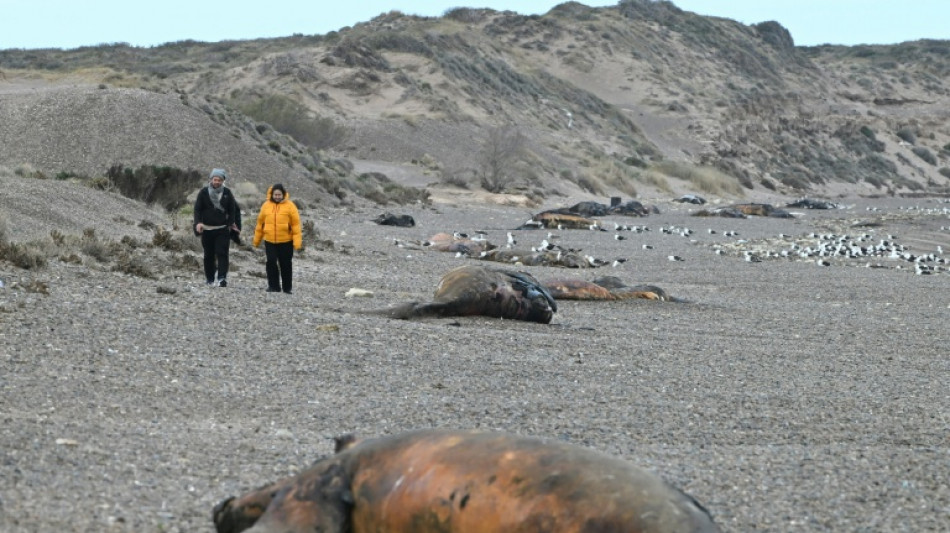
Bacteria suspected in deaths of hundreds of baby whales off Argentina / Photo: MAXI JONAS - AFP
A bacterial infection is suspected of killing hundreds of baby whales in the southern Argentine region of Patagonia, a marine mammal expert told AFP on Thursday.
This week again, dozens of dead southern right whale calves washed up on beaches in southern Chubut province, continuing a disturbing trend that began in June.
"The death rate (among young whales) is quite high this season in particular," Mariano Coscarella, a researcher at the Marine Mammals Laboratory of the national research council Conicet, confirmed to AFP.
Coscarella, who is based in Puerto Madryn, a major whale-watching destination on the Atlantic coast, said veterinarians suspected an outbreak of erysipelas, a serious disease caused by bacteria commonly found on the mammals' skin.
"It seems to be a natural cause however we cannot completely rule out the influence of human activity," he said.
The Chubut provincial government said Wednesday it was working closely with the scientific community to solve the mystery of the dying whales.
It said that preliminary research suggested it was caused by a "common marine bacteria."
Puerto Madryn and the nearby Valdes Peninsula are a major breeding ground for southern right whales, which grow up to 17 meters (55 feet) in length and weigh on average 40 tons, roughly the equivalent of four elephants.
A record 2,110 whales were counted in the area in 2025, including 800 young.
This year, authorities have counted 1,375 specimens, including nearly 400 calves, Coscarella said.
He added that the recent deaths "do not constitute a medium-term danger" for the area's whale population given the average life span of the southern right whale, which local authorities put at 60 years.
T.Furrer--NZN