Zürcher Nachrichten - California submits rival Colorado River water plan

EUR -
AED 4.35335
AFN 77.050797
ALL 96.66512
AMD 452.977132
ANG 2.121943
AOA 1087.00321
ARS 1715.259993
AUD 1.706088
AWG 2.136666
AZN 2.019869
BAM 1.955701
BBD 2.406579
BDT 146.012629
BGN 1.990709
BHD 0.449077
BIF 3539.921292
BMD 1.18539
BND 1.513224
BOB 8.256583
BRL 6.231008
BSD 1.19484
BTN 109.724461
BWP 15.634211
BYN 3.403228
BYR 23233.647084
BZD 2.403079
CAD 1.614917
CDF 2684.909135
CHF 0.911322
CLF 0.026011
CLP 1027.058063
CNY 8.240537
CNH 8.248946
COP 4350.080393
CRC 591.67013
CUC 1.18539
CUP 31.412839
CVE 110.259434
CZK 24.334287
DJF 212.769259
DKK 7.470097
DOP 75.226202
DZD 154.463202
EGP 55.903178
ERN 17.780852
ETB 185.61503
FJD 2.613371
FKP 0.865849
GBP 0.861444
GEL 3.194674
GGP 0.865849
GHS 13.089339
GIP 0.865849
GMD 86.533903
GNF 10484.470707
GTQ 9.164537
GYD 249.97738
HKD 9.259024
HNL 31.537408
HRK 7.536597
HTG 156.372106
HUF 381.328619
IDR 19883.141804
ILS 3.663335
IMP 0.865849
INR 108.693763
IQD 1565.320977
IRR 49934.560565
ISK 144.985527
JEP 0.865849
JMD 187.240547
JOD 0.840489
JPY 183.456955
KES 154.262212
KGS 103.662825
KHR 4804.757439
KMF 491.93733
KPW 1066.851144
KRW 1719.768532
KWD 0.36382
KYD 0.99575
KZT 600.939662
LAK 25713.701882
LBP 106998.998316
LKR 369.511346
LRD 215.369127
LSL 18.971842
LTL 3.500149
LVL 0.717031
LYD 7.497621
MAD 10.838453
MDL 20.096985
MGA 5339.730432
MKD 61.636888
MMK 2489.708718
MNT 4227.553379
MOP 9.608515
MRU 47.674593
MUR 53.852723
MVR 18.32658
MWK 2071.895403
MXN 20.70407
MYR 4.672854
MZN 75.580924
NAD 18.971842
NGN 1643.520192
NIO 43.96778
NOK 11.437875
NPR 175.559137
NZD 1.964681
OMR 0.458017
PAB 1.19484
PEN 3.994898
PGK 5.114742
PHP 69.837307
PKR 334.289724
PLN 4.215189
PYG 8003.59595
QAR 4.35638
RON 5.097064
RSD 117.394074
RUB 90.535429
RWF 1743.311992
SAR 4.447217
SBD 9.544303
SCR 17.203132
SDG 713.016537
SEK 10.580086
SGD 1.506161
SHP 0.88935
SLE 28.834661
SLL 24857.038036
SOS 682.865527
SRD 45.104693
STD 24535.182964
STN 24.498763
SVC 10.454472
SYP 13109.911225
SZL 18.966043
THB 37.225573
TJS 11.153937
TMT 4.148866
TND 3.433027
TOP 2.854135
TRY 51.401485
TTD 8.11259
TWD 37.456003
TZS 3076.744675
UAH 51.211415
UGX 4271.784345
USD 1.18539
UYU 46.367659
UZS 14607.262574
VES 410.075543
VND 30749.020682
VUV 140.814221
WST 3.213333
XAF 655.923887
XAG 0.014004
XAU 0.000244
XCD 3.203577
XCG 2.153391
XDR 0.815759
XOF 655.923887
XPF 119.331742
YER 282.508153
ZAR 19.134414
ZMK 10669.938133
ZMW 23.448816
ZWL 381.695147
  • SCS

    0.0200

    16.14

    +0.12%

  • RBGPF

    1.3800

    83.78

    +1.65%

  • BCC

    0.5100

    80.81

    +0.63%

  • VOD

    -0.0600

    14.65

    -0.41%

  • RYCEF

    -0.4300

    16

    -2.69%

  • JRI

    0.1400

    13.08

    +1.07%

  • RIO

    -4.1000

    91.03

    -4.5%

  • CMSC

    0.0500

    23.76

    +0.21%

  • RELX

    -0.3700

    35.8

    -1.03%

  • BCE

    0.3700

    25.86

    +1.43%

  • NGG

    0.2000

    85.27

    +0.23%

  • GSK

    0.9400

    51.6

    +1.82%

  • AZN

    0.1800

    92.77

    +0.19%

  • CMSD

    -0.0400

    24.05

    -0.17%

  • BTI

    0.4600

    60.68

    +0.76%

  • BP

    -0.1600

    37.88

    -0.42%

California submits rival Colorado River water plan
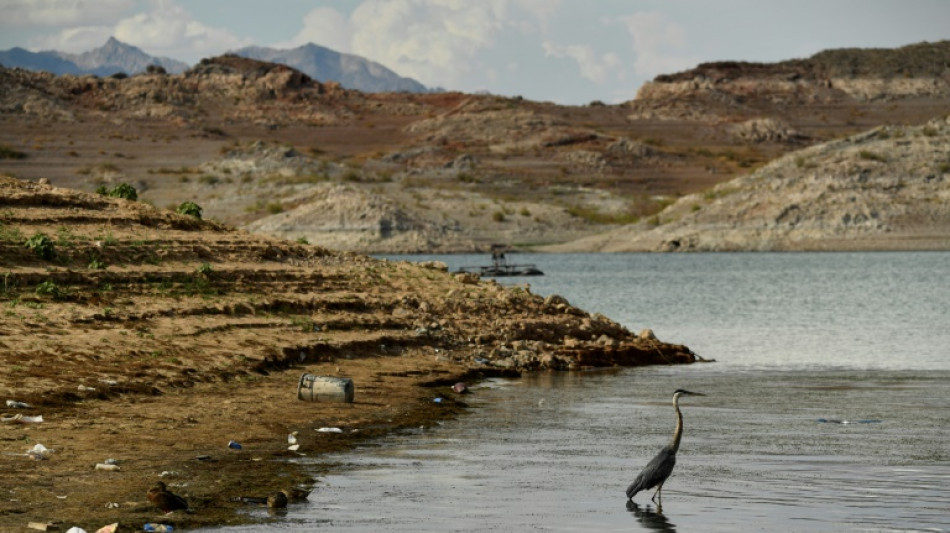
California submits rival Colorado River water plan / Photo: Patrick T. FALLON - AFP/File

California submits rival Colorado River water plan

California has submitted a rival plan for use of the Colorado River, after six other states accused it of refusing to cooperate in the battle over usage of a dwindling major US watercourse.

Text size:

Arizona, California, Colorado, Nevada, New Mexico, Utah and Wyoming were given until January 31 to come up with a plan to slash the amount of water they take from the river -- or face a solution imposed by Washington.

Everyone apart from California agreed on a proposal that would see a reduction in the amount of water that makes it as far as the most populous state in the country, where critics say farmers use too much to grow crops for export.

On Tuesday, California offered its own solution, and offered to trim its own use, but in the meantime to revert to the over-subscribed status quo.

"In the absence of a seven-state consensus proposal (we) should maintain existing protections to California’s senior entitlements," the Colorado River Board of California said in its submission to the Bureau of Reclamation, the federal government department with responsibility for water.

That came after a behind-closed-doors proposal last week from the state's representatives to model what would happen if big cities like Phoenix and Las Vegas were cut off from the water supply, CNN reported.

The suggestion was met with strong pushback from other negotiators, the broadcaster said, citing people familiar with the matter.

Eventually, the other six states huddled, and submitted a framework of water consumption ceilings, with the bulk of the cuts falling on California to "mitigate the risk of either Lake Powell or Lake Mead reaching dead pool."

Both reservoirs, fed by the Colorado River, have seen their levels plunge over the past two decades as a punishing drought grips the western United States.

Adel Hagekhalil, general manager of Metropolitan Water District of Southern California, said the state's proposal followed two decades of reductions from the region.

"We are committed to doing more now. But we must do it in a way that does not harm half of the people who rely on the river - the 19 million people of Southern California," he said.

"We must do it in a way that does not devastate our $1.6 trillion economy, an economic engine for the entire United States.

"The proposal presented today by California does all of this by equitably sharing the risk among Basin states without adversely affecting any one agency or state. The plan presented yesterday, which shut out California, does not."

The Colorado River rises in the Rocky Mountains and flows through Colorado, Utah, Arizona, Nevada, California and northern Mexico, where it empties into the Gulf of California.

It is fed primarily by snow accumulated at high altitude that gradually melts during the warmer months.

But declining precipitation and rising temperatures caused by humanity's unchecked burning of fossil fuels means less snow falls, and what does fall, melts faster.

That means less water reaches a river that is crucial to the great cities of the west like Las Vegas and Los Angeles, as well as to tens of thousands of acres (hectares) of farmland.

L.Muratori--NZN