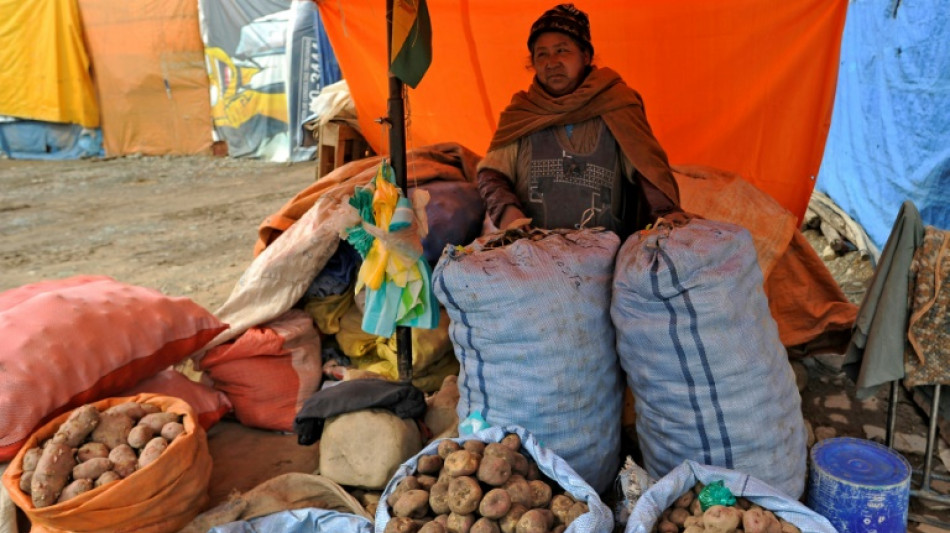
Drought and frost batter vital potato crops in Bolivia / Photo: JORGE BERNAL - AFP
Dozens of furrows lie barren in a dusty field on the Bolivian highlands. It should be replete with potato plants ready for harvest, but a deadly combination of drought and frost proved too much for the crop.
Cristobal Pongo, one of many peasants of the Aymara Indigenous group who devote their lives to potato farming in this region highly susceptible to climate change, looks dejectedly upon the dismal scene.
"The potato is our life. We harvest, we sell... It is our livelihood... (it pays) for our children's education," the 64-year-old told AFP as he knelt in his field about 4,000 meters (13,100 feet) above sea level.
This year, Pongo will have nothing to sell at the market in Calamarca, some 70 kilometers south of the capital La Paz. He does not know what he will do.
"The frost has killed the potato... Look at it, it is dead," he said, crestfallen.
Pongo's crop is not the only one affected by bad weather during the growth season. And the resulting shortage has seen the price of potatoes shoot up sevenfold to almost $2 per kilogram (2.2 pounds) in some markets.
This in a country where more than a third of the population lives in poverty, according to official figures.
Experts say seasonal rains that came too late and untimely frost are likely the outcome of a changing climate.
"The highlands, and... the whole region of Bolivia, are vulnerable to (climate) change," said Luis Blacutt, an atmospheric physics expert at the Higher University of San Andres in La Paz.
"These changes are manifesting now. There is a very, very acute rain deficit," he told AFP.
- 'Climate crisis' -
Normally, the region receives up to 70 percent of its annual rainfall between November and March, but in 2022, it came only at the end of December.
The delay also wreaked havoc in the Andean regions of neighboring Peru, which declared a 60-day state of emergency in several districts in December due to drought.
Already in 2010, a study in the Annals of the Association of American Geographers, a peer-reviewed journal, warned that "climatic changes in the Altiplano (or highlands) might have serious consequences for water management and Indigenous agriculture."
And research published in 2019 in the journal Frontiers in Environmental Science said human-induced climate change helped explain "the negative rainfall changes detected in the Altiplano during the last decades."
According to the International Potato Center, based in Peru, there are more than 4,000 varieties of edible potato -- the third most cultivated crop for human consumption after rice and wheat.
Most of them are found in the South American Andes.
Pongo now has to wait until the end of October to replant his crop, having given up on having any useful harvest this time around.
If no rain has fallen by then, he will have to wait even longer as the soil needs to be moist for potatoes to germinate.
But if he waits too long, the winter frosts that come ever earlier could once again destroy the fruits of his labor.
In the face of such uncertainty, Pongo and some neighbors have started using greenhouses erected with the support of a local NGO, Cipca, which comes to the aid of peasant farmers.
"In the Bolivian highlands, we are fully experiencing the effects of climate change," said Cipca technician Orlando Ticona.
"We are experiencing a climate crisis, which has had a profound impact on all crops in the highlands, that is potatoes and Andean grains. The potato mostly."
If not in the field, potatoes can be successfully produced in greenhouses, said Ticona.
However, greenhouse production is limited to much smaller areas, meaning growers could produce enough for their own use, but not enough to sell.
"Climate change is... putting food security at risk because it can reach a point where farmers cannot even produce for their own consumption," said Ticona.
"I have no hope," said Pongo.
M.J.Baumann--NZN