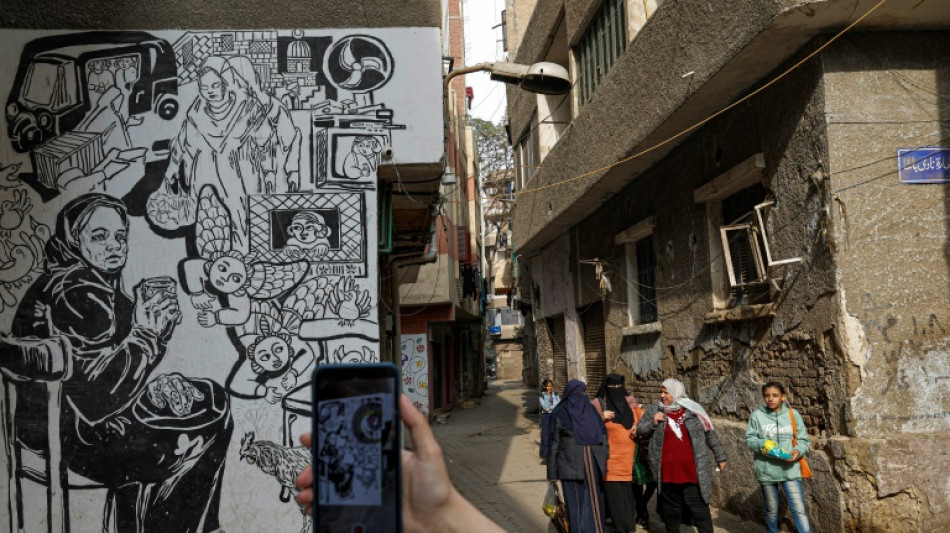
In Old Cairo, residents reconnect with their heritage / Photo: Khaled DESOUKI - AFP
For most of their lives, children from historic Cairo's Al-Khalifa district only saw the mausoleums, mosques and madrasa schools that pepper their neighbourhood from outside heavy bronze doors.
In one of the world's oldest Islamic cities, communities were becoming increasingly separated from the centuries-old buildings they lived alongside -- prompting architect and heritage management expert May al-Ibrashy to launch a programme to "foster a sense of ownership over this heritage".
Believing a sense of belonging is integral to protecting heritage, her "participatory conservation initiative" has included bringing the young through those once-closed doors.
"The first time we opened a heritage monument to children, they were ecstatic," Ibrashy said.
"Every day they had passed in front of this historic site, but had never been allowed inside".
The Athar Lina initiative, whose name means "the monument is ours" in Arabic, has carried out workshops, tours and summer camps in the Egyptian capital since 2012.
After years of slowly earning the neighbourhood's trust with the children's programme -- including play dates in the famous ninth-century mosque of Ibn Tulun, one of the oldest in Africa -- Athar Lina expanded the workshops to include adults.
In one of the first buildings Athar Lina renovated at the community's request -- an unfinished mosque that is now the Al-Khalifa Community Centre -- the sound of children playing echoes off ancient stone, while their mothers learn traditional embroidery skills.
- 'Lock and key' -
On the outskirts of the sprawling megacity of Cairo, ancient tombs, pyramids and temples hug the edge of the desert.
But the iconic domes and minarets of Islamic Cairo -- listed on the UN's World Heritage List for its "absolutely unquestionable historical, archaeological and urban importance" -- are embedded into the labyrinthine alleys of tight-knit working-class neighbourhoods.
However, since the 1980s, the authorities increasingly protected monuments by keeping "them under lock and key", said conservation and cultural heritage expert Omniya Abdel Barr.
"This idea is rooted in 19th-century beliefs that Egyptians don't deserve their heritage, that you have to erect fences or else they'll ruin it", she added.
Experts worried younger generations were growing alienated from their heritage.
"We noticed that the older generations knew a lot more about the monuments and had a much deeper connection to them, because they had all these childhood memories that today's children didn't," Ibrashy said, speaking from the Athar Lina office rooftop, framed by twin 14th-century minarets.
Abdel Barr said that supporting "living heritage" projects -- such as creating childhood memories and organising community events -- helps "make people feel like they belong to these spaces".
That, she argues, "is a better conservation strategy".
- 'Community is the soul' -
One example of the change is the 17th-century building of Beit Yakan, once known locally as "the dump".
The crumbling historic house, used by a butcher as a slaughterhouse, was condemned to be demolished.
But Alaa Habashi, professor of architecture and heritage conservation at Egypt's Menoufia University, bought the building in 2009 and spent a decade turning it into a community space.
Today its elegant restored courtyard, with a gentle breeze wafting through aromatic plants under intricately latticed "mashrabiya" windows, hosts locally led heritage crafts workshops and conservation awareness campaigns.
Such courtyards played "a key social and economic role" as community centres, Habashi said, a role he works hard to revive.
Under a half-Mamluk, half-Ottoman patterned library ceiling, Habashi said there were once around 600 historic houses with similar courtyards -- all built facing northwest to catch the cool wind -- but just 24 are protected as heritage monuments.
"The rest, those of them that are still standing, who knows what state they're in?" he said. "Every day, another one gets torn down."
Habashi warned the loss of such heritage would be irreparable.
"These buildings are only the body, the surrounding community is the soul", he said.
Public space is increasingly rare in crowded Old Cairo, often smothered in dangerous smog from traffic-packed streets, and sizzling summer heat rising amid global warming.
"There are very few places where people can come together, away from cramped apartments and congested streets," said Abdel Barr, who hopes the old houses could help solve modern problems.
"They can bring some peace of mind to the neighbourhood... I would love for these houses to become your local parks, where women can bring their kids and sit in the garden."
A.Ferraro--NZN