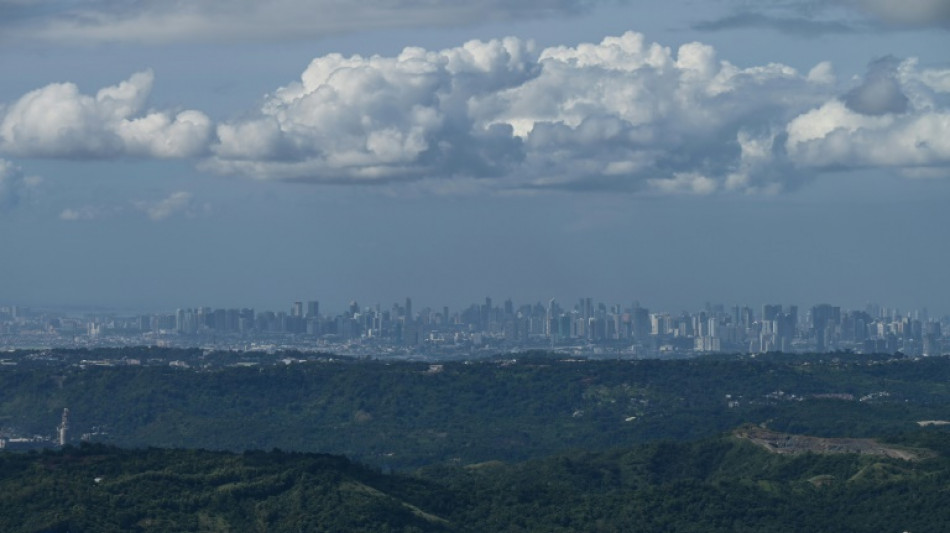
Wetter storms, deforestation: Manila faces worsening floods / Photo: JAM STA ROSA - AFP
From her house in a Manila suburb, Rowena Jimenez can't see the bare mountains around the built-up city. But she feels the impact of deforestation every time her living room floods.
Slash-and-burn farming, illegal logging, open-pit mining and development fueled by population growth have stripped the once-densely forested Philippines of much of its trees.
In Manila, where more than 13 million people live, low-lying areas are often inundated when storms lash the Sierra Madre mountain range, which lies east of the city and acts as a barrier to severe weather.
But without enough trees to help absorb the rain, huge volumes of water run off the slopes and into waterways that flow into the metropolis, turning neighbourhoods into disease-infested swamps.
Jimenez, 49, has lost count of the number of times the Marikina river has broken its banks and flooded the ground floor of her family's two-bedroom concrete house, a few blocks from the water's edge.
"There is always fear that it will happen again," said Jimenez, who lives with her husband, youngest daughter, sister, nephew and mother.
"Your heart sinks because you realise the things you worked so hard to buy will be destroyed again."
Jimenez blames environmental "abuses" upstream in the nearby Upper Marikina River Basin -- a catchment spanning roughly 26,000 hectares (64,500 acres) in the southern foothills of the Sierra Madre.
Only 2.1 percent of the watershed was covered by dense "closed forest" in 2015, according to a World Bank report.
Runoff from the mountains drains into the basin, which is critical for regulating water flow into Manila.
It was declared a "protected landscape" in 2011 by then-president Benigno Aquino, under a law aimed at ensuring "biological diversity and sustainable development".
That was two years after Typhoon Ketsana, known in the Philippines as Tropical Storm Ondoy, had submerged 80 percent of the city and killed hundreds of people.
But by then, many of the trees in the catchment had been cleared to make way for public roads, parking lots, private resorts, and residential subdivisions.
Jimenez still shudders at the memory of the water reaching 23 feet (seven metres) high and forcing her family to huddle together on the roof of their house.
"We didn't salvage anything but ourselves," she said.
- Wetter storms -
The combination of development in the catchment and wetter storms caused by climate change have exacerbated flooding in Manila, said Rex Cruz, a watershed management expert at the University of the Philippines.
"The surface of the Marikina watershed has been modified into something that is not able to absorb a lot of rainwater," he said. This also leads to water shortages in the dry season.
Cruz said the situation will worsen if "business as usual prevails" in the country, which is ranked among the most vulnerable nations to the impacts of climate change.
Official data show "closed forest" cover in the archipelago -- which has a total land area of 30 million hectares -- declined from 2.56 million hectares in 2003 to 1.93 million in 2010.
It rose to 2.22 million hectares in 2020.
Protecting existing forests and replanting others are made difficult by corruption and sometimes violent conflict over land ownership and usage.
Watchdog Global Witness ranks the Philippines as one of the most dangerous countries in the world for environmentalists, with 19 killed in 2021 and 270 slain in the decade preceding it.
The Masungi Georeserve Foundation has spent years trying to reforest about 3,000 hectares in the upper Marikina basin, which is less than 30 kilometres (19 miles) from Manila.
But there are disputes over whether the land should be conserved or developed.
Some people want to use it for quarrying, burning wood for charcoal, building resorts, or growing crops.
The Bureau of Corrections wants to put its headquarters there.
Masungi forest ranger Kuhkan Maas, 32, has been abused and even shot for trying to protect the land, where he has planted thousands of trees in the past decade.
He refuses to be intimidated.
"My dream is to see all the trees we planted flourish and to see the land that used to be barren become a lush forest," said Maas, still bearing the scar from where a bullet punctured his neck in 2021.
- 'Wicked problem' -
Without a land use policy and integrated environment laws to govern the competing uses of resources, it has been difficult to develop sustainably, said lawyer Tony La Vina, describing it as a "wicked problem".
Manila resident Jimenez said her family's house never flooded in the 1980s when she recalls the Marikina river being "pristine" and surrounded by farms, trees and a handful of families.
But as more and more land was developed for the growing population, their house began to flood in the following decade.
Since then, Jimenez said the family home is inundated once or twice a year, sometimes more.
The slightest drizzle sends her mother, who has Alzheimer's disease, into a panic.
"She'll pack things, put them in a plastic bag and nag us to start packing," said Jimenez.
"It's sad to know that the only memory she has left is the rain and flooding."
O.Pereira--NZN