Zürcher Nachrichten - Antarctic sea ice cover at record low

EUR -
AED 4.353382
AFN 77.05154
ALL 96.6659
AMD 452.980789
ANG 2.12196
AOA 1087.011649
ARS 1715.27374
AUD 1.700138
AWG 2.136683
AZN 2.016962
BAM 1.955717
BBD 2.406598
BDT 146.013807
BGN 1.990725
BHD 0.449081
BIF 3539.949869
BMD 1.1854
BND 1.513236
BOB 8.25665
BRL 6.231058
BSD 1.194849
BTN 109.725346
BWP 15.634337
BYN 3.403256
BYR 23233.834642
BZD 2.403098
CAD 1.611918
CDF 2684.930667
CHF 0.911329
CLF 0.026011
CLP 1027.065402
CNY 8.240602
CNH 8.248669
COP 4350.11551
CRC 591.674907
CUC 1.1854
CUP 31.413093
CVE 110.260324
CZK 24.336607
DJF 212.770976
DKK 7.470147
DOP 75.22681
DZD 154.464449
EGP 55.903629
ERN 17.780996
ETB 185.616528
FJD 2.613392
FKP 0.865856
GBP 0.861451
GEL 3.194656
GGP 0.865856
GHS 13.089445
GIP 0.865856
GMD 86.534664
GNF 10484.555345
GTQ 9.164611
GYD 249.979398
HKD 9.259098
HNL 31.537662
HRK 7.536653
HTG 156.373368
HUF 380.868342
IDR 19883.302315
ILS 3.66336
IMP 0.865856
INR 108.694634
IQD 1565.333613
IRR 49934.963672
ISK 144.986215
JEP 0.865856
JMD 187.242059
JOD 0.840447
JPY 183.458423
KES 154.263458
KGS 103.663312
KHR 4804.796226
KMF 491.940791
KPW 1066.859756
KRW 1719.772596
KWD 0.363823
KYD 0.995758
KZT 600.944514
LAK 25713.909461
LBP 106999.862086
LKR 369.514329
LRD 215.370866
LSL 18.971995
LTL 3.500177
LVL 0.717036
LYD 7.497682
MAD 10.83854
MDL 20.097148
MGA 5339.773538
MKD 61.637386
MMK 2489.728817
MNT 4227.587506
MOP 9.608592
MRU 47.674978
MUR 53.852825
MVR 18.326127
MWK 2071.912129
MXN 20.704153
MYR 4.672852
MZN 75.580739
NAD 18.971995
NGN 1643.533583
NIO 43.968135
NOK 11.414558
NPR 175.560554
NZD 1.959292
OMR 0.458021
PAB 1.194849
PEN 3.994931
PGK 5.114783
PHP 69.837845
PKR 334.292423
PLN 4.212869
PYG 8003.660561
QAR 4.356415
RON 5.097103
RSD 117.395021
RUB 90.53616
RWF 1743.326065
SAR 4.447253
SBD 9.54438
SCR 17.20327
SDG 713.019239
SEK 10.549127
SGD 1.506168
SHP 0.889357
SLE 28.834855
SLL 24857.238699
SOS 682.871039
SRD 45.10505
STD 24535.381029
STN 24.498961
SVC 10.454557
SYP 13110.017057
SZL 18.966196
THB 37.222281
TJS 11.154027
TMT 4.148899
TND 3.433054
TOP 2.854158
TRY 51.401896
TTD 8.112656
TWD 37.456216
TZS 3076.769513
UAH 51.211828
UGX 4271.81883
USD 1.1854
UYU 46.368034
UZS 14607.380494
VES 410.078852
VND 30749.268909
VUV 140.815358
WST 3.213359
XAF 655.929182
XAG 0.014004
XAU 0.000244
XCD 3.203602
XCG 2.153409
XDR 0.815765
XOF 655.929182
XPF 119.331742
YER 282.51038
ZAR 19.104199
ZMK 10670.019447
ZMW 23.449006
ZWL 381.698228
  • SCS

    0.0200

    16.14

    +0.12%

  • RBGPF

    1.3800

    83.78

    +1.65%

  • CMSD

    -0.0400

    24.05

    -0.17%

  • RELX

    -0.3700

    35.8

    -1.03%

  • AZN

    0.1800

    92.77

    +0.19%

  • RIO

    -4.1000

    91.03

    -4.5%

  • CMSC

    0.0500

    23.76

    +0.21%

  • BTI

    0.4600

    60.68

    +0.76%

  • BCE

    0.3700

    25.86

    +1.43%

  • RYCEF

    -0.4300

    16

    -2.69%

  • NGG

    0.2000

    85.27

    +0.23%

  • GSK

    0.9400

    51.6

    +1.82%

  • BCC

    0.5100

    80.81

    +0.63%

  • JRI

    0.1400

    13.08

    +1.07%

  • VOD

    -0.0600

    14.65

    -0.41%

  • BP

    -0.1600

    37.88

    -0.42%

Antarctic sea ice cover at record low
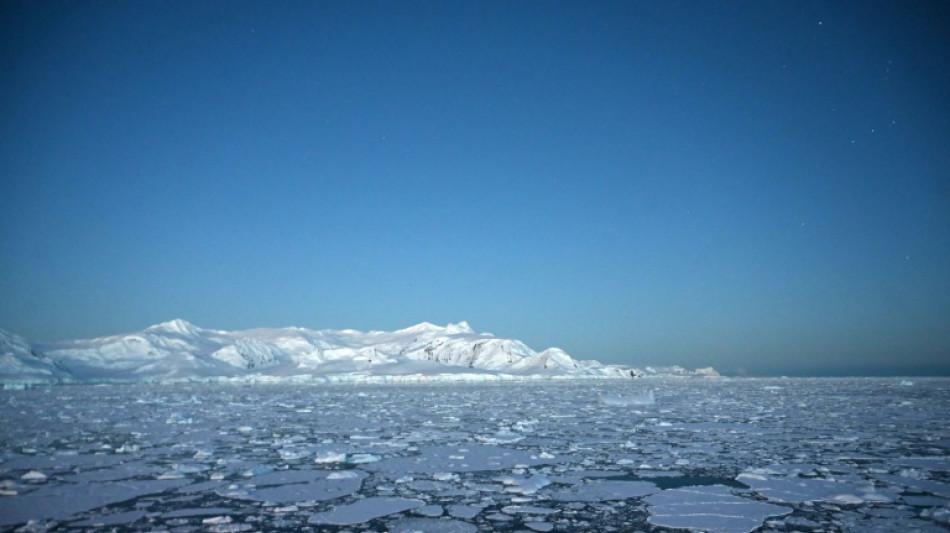
Antarctic sea ice cover at record low / Photo: Johan ORDONEZ - AFP/File

Antarctic sea ice cover at record low

Sea ice in Antarctica shrank to the smallest area on record in February for the second year in a row, continuing a decade-long decline, the European Union's climate monitoring service said Tuesday.

Text size:

On February 16, the ocean surface covered by ice around the frozen continent shrank to 2.09 million square kilometres (800,000 square miles), the lowest level since satellite records began, according to figures provided to AFP by the Copernicus Climate Change Service (C3S).

"Antarctic sea ice reached its lowest extent in the 45-year satellite data record," said Samantha Burgess, Deputy Director of C3S.

US government scientists have also confirmed a new record last month but indicated an even lower figure of 1.79 million sq km, a difference Copernicus attributed to "different sea ice retrieval algorithms".

Sea-ice concentrations during the southern hemisphere summer were well below average in all sectors of the Southern Ocean.

Startlingly, the record lows this year and in 2022 are about 30 percent below the 1981-2010 average.

"These low sea-ice conditions may have important implications for the stability of Antarctic ice shelves and ultimately for global sea level rise," said Burgess.

"Polar ice caps are a sensitive indicator of the climate crisis."

Melting sea ice has no discernible impact on sea levels because the ice is already in ocean water.

- A new trend -

But diminished ice cover is nonetheless a major concern because it helps accelerate global warming, including in the Arctic region.

About 90 percent of the Sun's energy that hits white sea ice is reflected back into space. But when sunlight hits dark, unfrozen ocean water, nearly the same amount of that energy is absorbed instead, contributing directly to a warming planet.

Both the North and South pole regions have warmed by roughly three degrees Celsius compared to late 19th-century levels, three times the global average.

But unlike sea ice in the Arctic, which has diminished by three percent a year since the late 1970s, sea ice in Antarctica has remained relatively constant over the same period, albeit with large annual variations.

Until recently -- over the last eight years -- minimum sea ice extent in the Southern Ocean has consistently been below the average for the 1991-2020 period.

Antarctica encountered its first recorded heatwave in 2020, with an unprecedented 9.2C above the mean maximum. In March last year, a research centre in eastern Antarctica saw temperatures soar 30 degrees above normal.

Recent ice cover during the austral summer has shrunk most around West Antarctica, which is more vulnerable to the impacts of global warming than the far larger East Antarctica.

The record minimum sea ice extent in the Arctic -- 3.4 million square kilometres -- occurred in 2012, with the second- and third-lowest ice-covered areas in 2020 and 2019, respectively.

In 2021, The UN's IPCC climate science advisory panel forecast with "high confidence" that the Arctic Ocean would become practically ice-free in September at least once by mid-century.

F.Carpenteri--NZN