'Uncharted territory': South Sudan's four years of flooding / Photo: Simon MAINA - AFP
It had not rained properly for months but the floods kept coming, inching up the mud-earth fortifications that stood between Bentiu's marooned and starving people and the endless water beyond.
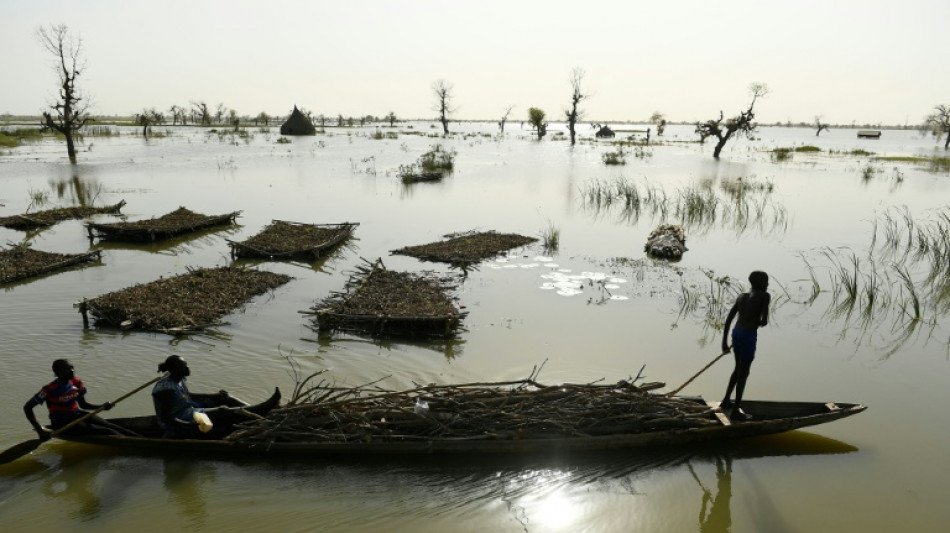
Four straight years of flooding, an unprecedented phenomenon linked to climate change, has swamped two-thirds of South Sudan but nowhere more dramatically than Bentiu, a northern city besieged by water.
Hundreds of thousands of people are trapped beneath the water line, protected only by earthen dykes that must be constantly checked and reinforced to avoid a catastrophic breach.
All roads out of Bentiu are flooded, including the lifeline to Sudan that once provided the capital of Unity state with most of its food. Supplies must now be brought many days over the floodplain, canoe by canoe.
"It's basically become an island," said William Nall, head of research, assessment and monitoring at the World Food Programme (WFP), which rations out whatever grains, vegetable oil and peanut paste make it through the waterways choked with reeds.
"There's no record of Bentiu being flooded like it has... This is something that is unique."
- 'They cannot survive' -
The monumental crisis is illustrative of a wider disaster befalling South Sudan, the world's youngest country and one of the most vulnerable to climate change.
One million people in the Nile Basin nation have been affected by year-on-year floods that have submerged an area larger than Denmark in a cycle of extreme inundations since 2019.
Millions of livestock have perished and 10 percent of the country's arable land has turned to swamp at a time when 7.7 million people do not have enough to eat.
Record-breaking rainfall over great lakes in upstream countries pushed enormous volumes of water into the White Nile, spilling over the plains downstream in a slow-moving disaster.
Vast tracts of land became so saturated that water could not drain away. Even during the dry season the levels stayed high, creating what Nall called "permanent wetlands" in places like Bentiu.
Experts say the water in some areas may not recede for years, even decades.
Far from a one-off shock, the floods represent a more permanent change for subsistence farmers and cattle herders, who are fleeing to cities, totally unprepared for what comes next.
"They do not know how to survive," community leader John Both Wang told AFP as women from his flooded hamlet waited for food donations near a fast-growing shantytown in Bentiu.
"They do not want to be here. They want to go back."
- Always hungry -
But land is becoming more uninhabitable by the day.
In January, at the height of the dry season, satellite imagery showed the area subsumed by floods expanded 3,000 square kilometres (1,160 square miles) within a single week.
"People are migrating every day. Today your place may be dry, but tomorrow it is underwater," said Duop Yian, who grew up around Bentiu and works for the Danish Refugee Council, a humanitarian organisation.
Most arrive with nothing and join an enormous population in dire need, including over 100,000 refugees from the country's 2013-2018 civil war.
Kuyar Teny waded through floodwaters to reach Bentiu with her famished 18-month-old grandson.
"In the morning, he would always be hungry and crying, but we did not have any food," she told AFP as she waited to see a doctor. Malnutrition has turned the boy's hair the colour of straw.
A health clinic serving 20,000 people had just 10 staff when visited by AFP. Inside one tent, three women on intravenous drips shared a single bed.
Humanitarian organisations, not the government, are providing services in the beleaguered city.
Beyond the sandbags and levees, the picture is bleak.
Yian indicated where farmers once tilled land and children went to school somewhere beneath the surface.
Little remained but the very tips of thatch huts and masses of water lilies -- the last resort for the desperately hungry, he said.
- 'We've been forgotten' -
Some are clinging on, trying to survive on whatever high land is left.
Once numbering thousands, today just a few hundred people live in Tong on a scattering of islands one hour by canoe from Bentiu.
Among them is Magok Bangany, an 80-year-old farmer born and raised in the village. He remembered a great flood in the distant past, around the age he reached adulthood.
"It lasted two years, but then receded. This is the worst I've seen," he said, using a cane as mud sucked at his feet.
South Sudan is prone to seasonal flooding. But nothing of this magnitude has been observed since record-keeping began, said Nall.
"There are historical patterns that suggest these large events tend to last for decades," he told AFP.
"We're all in uncharted territory here. This is so much bigger than the most recent event of this kind."
These forces are being felt even in places spared the worst of the deluge.
Unable to find grass, cattle herders have taken their livestock south and clashed over land and resources in the country's breadbasket region, according to the International Crisis Group.
The think tank warned that South Sudan "exemplifies the compounding, climate-driven forms of instability and violence" that Africa could face without money from wealthy countries to adapt to global warming.
But donations have been scarce. The war in Ukraine has sapped aid budgets and raised food prices, and WFP has been forced to halve rations even in hard-hit Bentiu.
Families that exhaust their monthly allocation make do on whatever wild flowers and fruits they can stomach.
"We have been forgotten," said Mary Nyaruay from Tong. "We must struggle ourselves to survive."
R.Schmid--NZN