'Nightmare': Stinky seaweed smothers French Caribbean beaches / Photo: Olivier MORIN - AFP
Jose Viator was hoping tourists would flock to his beachside bar on the French archipelago of Guadeloupe, but he has been forced to close because of stinky brown seaweed.
"It's a nightmare," the 61-year-old said.
The pristine sand and turquoise Caribbean waters of his coastal village are usually a magnet for tourists at this time of year.
But a thick carpet of potentially toxic sargassum algae has washed up on the beach of Capesterre, filling the air with the smell of rotten eggs as it decomposes and keeping visitors at bay.
It is just one part of the Caribbean to have tackled excessive seaweed influx in recent years, in a phenomenon that has been linked to pollution and global warming.
More than a third of the sargassum washing up in Guadeloupe over the past 12 years has landed in Viator's village.
"We make a living from tourism, but we're forced to close several months a year" because of the stench, he said.
The fumes also damage nearby houses and other property by eating away at metal, but insurance companies will not reimburse the damage, he said.
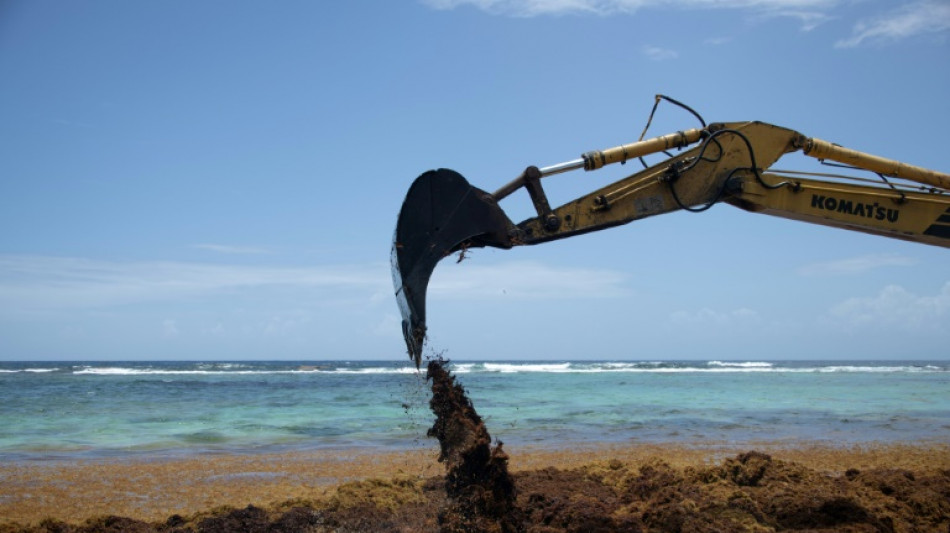
A digger ploughed up and down the beach nearby, scooping up clumps of the rotting seaweed so that a truck could ferry them away.
Jean-Fernand Diabangouaya, a 54-year-old convenience store employee, said people were resigned to the influx of brown algae.
"We're used to it. It's been 12 years now," he said.
- Health risks -
Since 2011, 40 percent of the sargassum washing up in the Guadeloupe archipelago has landed in Capesterre, according to the authorities.
"We have always known sargassum, but since 2011 it's really got worse," Sylvie Gustave-dit-Duflo, the vice-president of the Guadeloupe region in charge of environmental affairs, told AFP.
The decomposing algae emits around 30 gases in total, she said.
Among them, hydrogen sulphide (H2S) causes the rotting egg smell and is thought to have negative health effects if inhaled in large quantities.
Since mid-April local authorities have recommended "vulnerable people" move away for the area after measuring H2S concentration in the air.
Prolonged exposure to slightly higher levels can cause headaches and problems in some asthma patients, while a 2022 study has linked the rotting seaweed to an increased risk of pregnancy complications in women living on the coast.
Scientists believe global warming, deforestation and runoff water full of sewage, agricultural waste and other nutrients have all contributed to sargassum choking Caribbean beaches in recent years.
"It's probably linked to several factors: nitrate and potassium being flushed into the ocean, whose temperature is rising," said Gustave-dit-Duflo.
- 'Curse we did not cause' -
Sargassum, whose brown branches are dotted with bubbles that keep it afloat, has existed for centuries in the north of the Atlantic Ocean.
But huge mats of the algae have started to appear in the south Atlantic in recent years, likely fed by the nutrient-rich runoff of the Mississippi, Amazon and Congo rivers.
The so-called Great Atlantic Sargassum Belt contained about 13 million tonnes of seaweed by the end of March, according to the University of South Florida.
Sargassum may provide a rich habitat for marine fauna at sea, but it harms coastal wildlife when it washes up on land.
And removing it from the coastline also costs millions of euros, says Gustave-dit-Duflo.
"We're having to manage a curse that we did not cause," she said, calling for international action to solve the problem.
Local authorities are aiming to set up a marine barrier made up of nets and buoys to protect the village's beaches from the brown seaweed by June, Mayor Jean-Claude Maes said.
Until then, the only option to get rid of the rotting algae is to spread it out across acres of isolated land until it fully decays and dries out.
But even that is not ideal.
When it decomposes, the algae leaks heavy metals into the ground, according to a 2022 government report.
R.Bernasconi--NZN