Fungi and plants clean up California pollution / Photo: Patrick T. Fallon - AFP
In an industrial wasteland in Los Angeles, Kreigh Hampel is uprooting California buckwheat with a pitchfork to find out how much lead it has absorbed.
The plant's delicate white and pink flowers belie an astonishing cleaning power, which scientists think could be harnessed to get rid of dangerous pollutants -- and even recycle them.
"That's the miracle of life," enthuses 68-year-old Hampel, who is volunteering on the project.
"Plants really can do this work and they know how to do it, they've done it so many times over millions of years," he says.
The experiment is part of a project run by University of California Riverside which has scattered carefully selected plants and fungi on this former industrial site in the hope of getting rid of the heavy metals and petrochemicals that have contaminated the area for decades.
Danielle Stevenson, who is leading the study, says such bioremediation techniques can be much more cost-effective than traditional techniques.
"The conventional method of cleaning up sites is just to dig up all the contaminated soil and to dump it somewhere else," she told AFP.
"That approach doesn't actually solve the problem, right? It just moves it somewhere else." And, she says, it costs a lot of money.
Stevenson's project, which is being carried out on three sites in and around Los Angeles, has a price tag of around $200,000 and so far is showing very promising results.
- Solar-powered vacuum cleaners -
"In three months, we had a 50 percent reduction of the petrochemicals and then in six months, we were getting pretty close (to that level) with some of the metals," she said.
Stevenson, a mycologist by training, has chosen her anti-pollution weapons with care.
Oyster mushrooms have been incorporated into the soil because of their natural role in decomposition: Their underground part, called the mycelium, is sucking up diesel.
"Those same fungi that in nature would eat a dead tree will also recognize diesel oil, for example, as a food source.
"The reason is, it's basically the same thing. A lot of our fossil fuels are just dead stuff that got compressed over long periods of time."
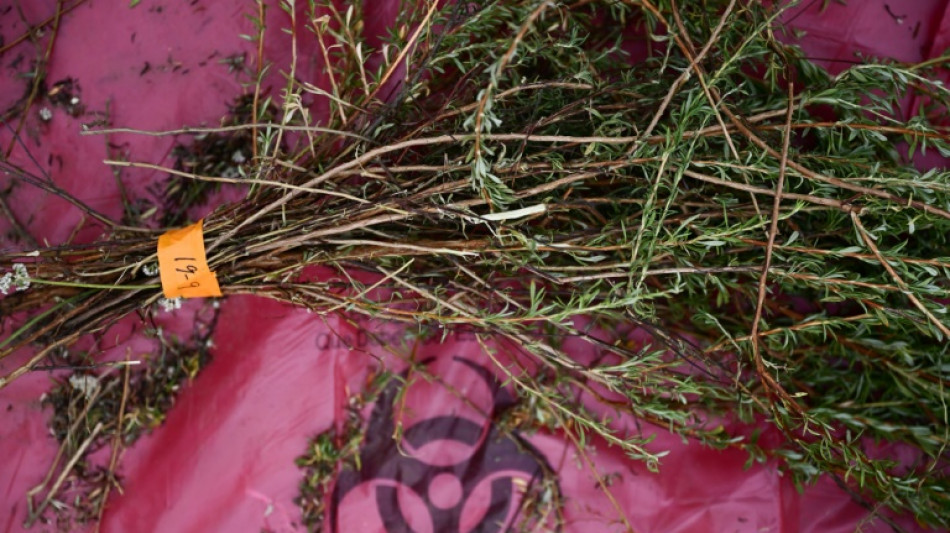
Several California native plants, including the telegraph weed and the California bush sunflower, are particularly good at absorbing heavy metals.
Stevenson thinks of the plants essentially as "solar powered vacuum cleaners: They basically suck up the metals, like lead, into their bodies.
"When we pull out the plants, we've removed the lead from the soil."
The lead and other metals can then be recovered from those plants -- and even reused.
Throughout the United States and the industrialized world, commercial sites that outlive their useful life to the companies that pollute them are often just abandoned, says Stevenson.
The responsibility to put them right falls on poorly funded or ill-equipped local authorities, who struggle to find the money or the expertise.
Historically the problem is worse in working class or ethnic minority neighborhoods, where politicians feel more able to ignore complaints.
In the United States, where the Environmental Protection Agency lists nearly 1,900 problem sites, only a small number of clean-up projects are carried out each year, Stevenson says.
She hopes that a cheaper method will enable more sites to be cleaned up.
- 'The Last of Us' -
Advocates say bioremediation's uses are not limited to fixing former industrial sites. The process can also be used to help clean up the toxic ash left by some wildfires -- an annual problem in fire-prone California.
So why is this technique still so underdeveloped?
"Bioremediation is still considered risky," explains Bill Mohn, professor of microbiology at the University of British Columbia in Canada.
Unlike soil excavation, "it's hard to guarantee that you will systematically reach the level of pollutants that are required.
"Whereas, we know that if you dig up the soil and send it to somebody who will take it if you pay them, then you've solved your problem."
Stevenson, meanwhile, points to unhealthy prejudices about mushrooms -- think of the terrifying fungi that infect the zombies of the HBO smash series "The Last of Us."
"I get asked all the time: 'If you introduce a fungus to clean up a site, is it going to take over, eat our house and take over the world?'" she says.
It won't, she is quick to add.
But that is why it is important to be conducting this kind of experiment in a real-world setting, not just in a laboratory.
"I think once we get more field tests of these methods, people will feel more confident choosing some of these approaches," she says.
D.Graf--NZN