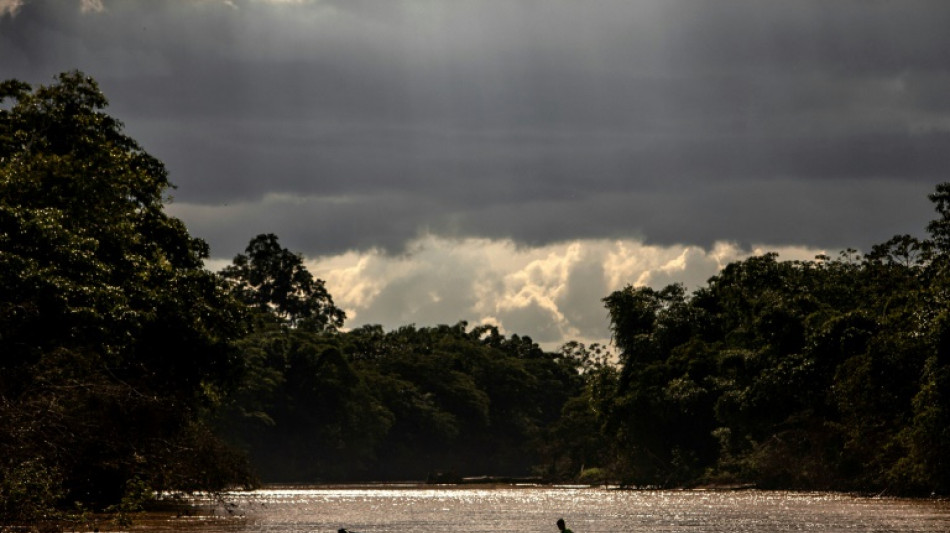
'Patrol' film exposes Nicaragua forest threat from beef industry / Photo: INTI OCON - AFP/File
Surrounded by fallen trees and languid cows, illegal cattle rancher Chacalin surveys a clearing deep inside one of Nicaragua's largest remaining protected rainforests.
"When I came here, I knew it was a reserve. I just stole the land. I didn't pay for it," he says calmly, staring away from the camera.
"If they take me out of here they can take me off the land, but I don't lose money. That's how we operate."
Beginning in 2016, and over several years, filmmakers Camilo de Castro and Brad Allgood visited the Indio-Maiz Biological Reserve for a documentary about the threats of deforestation and indigenous rights violations.
The roughly 1,000-square-mile (2,600 sq km) tropical rainforest bordering Costa Rica is a biodiversity haven, and the sacred home of the indigenous Rama people, but despite legal protections, it has seen a rapid influx of illegal settlers.
After violent protests erupted in the Central American nation in 2018 -- in part triggered by fury over the government's failure to tackle a massive fire in the reserve lit by an illegal settler -- investigative journalist de Castro had to flee his home country.
In his absence, the situation in Indio-Maiz has only worsened, and President Daniel Ortega's intensifying crackdown on dissent has made it too dangerous for the filmmakers to return.
This February, de Castro was one of 94 dissidents stripped of their citizenship -- along with his mother Gioconda Belli, a prominent writer -- and he now lives in exile in Costa Rica.
Relying on Nicaraguans within the country to send updates and images via the encrypted Signal app, the directors are now premiering "Patrol" at the Mountainfilm documentary festival in Colorado, hoping to draw attention to the situation from afar.
"This is probably the last independent documentary that's gonna come out on Nicaragua in who knows how long," said de Castro.
"The government basically has put up a wall around the country so that people inside can't hear anything coming from outside, and can't share information about what's really happening in the country."
- 'Colonization' -
The documentary follows indigenous Rama and Afro-descendent Kriols as they patrol their lands via canoe and on foot through dense, treacherous jungle, avoiding blood-sucking ticks and predatory jaguars.
It chronicles their encounters with ever-swelling ranks of newly arrived illegal settlers. Many are in the pocket of wealthy cattle ranchers living outside the reserve, and are paid to clear the land before the cows arrive.
During the filming, an indigenous patrol encounters a large, sophisticated ranch that has sprung up in the rainforest, and leaders report it to police and Nicaraguan government officials.
But they are told they must pay up if they want police to investigate, while a meeting with a minister fails to materialize.
While rampant deforestation is not unique to Nicaragua, Allgood said the situation is different from places like the sprawling Amazon, because Indio-Maiz is a "small area" where "it would not be difficult to put up a barrier to prevent people from going in."
The government is "turning a blind eye -- it's in plain sight, but nobody pays attention."
Meanwhile, the land conflict has spilled into violence. Nicaragua has recently seen a string of murders of indigenous people by settlers, many of which go unpunished.
"There's a lot of racism involved," said de Castro. "I would say we're filming the last stage of 500 years of colonization in Nicaragua."
- 'Uphold the law' -
Ninety percent of deforestation in the region is driven by illegal cattle ranching, according to Christopher Jordan, Latin American director for conservation group Re:wild.
"Government corruption allows them to steal and deforest the land without consequences," he says in the film.
Beef is one of impoverished Nicaragua's largest exports. This tiny country, the size of Mississippi, is the United States' sixth-biggest global supplier.
Since 2015, a US law requiring beef to carry a "country-of-origin" label has been dropped, meaning consumers rarely know if their burgers or steaks come from animals reared on Indigenous forest lands.
While many importing companies claim to check the origin of their beef back to its original farm, de Castro and Allgood say this is not possible in Nicaragua, where the traceability process is too opaque.
"We talk about oil, we talk about mining... but the food industry is still not something that's getting enough attention," said de Castro.
"What we want is for consumers to be more wary, to ask questions when they buy beef at the supermarket."
As for the Nicaragua government?
"What we need is political will, to really make them make an example of some of these illegal cattle ranchers and throw them in jail," he said.
"Once they throw a few of them in jail, people will think twice about going in. That's what we want. We want the government to uphold the law."
A.Ferraro--NZN