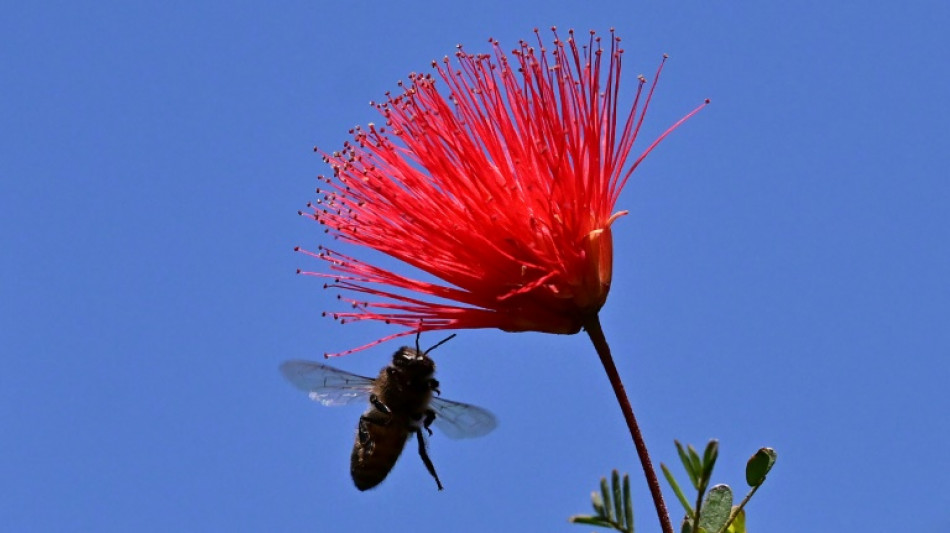
California's honey bees await the famous sunshine
/ Photo: Frederic J. BROWN - AFP
California's very wet winter gifted the state a spectacular superbloom -- an explosion of flowers that delighted hikers and should have been great news for bees.
But beekeepers say lingering low temperatures and gray skies in the Golden State are keeping the insects indoors -- and if it doesn't get sunny soon, the bumper honey harvest they were hoping for might not materialize.
"The bees don't like to fly when it's cold and damp," explains Jay Weiss, a backyard beekeeper in Pasadena, as he lifts the lid off a hive to reveal thousands of insects.
Of course, "cold and damp" is relative.
But with temperatures in the Los Angeles area topping out around 20 Celsius (68 Fahrenheit) most days right now, and the area's famously blue skies hidden by a blanket of cloud, it all adds to the impression that the weather is just not being very Californian this year.
While a few overcast weeks in May and June are not unusual, the weather has never really cheered up from the deluge that walloped the state over the winter.
A series of atmospheric rivers -- high altitude ribbons of moisture -- chugged into the western United States, dropping trillions of gallons of water on a landscape that had been baked dry by years of punishing drought.
Reservoirs that had been perilously low drank their fill, and rivers burst their banks.
The downpour was great news for water managers and for homeowners fed up with brown lawns and hosepipe restrictions.
But honeybees really struggled, unable to take wing in all that rain.
"I had healthy strong hives, but next thing you know two months later, the bees starved to death inside the hive," said Weiss.
"I lost five hives over the winter.
"Beekeepers in Southern California are not used to really bad weather," he told AFP.
- May gray, June gloom -
When the rain stopped in April, hillsides exploded into a riot of oranges, yellows, purples and whites; a carpet of color that could be seen from space.
The abundance should have been manna from heaven for the bees -- a vast superstore of nectar and pollen that would fatten hives and give honeymakers their sweet reward.
But May was gray and June has begun with gloom.
National Weather Service meteorologist Joe Sirard says an exceptionally wet winter with rain that lasted longer than usual gave way to the cloudy skies that are common at this time of year, without the burst of sunshine seen in previous years to separate them.
"We're in the climatologically cloudiest two months in Southern California, which keeps temperatures on the cool side," he told AFP.
The phenomenon is caused by cool ocean water that keeps air temperatures low around the coast -- the so-called marine layer.
"Typically, the marine layer clouds will come in at night, and usually scatter out in the morning, into the afternoon," though they can stay all day.
The next week or so looks set for more of the same, but July and August -- the bulk of the meteorological summer -- can be expected to be sunny, he said.
That'll be good news for the bees, who will finally be able to get out and about amongst all those flowers.
If the sun does come through, Weiss, a former professional magician who drifted into beekeeping 20 years ago, will be hoping to harvest as much as 100 pounds (45 kilograms) of honey from each of his hives.
He'll also make soaps, lip balms and various ointments from the wax, all smelling deliciously of the bees' sweet confection.
"The super bloom can double our production of honey this year," said Weiss.
That's as long as the insects are given their Goldilocks moment -- not too hot and not too cold.
"Once we're into July, the temperatures could get really hot and so they're not going to be producing honey anymore," said Weiss.
"So I would say we got about six weeks for this to happen.
"But when they start making honey, it's unbelievable how fast things happen."
L.Zimmermann--NZN