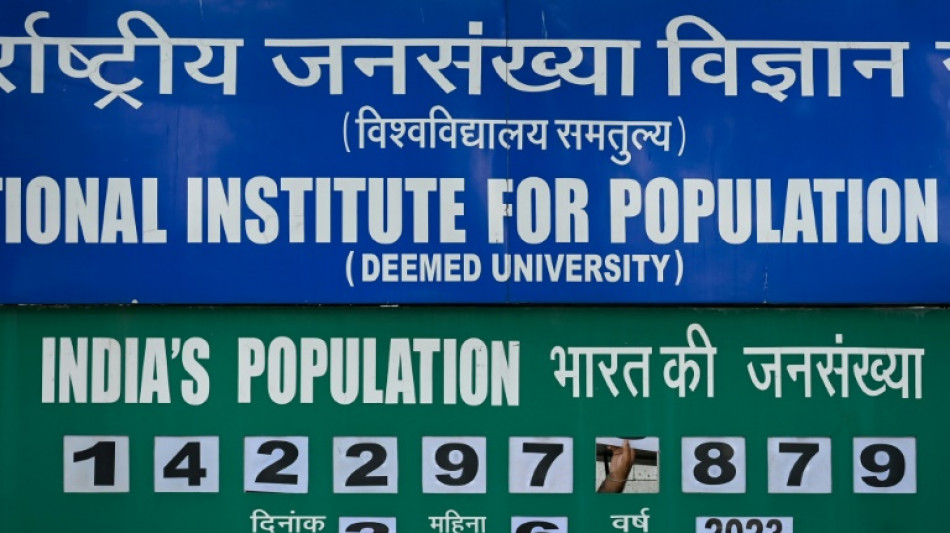
Indian clock tells story of most populous nation / Photo: Punit PARANJPE - AFP
India's first population clock, made up of 10 white numbered cards on a large green metal board, attracts curious passersby who watch it record the story of the world's most populous nation.
The clock -- manually updated every day according to projected estimates and akin to a cricket scoreboard in appearance -- was first erected in 1982 when India was home to more than 684 million people, according to the 1981 government census.
That figure more than doubled in the following decades.
India grew rapidly to overtake China at the top of the population ranks with more than 1.42 billion people, according to a United Nations projection in April.
"An extra slot had already been made in the clock, expecting that we were going to cross one billion," said Professor Chander Shekhar at the International Institute for Population Sciences in Mumbai, where the clock is located.
Overpopulation has long been a concern, with the government establishing a nationwide family planning programme in 1952.
But it was a controversial enforced-sterilisation push in the 1970s that sparked public debates and spurred the institute to create the clock, Shekhar said.
Every day, security guards change the numbers using projections of the natural growth rate -- the difference between the number of births and the number of deaths per 1,000 a year -- derived from government and UN estimates.
"We feel good when we update the board, as passersby can also see the growing population numbers," 56-year-old security supervisor Salunkhe V.V. told AFP.
The current projections estimate that India's population increases by just under 41,000 people a day -- one every two seconds -- or about 15 million a year.
- Boon or bane? -
India's current fertility rate is two births per woman, just under the replacement threshold of 2.1, and down from government estimates of 4.8 in 1981.
The fertility rate varies across the country, with poorer states like Uttar Pradesh and Bihar -- boasting a combined population of more than 325 million -- having the highest rates, according to a 2019 government survey.
In contrast, the two wealthiest states of Maharashtra and Tamil Nadu have fertility rates of 1.56 and 1.54 respectively, far below the average, according to the survey.
Family planning has largely been left to women, with less than one in 10 men using condoms, while female sterilisation was at nearly 38 percent, according to the government's 2019-2021 National Family Health Survey.
Shekhar, 49, was drawn into studying population from a young age, fascinated and "agitated" by large crowds of people everywhere he went.
"I used to hate these numbers," the fertility and social demography expert said.
"But after I got my Master's in Statistics, I thought, 'Let us understand this, is it a problem? Or can it really be solved?'"
Shekhar believes the large numbers don't have to be a ticking time bomb if authorities focus on raising people's quality of life.
Education and health outcomes -- such as falling infant and maternal mortality rates -- have improved since 1982, and India's economy has grown to become the fifth-largest in the world.
But in many cities, residents battle for resources while facing water shortages and air and water pollution.
Youth unemployment for the ages of 15-24 stood at 23.2 percent last year, according to the World Bank.
The overall jobless rate was 7.7 percent in May, data from the Centre for Monitoring Indian Economy showed.
Shekhar said a key concern was that "India will become older before it becomes richer".
"For that (not to happen), we need to have people be skilled, and have employment opportunities for a huge, young, bulge of population."
M.Hug--NZN