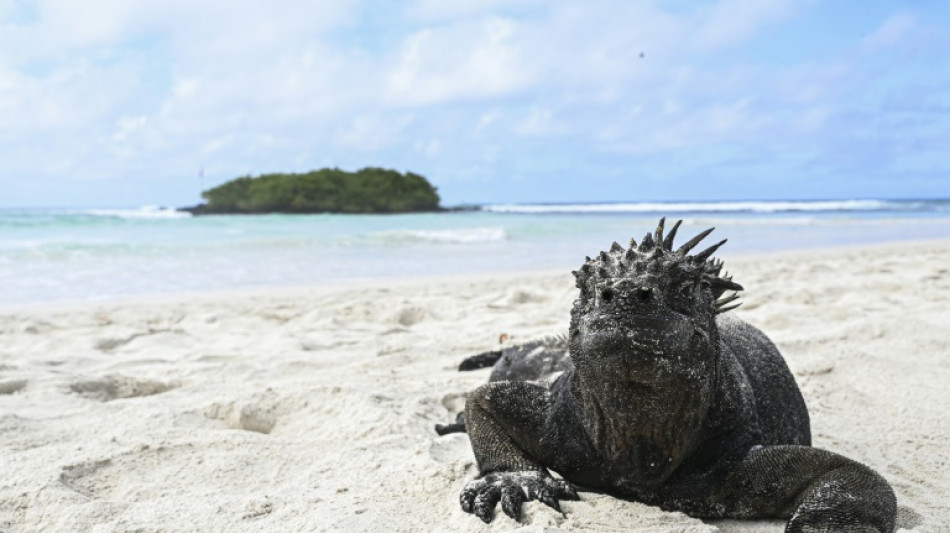
El Nino spells trouble for vulnerable Galapagos iguana / Photo: ERNESTO BENAVIDES - AFP
Unusually warm for this time of year, the waters of the Pacific signal hard times for the reptilian inhabitants of Ecuador's iconic Galapagos Islands.
The balmy temperature is the first symptom of a new cycle of the El Nino weather phenomenon that periodically pronounces a sentence of starvation on the archipelago's marine iguanas.
Experts fear this El Nino could be one of the most intense in decades.
On the white sands of Santa Cruz island, a species called Amblyrhynchus cristatus can live for as long as 60 years, uniquely adapted among extant iguanas for ocean diving around the islands synonymous with Charles Darwin's theory of evolution.
With its sharp claws and crest of back spines, the reptile resembles a prehistoric creature.
It may look tough, but it is highly susceptible to temperature fluctuations in the Pacific that affect its main food source -- algae -- for which it digs among rocks under water or in the shallows.
Marine iguana populations "undergo extreme fluctuations by cyclic, but unpredictably recurring, famine (El Nino) and feast (La Nina) events," according to the International Union for Conservation of Nature (IUCN), which lists the species as vulnerable.
Last month, the US National Oceanic and Atmospheric Administration (NOAA) announced "El Nino conditions are present and are expected to gradually strengthen" as the year progresses.
El Nino events are marked by warmer-than-average sea surface temperatures in the central and eastern Pacific near the equator, and occur every two to seven years and last about nine to 12 months.
"We should be getting cold water now, at the end of June, July, August, but we still have very warm water," Danny Rueda, director of the Galapagos National Park, told AFP.
He cited two previous particularly harsh El Nino events: One in 1982 and another in 1997 that bleached corals and wreaked havoc on the islands' animal life -- also tortoises, penguins, cormorants and sea lions.
And "according to the forecasts, this could be (an) El Nino matching those in magnitude," said Rueda.
- Cannot swim far -
According to World Meteorological Organization (WMO) secretary general Petteri Taalas, "the newly arrived El Nino will turn up the heat and bring with it more extreme weather" to Latin America and the Caribbean.
In a statement issued Tuesday to accompany a report on climate change effects in the region, he cautioned that "early warnings... will be vital to protect lives and livelihoods."
The WMO says climate change is likely increasing the impacts of El Nino events "in terms of more intense heat and heavier precipitation."
Galapagos species are able to survive cyclical changes in the local climate. But if variations occur too often or are too extreme, species can struggle to recover a balance between births and deaths.
El Nino-induced food shortages can mean starvation for marine iguanas -- whose body length has been recorded during previous events to shrink by as much as five centimeters (1.9 inches). Male iguanas can grow up to about 1.3 meters (4.2 feet) long, females about half that.
"Predictions that climate change may increase the severity and frequency of El Nino events... suggest that some (marine iguana) subpopulations could be removed entirely," says the IUCN.
According to Rueda, there are about 450,000 iguanas on the islands. Their numbers, say the IUCN, can drop by 90 percent after a strong El Nino event.
- 'No preventive measures' -
Marine iguanas can dive up to 12 meters deep and stay under water for an hour, but they "cannot swim long distances in the open sea to look for food" made scarce by algae die-offs, said Washington Tapia, director of the NGO Galapagos Conservancy.
Less algae also means less fish to feed birds, sea lions and other island species.
El Nino also brings heavier rains to the Pacific that inundate turtle nests on the beaches and wash away eggs.
"It being a natural phenomenon, we have no preventive measures" against El Nino's effects, said park director Rueda.
"All we can do is count the post-El Nino populations to calculate what the impact was."
Some 1,000 kilometers (about 621 miles) off the Ecuadoran coast, the archipelago is also home to about 33,000 people.
The islands, popular with tourists, are a World Heritage Site and home to flora and fauna found nowhere else in the world.
Darwin visited in 1835 and developed his theory of evolution based on his studies of Galapagos species, including iguanas.
P.E.Steiner--NZN