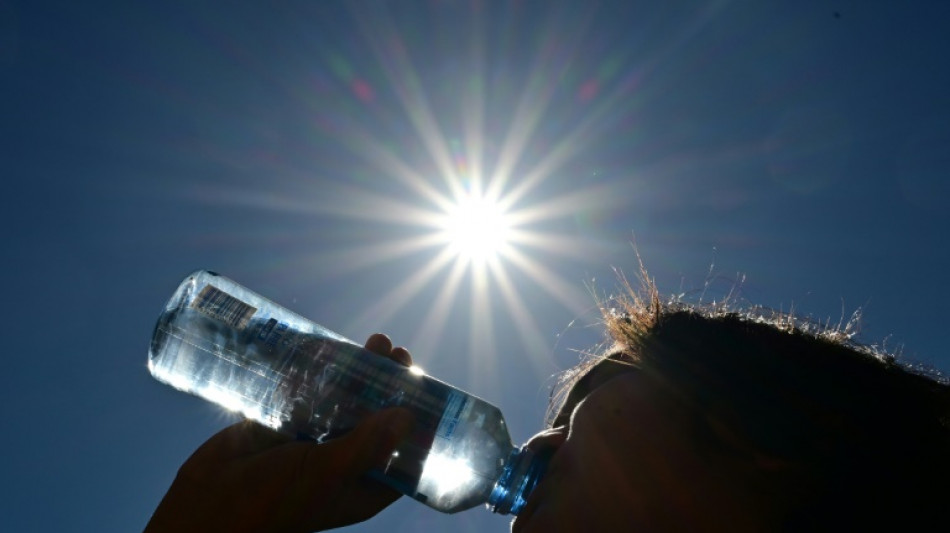
Southern US set to sizzle under prolonged heat wave / Photo: Frederic J. BROWN - AFP
More than 50 million Americans are set to bake under dangerously high temperatures this week, from California to Texas to Florida, as a heat wave builds across the southern United States.
A mass of hot air was settling over southwestern desert states, the National Weather Service (NWS) warned, with parts of Arizona, Nevada and New Mexico at risk of seeing the mercury soar past 100 degrees Fahrenheit (38 C).
The NWS has issued excessive heat warnings for the southern and central regions of California, with temperatures expected to hit even as high as 112 degrees Fahrenheit in parts of Los Angeles County after Tuesday.
"Heat is the number one weather-related killer," the NWS in Las Vegas warned, saying this level of "extreme heat with little to no overnight relief affects anyone without effective cooling and/or adequate hydration."
The new warnings come after world daily temperature records were smashed on three days last week, according to preliminary data.
On July 6 the planet's average surface temperature was 17.23C (63.01F), an unofficial record, according to the University of Maine's Climate Reanalyzer tool, which uses a combination of observations and computer modeling.
Climate scientists are sounding alarm about the impact of human-caused global warming, and warning 2023 is on track to be the warmest since records began.
In Texas, which is experiencing a prolonged "heat dome" in which warm air is trapped in the atmosphere like a convection oven, the border city of El Paso broke the record for most consecutive 100 F days on Sunday, according to the NWS.
The number is now 24, beating 23 days in 1994.
"Looks like plenty of more 100+ degree days on the horizon," the office said.
And the heat wave in Arizona could prove to be "one of the longest if not the longest, depending on how it is measured," the NWS in Phoenix said.
The area has now seen 10 days of temperatures at or above 110 degrees.
Aid organizations in Tucson, about two hours away, handed out ice and bottles of water and Gatorade over the weekend, according to the New York Times.
- 'Hottest week on record' -
Dehydration is a major summertime risk in the United States.
Last week, a man died in California's Death Valley, which authorities said could likely be attributed to the heat. His car had two flat tires and the air conditioning had stopped working.
In addition to extreme heat, authorities in the Golden State are raising the alarm over flash flooding as high temperatures melt the deep snowpack that fell on the Sierra Nevada mountains last winter over several intense storms.
The northeastern United States also faced flooding Monday after heavy rain across several states washed out highways and killed at least one person in New York state.
Scientists say rising global temperatures -- caused largely by burning fossil fuels -- are aggravating extreme weather worldwide.
Global surface temperatures have increased by about 2F (1.1C) since 1880, making extreme heat more frequent, while a warming earth intensifies the risk of heavy rain because a warmer atmosphere holds more water.
According to the United Nations' World Meteorological Organization, "the world just had the hottest week on record, according to preliminary data."
Extreme heat is the deadliest weather hazard in the United States, according to official data, with the elderly, the very young, people with mental illness and chronic diseases at highest risk.
O.Meier--NZN