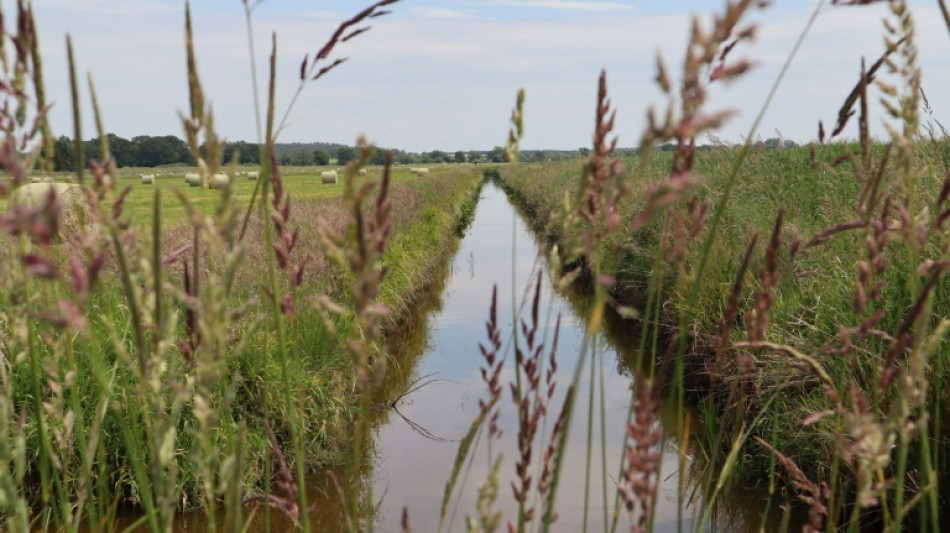
Rewetting German marshes to blunt climate change impact / Photo: Paul NOLP - AFP/File
Amid the fields of northern Germany a vast expanse of bulrushes has been planted to form one of Europe's largest reclaimed marshes.
Just four years ago, the 10-hectare (25-acre) plot close to the town of Malchin was a simple field.
Like 98 percent of Germany's historic wetlands, the area slowly dried up over centuries as its peat was harvested and the soil cultivated for grain or keeping livestock.
Now, the land has been rewetted and planted with rushes that rise up to two metres (seven feet) high.
With rubber boots that go up to her knees and a GPS navigation device in hand, biologist Meline Brendel wades through the marshes' stagnant waters.
"Marshes cover three percent of the Earth's surface and trap twice as much CO2 as all forests," says Brendel.
Left alone, such bogs are massive sinks for carbon locked into the peat and prevented from escaping as gas by the water that covers the ground.
Once dry, however, the earth releases the stored carbon when it comes into contact with oxygen.
"In this region, marshes therefore emit more CO2 than all forms of transport put together," says the scientist.
Over a year, one hectare of drained marshland produces as much CO2 as a car travelling 145,000 kilometres (90,000 miles), according to the Greifswald Mire Centre.
- Wetland habitat -
In Germany, current and former wetlands cover some five percent of the country's land area -- although the overwhelming majority has been drained.
To keep these emissions in check, the government-financed Paludi-PROGRESS project funded the rewetting of the former marshland.
The land was criss-crossed with trenches, flooded and planted with bulrushes.
Today, the area is habitat to a multitude of birds, fish, insects, spiders and amphibians. The bulrushes are cut each year and used for household insulation, among other practical applications.
Her eyes glued to the GPS, Brendel navigates her way through the wet maze, sinking a spike into the peat as she goes to measure the level of the water.
"The problem is that projects like ours are still just pilots. The plants cannot yet be used on an industrial scale" as material for roofing or insulation, she says.
The German government, which aims to make Europe's top economy carbon neutral by 2045, last year launched a four-billion-euro ($4.5 billion), four-year plan of action to "improve the general state of ecosystems" in the country.
Half of the programme's funds will go toward protecting marshes.
A new law encouraging such efforts within the EU was recently adopted by the European Parliament. However, the programmes have run into opposition from farmers.
- Cows and carbon -
For Brendel, the point is not to "force the rewetting of fields on farmers", but to convince them of its importance for the climate and the possibility to make a living from cultivating wetland.
The 28-year-old scientist concedes that farming marshes is currently "not recognised as agriculture and farmers therefore don't have access to organic farming subsidies".
"We need to make it more accessible and less bureaucratic to turn drained land back into marshes and to share what we have learned."
Twenty years ago, Bavarian farmer Lorenz Kratzer opted for an intermediate solution: keeping livestock on marshland that is slightly less wet than normal and giving his animals plenty of land to roam.
On a hot summer's day in Freising in southern Germany, 20 or so of his cows seek the shade of the trees and bushes growing on his marshland used for grazing.
As the soil dries out due to climate change, the 64-year-old says it "would be a very good thing... to let the marshes return to nature, to flood them again".
"The creation of pastures goes along well with this. You can see that the grass is growing better," he said.
Kratzer sells his organic meat locally, showing that it's possible to combine agriculture and marshland protection.
Back in Malchin, across the way from the reclaimed marsh, a herd of cows grazes peacefully in a field.
"You can't see it but carbon is escaping from the ground" dried to make pastures for livestock, says Brendel, who dreams of a world where "there are no more dry marshes".
O.Meier--NZN