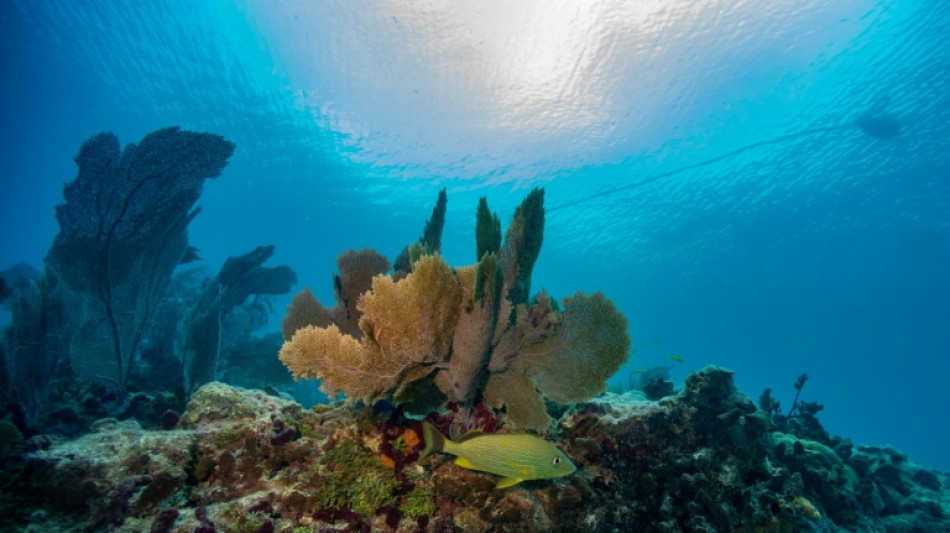
Alarm as seawater heats up off Florida Keys, imperiling reef / Photo: Joseph Prezioso - AFP/File
Super-heated seawater off the Florida Keys has grown so perilous to the world's third-largest barrier reef that scientists are now removing samples of coral from ocean nurseries to place in cooler land-based tanks.
Sea temperatures off Florida have risen to extraordinary highs this month, presenting a severe threat to the barrier reef.
"Hot water is not good for any marine organism, whether it be coral, fish or lobster. So we run the risk of having massive fish die offs, sea turtle die offs, things like that," said Alex Neufeld, projects coordinator with the Coral Restoration Foundation.
Surface water temperatures rose above 90 degrees Fahrenheit (32.2 degrees Celsius) several days earlier this month, and on Monday hit a record 101.1F in Manatee Bay, a sound near Key Largo.
Coral can routinely survive sea temperatures between 70 and 84F (21 to 28.8C).
"This is the worst that I've seen. And I think many people would agree that... it has the potential to be the worst one that the Keys has ever experienced," Neufeld said.
Neufeld's nonprofit group, working with other local groups, has been collecting samples of genetic strains of coral from nurseries "and pulling them into land-based facilities where the water parameters can be controlled, and where they can be safeguarded," he said.
As scientists race to ensure the survival of reef-based sea life, business owners despair over the possible impact on tourism to the Florida Keys.
Brian Branigan, a 65-year-old boat captain who rents launches to tourists from Big Pine Key (near Key West), says the warming has shaken him.
"What has happened in the last two weeks is terrible, shocking. I wanted to cry myself, when I was in the water, snorkeling to see this," he said as he took AFP to Looe Key National Marine Sanctuary, some five miles (eight kilometers) off the coast.
Just a few feet below the boat, barracuda, blue tang surgeonfish and parrotfish dart around a reef populated with coral that is turning white, a sign of severe stress.
The bleaching of the reefs appears to be accelerated this year, and summer heat has barely passed its mid-point.
Bleaching occurs when stressed coral expel algae living in symbiosis with them, providing them with nutrients and giving them color.
Fallout from damage to the reef could definitely spill onto land.
- 'Very sad' -
According to the National Oceanic and Atmospheric Administration, Florida's coral reefs generate $2 billion in local revenue and 70,400 full- and part-time jobs.
Brad Roberts traveled with his family from Fort Myers on Florida's Gulf Coast to Islamorada in the Keys to fish for lobster.
"What's happening is very sad to see. A lot of these people make their living off the reefs. And I don't think people will want to come down here and see a bunch of dead coral," Roberts said.
Sport fishermen, a significant sector of tourism, may have a change of heart toward the area.
"If you come down here and have four bad trips, and only one good trip, well, you're probably going to want to spend your tourist dollars somewhere else," said Roberts, an insurance company employee.
Branigan, who learned to scuba dive 48 years ago, depends heavily on sport fishermen and scuba aficionados to rent his boats.
"We are concerned about how it will impact us, personally and financially," he said. "I'm sure it will have some negative impact and maybe catastrophically even."
While business owners worry about survival, Neufeld and other scientists remain busy seeking to gather coral samples from nurseries.
"We've taken representatives from all of those corals and... we've actually moved them to physically different locations to further safeguard and build in a bit of redundancy for those critical species," he said.
For two weeks now, groups like Coral Restoration Foundation have been collecting the samples to bring to land-based -- less heated -- tanks, he said.
Their mission is essential to protect the barrier reef -- but also indirectly the humans living on shore.
Reefs, in addition to harboring numerous marine animals, are one of the main protective barriers against hurricanes and storm surges made more intense by global warming.
M.J.Baumann--NZN