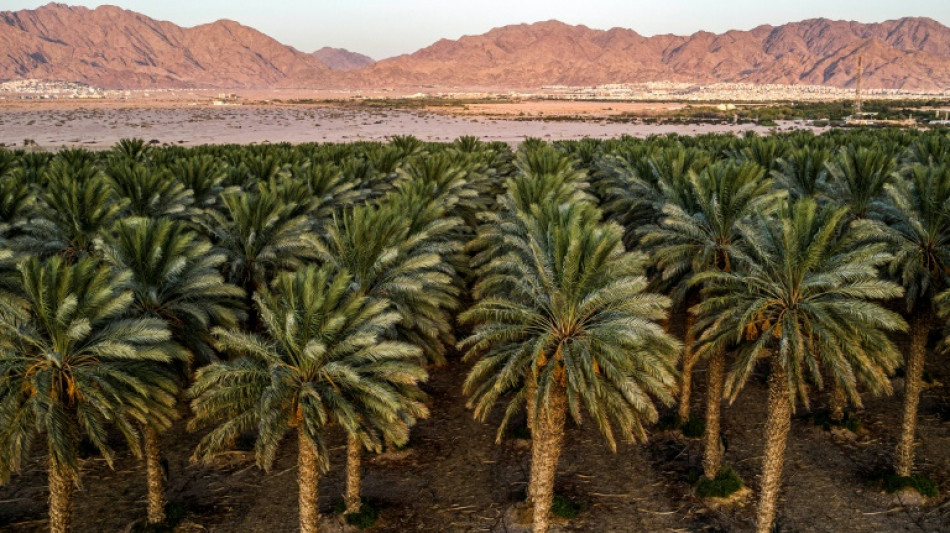
Israel's pioneering use of water 'to the last drop' / Photo: MENAHEM KAHANA - AFP
In the scorching summer heat, an Israeli farmer tends to a dripline taking a mix of ground and recycled water to palm trees -- an approach honed for decades in the arid country and now drawing wide interest abroad.
At the plantation in a desert near Eilat, a coastal holiday resort on Israel's southern tip, the mineral-rich water passes through a plastic tube, nourishing the dates high above.
"All of Eilat's sewage is treated," said Arik Ashkenazi, chief engineer of Ein Netafim, Eilat's water and sewage utility, during a tour of the facility that sees wastewater cleared of solids and biological hazards.
"The treated wastewater is transferred, to the last drop, to farmers" who mix it with groundwater and use it on the trees, he said.
Eliat is hemmed in between the desert and Red Sea, isolated from the rest of Israel with no natural freshwater. Its drinking water is a combination of desalinated groundwater and seawater.
After domestic use turns it into sewage, it is treated and then allocated to farmers, enabling the parched region to support agriculture.
While Eilat used to be the exception in Israel's water management, it is now more of a prototype for the country and perhaps the world.
Globally, more than two billion people lack access to safe drinking water, the United Nations says, with floods and droughts triggered by climate change further exacerbating the situation.
Alarming data presented by the UN's Department of Economic and Social Affairs shows "80 percent of wastewater in the world flows back into the ecosystem without being treated or reused".
- 'Foundation for peace' -
Israel began recycling wastewater when it saw that its water sources -- groundwater and water from the northern Sea of Galilee -- were insufficient to meet the needs of a growing population.
"We began to realise that sewage was a water source, reaching almost 100 percent reuse in Israel," said Yossi Yaacoby, vice president of engineering for Mekorot, Israel's national water company, noting that 90 percent of the treated wastewater went to agriculture.
"That wasn't enough either, so we began desalinating seawater," he said, beginning with Eilat in 1997 and then the Mediterranean, with desalinated water now providing 60-80 percent of Israel's drinking water.
Israel has had sole access to the Sea of Galillee, a freshwater lake, since seizing the Golan Heights from Syria in the 1967 Six-Day War.
In the 1960s, Israel's construction of its so-called national carrier -- the pipeline transferring water from the Sea of Galilee to drier and more populated parts of the country -- caused tensions and even exchanges of fire with Syria.
"Water was a source of conflict," Yaacoby said.
Nowadays, "Israel understands that water is a foundation for peace", he added, with Israel selling it to some of its neighbours.
"We supply the Jordanians 100 million (cubic metres) from the Sea of Galilee, and a similar quantity to the Palestinians -- mainly in the West Bank with a small amount to Gaza, and it will increase," Yaacoby said.
- 'Not a free good' -
With rising climate instability, growing populations and dwindling resources, it's not only Middle Eastern countries that Israel is helping to tackle their water problems.
"The world is undergoing a huge crisis," Yaacoby said, noting that "states you'd never imagine" like France, Germany and Italy were rethinking the issue.
"Israel understood from its inception that water is a scarce resource," he said, and by now "has a large reservoir of knowledge accumulated over the years pertaining to regulatory matters, managing water sources", he said.
In addition, Israel is "constantly developing technologies" in the field of water, Yaacoby said.
Clive Lipchin, an expert on water management at the Arava Institute in southern Israel, said the rising unpredictability due to climate change should make "everybody around the world" consider desalination and treating wastewater.
But beyond the technologies being expensive and high on energy consumption, a comprehensive solution would demand people changing their attitude on the use of water.
"It's a basic right, but it cannot be a free good. People have to pay," Lipchin said.
"Most people around the world do not pay. So that's a huge barrier" and a challenge to governments whose citizens have been paying nothing for decades, he said.
Yaacoby too said that the main challenge for the future of water use was not in the realm of engineering, but rather the mindset of people who were in no rush to preserve water they received for free.
Such a change required "courageous political decisions", he said.
A.P.Huber--NZN