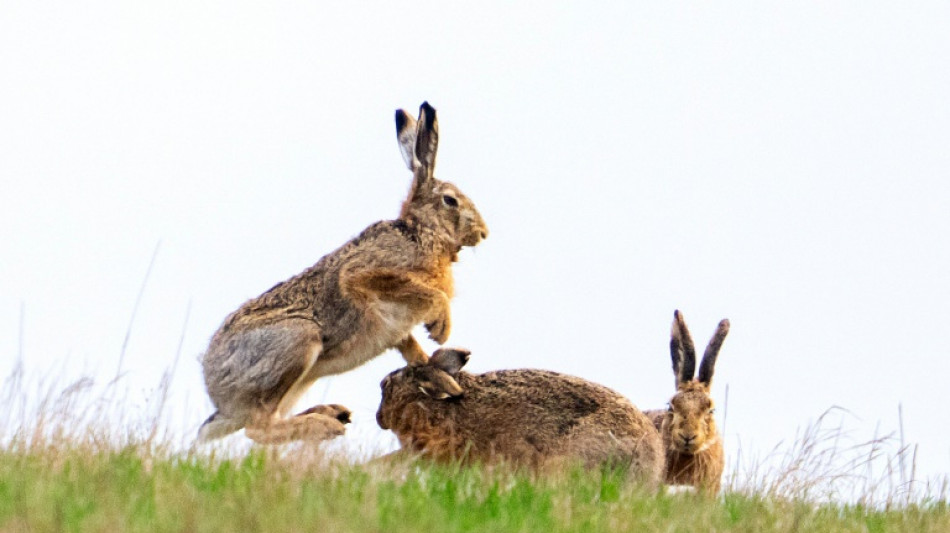
Cute but calamitous: Australia labours under rabbit numbers / Photo: GEORG HOCHMUTH - APA/AFP/File
With their outsized ears and fluffy fur, rabbits are often seen as cute and harmless. Yet the creature is behind one of the globe's most harmful biological invasions, ravaging Australia, whose efforts to limit the problem have tended only to make things worse.
Back in 1859, a mere 24 European breeding rabbits, scientific name Oryctolagus cuniculus, disembarked from England, brought over by Thomas Austin, who enjoyed hunting parties on his Victoria estate.
But 150 years on, and according to a 2022 study by PNAS, a peer reviewed journal of the US National Academy of Sciences, some 200 million rabbit colonisers now roam the land of the kangaroo, devouring vegetation as they go, laying waste to native plant species, causing habitat degradation and threatening the survival of numerous native species.
With as many as seven annual litters -- each with an average of five offspring who reach sexual maturity from the age of 3-4 months -- the rabbit is able to spread its presence very quickly.
From its early years Down Under, the creature benefited from the general absence of predators and its facility to adapt to its new climate.
That enabled it to spread out by some 110 kilometres (65 miles) a year. Within 70 years, it had occupied around 70 percent of Australia's land mass.
That made it "the fastest known invasion by a mammal anywhere in the world," according to a report by Australia's national science agency CSIRO.
- Counting the cost -
The rabbit may look small and placid -- yet it is voracious in the extreme. Herbs, bulbs, seeds, shrubs -- its appetite extends to all kinds of herbaceous plant. This contributes to desertification of the outback, deprives other species of food and also eats away at crops.
The agricultural and horticultural damage wrought by the critters comes in at some 200 million Australian dollars ($130 million) each year, according to the Western Australian ministry for agriculture and food.
As such, for more than a century now, the authorities have been doing all they can to try to limit the damage.
Intensive hunting, traps, bulldozers to destroy burrows, poison or even explosives -- everything has been tried. But the rabbit has resisted and its numbers have progressed.
In 1901, Australia decided to construct an 1,800 kilometre-long (1,118 miles) barrier in a bid to stop the furry creatures proliferating to the country's western agricultural lands.
Yet by the time construction was completed, rabbits had already reached the other side. An extension followed, then another, taking the fence to beyond 3,000 km of barriers and fences. All in vain.
Australia tried plan B -- introducing predators, such as the fox.
The 'cure' proved to be worse than the disease. It turned out the fox preferred to target easier prey such as small marsupials endemic to the country and already threatened with extinction.
- Classic cases -
In the 1950, science was recruited to come to the rescue.
The myxomatosis virus, a disease which causes fatal tumours in rabbits, was introduced into the country. To begin with, success looked to have been achieved, the rabbit population going from 600 million down to 100 million. But it managed to adapt and ended up developing resistance to a virus which gradually became ineffective.
Australia tried a new angle of attack some years later: the Spanish flea, supposed to spread disease among rabbits.
Again, the plan failed. Worse still, the parasite infected other species.
In 1995, a new attempt at eradication followed, via a haemorrhagic fever virus, which ended up worrying the scientific community amid fears it might mutate.
Very effective against rabbits, this highly contagious pathogen can further spread quickly to other countries via mosquitoes. Two years later, it arrived in New Zealand, likewise also labouring under a rabbit invasion.
If Australia thought that might have been a price worth paying, there would soon be disabused.
The stoat, introduced as a predator to the rabbit left deprived as the population dropped, fell back on targeting the kiwi, a bird endemic to the island which became threatened in turn.
Both Australia and New Zealand represent classic cases in terms of what not to do regarding the introduction and management of invasive species, says Elaine Murphy, principal scientist at New Zealand's Department of Conservation and an expert on introduced mammals and the threats to diversity they pose.
While rabbit numbers look to have stabilised under the 300 million mark, the Australian government says it is maintaining research into means of permanently stemming the propagation problem.
U.Ammann--NZN