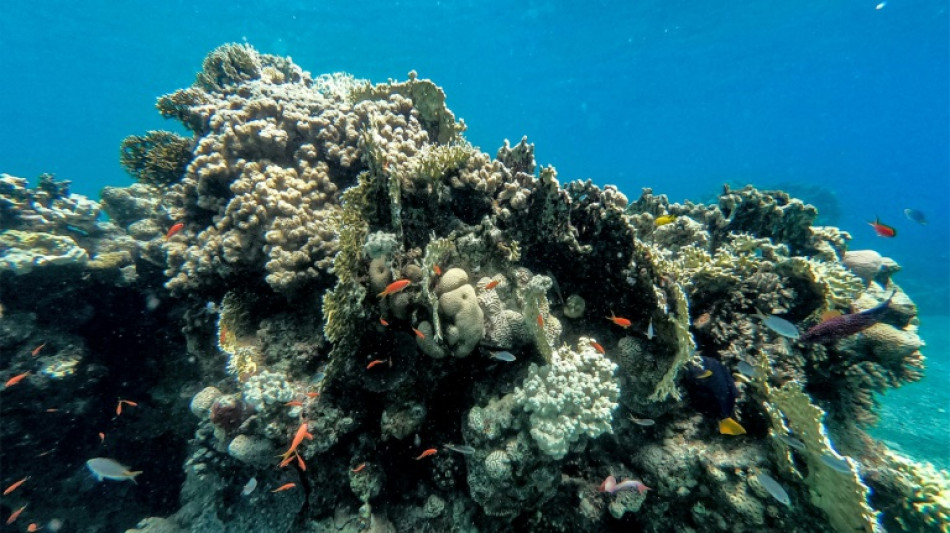
Red Sea corals threatened by mystery sea urchin deaths / Photo: MENAHEM KAHANA - AFP
The Red Sea's spectacular coral reefs face a new threat, marine biologists warn -- the mass death of sea urchins that may be caused by a mystery disease.
Because the long-spined creatures feed on algae that can suffocate corals, their die-off could "destroy our entire coral reef ecosystem", warned scientist Lisa-Maria Schmidt.
In Israel's Red Sea resort of Eilat, which borders Jordan and Egypt, Schmidt recalled the moment she and her colleagues first witnessed the population collapse.
"When we jumped into the water, all of a sudden all those specimens we used to see before were gone, and what we saw was skeletons and piles of spines," she told AFP.
The team had first heard reports in January that a sea urchin species off Eilat was dying rapidly, so they went to a site known for an abundance of the species Diadema setosum.
They first thought that local pollution could be to blame.
But, within two weeks, the spiny invertebrates also started dying down the coast, including in a seawater-fed facility of the Inter-University Institute for Marine Sciences.
Scrambling to find the cause, the scientists watched with growing alarm as the mass mortality spread south through the Red Sea.
The team found that it affected two kinds of sea urchin, Diadema setosum and Echinothrix calamaris, while other species in the same environment remained unharmed.
In the marine reserve off Eilat, colourful fish and some other sea urchin species could be seen by a visiting AFP journalist -- although the impact of humans was never far away.
While snorkelling, Schmidt grabbed floating plastic rubbish and pushed it up the sleeve of her wetsuit, to discard later.
Walking along the beach, she also picked up handfuls of algae, to feed to the sea urchins still alive in tanks.
- 'Absolutely devastating' -
A similar mass mortality earlier hit sea urchins in the Caribbean, raising speculation that a disease may have arrived in the Red Sea by ships, whose ballast water can carry pathogens and exotic species.
"I think it's especially scary for that region, especially in the Red Sea," said Mya Breitbart, a biologist from the University of South Florida in the United States.
She pointed out that, while coral reefs are dying off in many other areas, "those corals are known to be quite resilient, and I think people have placed a lot of hope in those reefs".
Early last year, Breitbart started hearing that the Diadema antillarum species -- similar to those affected in the Red Sea -- was rapidly changing behaviour and then dying in droves in the Caribbean.
The area has still not recovered from a similar event in the 1980s, whose cause was never discovered, and Breitbart described this second die-off there as "absolutely devastating".
Within months she and scientists working across the Caribbean had pinpointed a pathogen, giving hope that the cause of the Red Sea die-off could be discovered.
- Next disease 'on the way' -
Omri Bronstein, from the University of Tel Aviv, has been working with the team in Eilat and elsewhere to try and identify the source.
"Are we talking about the same pathogen, for example, as the one that hit the Caribbean" in the 1980s, asked Bronstein, who runs a laboratory at the university where sea urchins lie in glass jars.
"Or are we looking at a completely different scenario?"
Stopping the die-off in the seas is impossible, lamented Bronstein.
Instead, the scientific community is working towards establishing a broodstock population of the affected species which can be released into the Red Sea once the current threat has passed.
Once the cause has been identified, Bronstein and his colleagues will also seek to determine how it reached the Red Sea.
If it was transported by a vessel, for example, steps could be taken to clean up ships and minimise the risk of spreading the next deadly pathogen.
"This is something that we can fix, because the next disease is on the way," he said.
"It is probably in one harbour and in one of the ships that is currently sailing our oceans."
R.Bernasconi--NZN