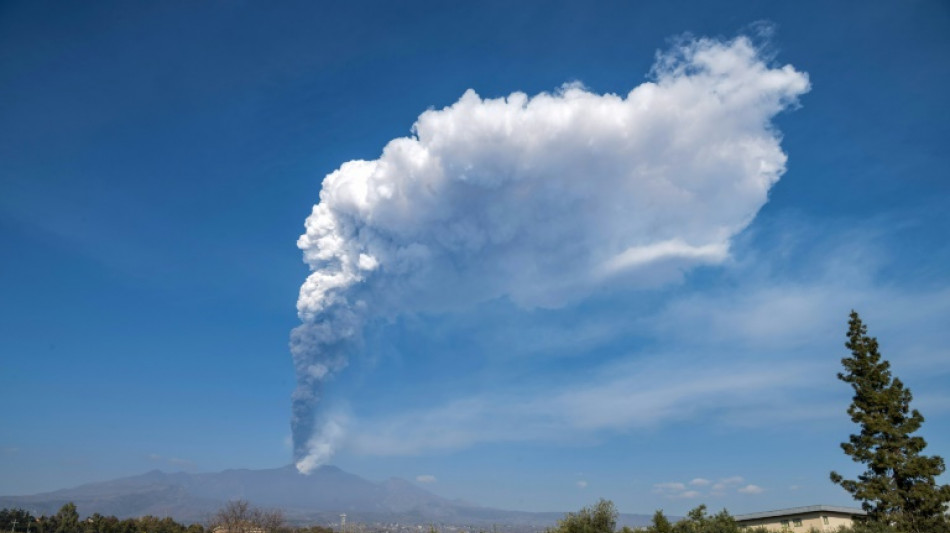
As temperatures rise, Sicily turns to exotic fruits / Photo: Giovanni ISOLINO - AFP/File
Avocados, mangos, bananas and passion fruit -- a wealth of exotic produce is growing under the shadow of Sicily's Mount Etna, as the Italian island's farmers adapt to global warming.
In a setting more akin to the Tropics than Europe, fields of mango and avocado trees, punctuated by palm trees, stretch out between the volcano and the glistening Mediterranean Sea.
"Over the past decade, a whole new sector has emerged," said Andrea Passanisi, an avocado farmer and head of the agricultural organisation Coldiretti in Catania, Sicily's second-largest city.
It was during a visit to Brazil in the 2000s that Passanisi noted how similar the climate was to Sicily -- which is best known for oranges and lemons -- and thought about growing exotic fruits back home.
He had just finished a law degree, but the 39-year-old decided to plant some avocados -- and now farms a range of exotic fruits.
The fertile soil around Etna, the hot and humid microclimate and the limited variations in temperature between day and night have turned out to be ideal conditions.
Today, more than 40 farmers are growing exotic fruits on hundreds of hectares of land across the region.
The producers set up a website to sell direct to consumers, sending fruit around Italy but also across Europe.
- Drought resistant -
In the late summer heat, the mango harvest is in full swing. Carla Cassaniti walks through her farm with a pair of pruning shears in hand, picking fruit off the trees one by one.
A Sicilian by birth, Cassaniti had been working in Milan before she decided to return home a decade ago and start a farm.
She sells through a cooperative which brands the fruit as "Etna Mango".
The changing climate in Sicily is "an opportunity for farming new crops", she says.
"Given that these are fruits native to a tropical climate, they need water at the beginning of cultivation, but then, when a plant is grown, they are well able to resist drought," she said.
The last four years have been the hottest recorded in two centuries in Italy, with a European high of almost 49 degrees Celsius recorded in Sicily in 2021.
This year has also been a scorcher. The average temperature in the first seven months was 0.67 degrees higher than the historic average, according to the National Research Council.
Although tropical fruits are not immune to extreme heat -- avocado trees, for example, are likely to produce less fruit in a heatwave -- a larger variety of produce is viewed by growers as an asset amid ever-changing weather conditions.
Cassaniti also believes that growing exotic fruits for the Italian market helps the environment by reducing the need for imports from afar.
"Consuming a local product has a lower carbon footprint," for example compared to bananas from Brazil, she said.
- Orange vs mangos -
Still, there are risks.
Prices are currently higher for exotic fruits than for oranges and lemons but the yield per hectare is lower.
And there is the possibility that even more extreme weather fuelled by ever worsening climate change could force island farmers once again to adapt.
"Now the cold doesn't arrive in December, but in January or February," a period that "for tropical plants is when the flowering begins, the plant begins to wake up", noted Passanisi.
A major cold snap during this time "becomes a problem, and risks compromising production," he said.
Another reason why many in Sicily -- Italy's largest producer of citrus fruits -- aren't giving up beloved lemon and orange groves.
"Citrus fruits are much more robust, both to heat and cold," Passanisi said.
W.F.Portman--NZN