Zürcher Nachrichten - Toxic storms blamed on climate change cloud Tajikistan

EUR -
AED 4.304491
AFN 77.683902
ALL 96.447187
AMD 447.040283
ANG 2.098507
AOA 1074.803393
ARS 1700.302607
AUD 1.774035
AWG 2.109755
AZN 1.996556
BAM 1.955101
BBD 2.359897
BDT 143.290028
BGN 1.956341
BHD 0.44175
BIF 3464.121464
BMD 1.172086
BND 1.512779
BOB 8.096177
BRL 6.472377
BSD 1.171701
BTN 105.712232
BWP 15.483732
BYN 3.43773
BYR 22972.890342
BZD 2.356498
CAD 1.616102
CDF 2653.603242
CHF 0.931695
CLF 0.027223
CLP 1067.934634
CNY 8.252952
CNH 8.247567
COP 4528.601334
CRC 583.803873
CUC 1.172086
CUP 31.060285
CVE 110.226559
CZK 24.345389
DJF 208.649015
DKK 7.470937
DOP 73.625266
DZD 152.007933
EGP 55.708666
ERN 17.581294
ETB 182.221906
FJD 2.677338
FKP 0.875398
GBP 0.876222
GEL 3.152799
GGP 0.875398
GHS 13.474301
GIP 0.875398
GMD 86.145469
GNF 10243.558714
GTQ 8.973794
GYD 245.134511
HKD 9.120349
HNL 30.861501
HRK 7.53537
HTG 153.457137
HUF 387.499906
IDR 19640.70776
ILS 3.755072
IMP 0.875398
INR 105.674299
IQD 1534.864725
IRR 49374.133109
ISK 147.600955
JEP 0.875398
JMD 187.477018
JOD 0.830988
JPY 182.846036
KES 151.140394
KGS 102.498683
KHR 4692.383577
KMF 493.44894
KPW 1054.870584
KRW 1733.316227
KWD 0.359714
KYD 0.97636
KZT 604.531752
LAK 25373.36767
LBP 104923.603707
LKR 362.526664
LRD 207.385906
LSL 19.645616
LTL 3.460866
LVL 0.708984
LYD 6.350839
MAD 10.739055
MDL 19.760277
MGA 5269.229822
MKD 61.533541
MMK 2461.447971
MNT 4158.096482
MOP 9.390925
MRU 46.773287
MUR 54.036943
MVR 18.120156
MWK 2031.717452
MXN 21.105681
MYR 4.785044
MZN 74.908115
NAD 19.645533
NGN 1706.533948
NIO 43.115332
NOK 11.914433
NPR 169.142456
NZD 2.034466
OMR 0.450517
PAB 1.171691
PEN 3.945024
PGK 5.050303
PHP 68.798132
PKR 328.303707
PLN 4.202403
PYG 7822.338745
QAR 4.27281
RON 5.090836
RSD 117.339579
RUB 93.702302
RWF 1705.9269
SAR 4.396323
SBD 9.54092
SCR 15.932148
SDG 705.012907
SEK 10.88881
SGD 1.513497
SHP 0.879368
SLE 28.245058
SLL 24578.066745
SOS 668.475428
SRD 45.333877
STD 24259.818775
STN 24.491772
SVC 10.252425
SYP 12961.357892
SZL 19.651314
THB 36.820503
TJS 10.820234
TMT 4.114023
TND 3.424806
TOP 2.822103
TRY 50.177101
TTD 7.950261
TWD 36.991634
TZS 2918.494768
UAH 49.488874
UGX 4185.540318
USD 1.172086
UYU 45.913596
UZS 14130.072222
VES 327.262188
VND 30841.105284
VUV 142.259511
WST 3.263926
XAF 655.736708
XAG 0.017776
XAU 0.000271
XCD 3.167621
XCG 2.111673
XDR 0.815523
XOF 655.733911
XPF 119.331742
YER 279.483795
ZAR 19.635142
ZMK 10550.198224
ZMW 26.655931
ZWL 377.411292
  • SCS

    0.0200

    16.14

    +0.12%

  • RBGPF

    0.0000

    80.22

    0%

  • CMSD

    0.0000

    23.28

    0%

  • RYCEF

    0.5400

    15.4

    +3.51%

  • CMSC

    0.0300

    23.29

    +0.13%

  • JRI

    0.0000

    13.43

    0%

  • NGG

    -0.7700

    76.39

    -1.01%

  • RIO

    0.4400

    77.63

    +0.57%

  • BCC

    1.4100

    77.7

    +1.81%

  • RELX

    0.0900

    40.65

    +0.22%

  • BCE

    -0.3000

    22.85

    -1.31%

  • VOD

    -0.0100

    12.8

    -0.08%

  • GSK

    -0.4200

    48.29

    -0.87%

  • BTI

    -0.1300

    57.04

    -0.23%

  • BP

    -1.1600

    33.31

    -3.48%

  • AZN

    0.7500

    90.61

    +0.83%

Toxic storms blamed on climate change cloud Tajikistan
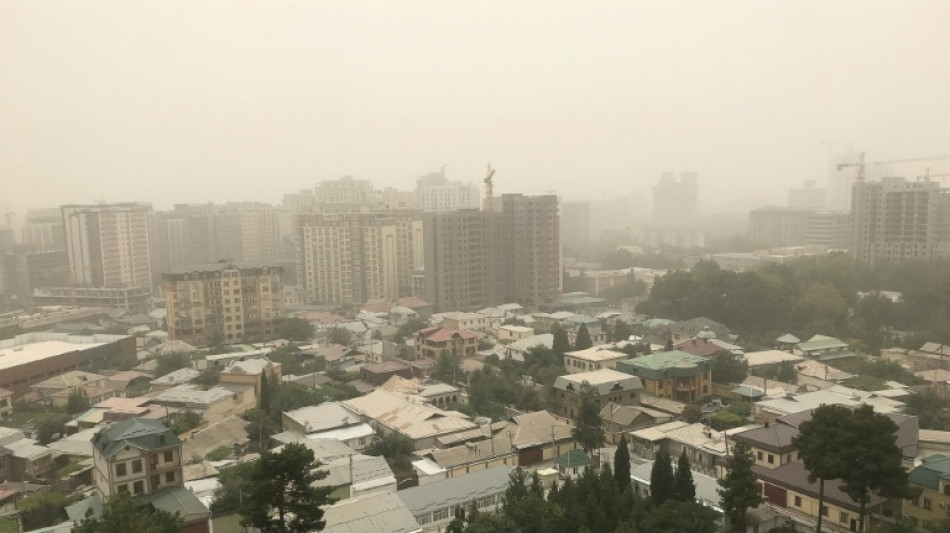
Toxic storms blamed on climate change cloud Tajikistan / Photo: Nasim ISAMOV - AFP

Toxic storms blamed on climate change cloud Tajikistan

The air was dry and warm and the skies over Dushanbe were grey without a hint of sun during another recent toxic sand storm that enveloped the capital of Tajikistan.

Text size:

Storms like this, which experts say are being caused by climate change, are becoming increasingly frequent across Central Asia, harming its inhabitants.

The imposing mountains around Dushanbe were barely visible through the haze and hulks of apartment blocks under construction stood like ghostly apparitions.

Tajikistan was ranked one of the top 10 most polluted countries in the world in the 2022 IQAir air quality index.

"I can't stop coughing. I'm fed up with this dust choking me," Munira Khushkadamova, a teacher, said during a visit to the Sofia clinic in Dushanbe.

For the last two years, the 43-year-old has been suffering from respiratory failure -- a diagnosis given to her from her doctor Faical Sakhray.

"In the last few years I have been getting more and more patients with cardiovascular diseases," he told AFP, blaming fine particles from the storms.

"The biggest ones enter the organism and stay in the upper respiratory tract but the finer ones go into the lower respiratory tract, then the lungs, the heart and other organs," he said.

- High exposure -

The United Nations estimates that 80 percent of the Tajik population is exposed to the highest concentrations of fine particles, known as PM2.5.

Sakhray said people should drink plenty of water and wear a mask for protection.

But the number of people wearing a mask in the streets of Dushanbe is minimal.

Despite having "difficulty breathing and headaches", Nigora Yusupova said she would not wear a mask because it "makes breathing harder".

These types of storms used to be rare but they now start in spring and continue into the autumn in large parts of Central Asia.

"In the 1990s, there were two or three sand and dust storms per year in Tajikistan. Now there can be up to 35," said Zebuniso Muminzoda, head of the Tajik branch of the Regional Environmental Centre for Central Asia.

"Because of climate change, longer dry seasons lead to sand and dust storms by drying out the ground and stronger winds then pick up this dry soil," she said.

The storms often start out in the dried-out stretches of the Aral Sea in Uzbekistan but also in the Kazakh steppes and in neighbouring Afghanistan.

Muminzoda pointed to a "human factor", saying forestry, bad irrigation and year-round livestock farming were all contributing to "degrading the soil".

It is a vicious circle for a poor, mainly rural country like Tajikistan, where the toxic storms also have a negative effect on farming and soil fertility.

The sand and dust also falls on the region's many glaciers -- a crucial source of water in the region and "speeds up their melting," Muminzoda said.

While there are often tensions between Central Asian countries, they are attempting common efforts to tackle environmental questions like water management and nuclear waste disposal.

But the storm threat in Tajikistan is still under-estimated "as natural catastrophe", according to the Regional Environmental Centre, which operates in all five countries in the region.

G.Kuhn--NZN