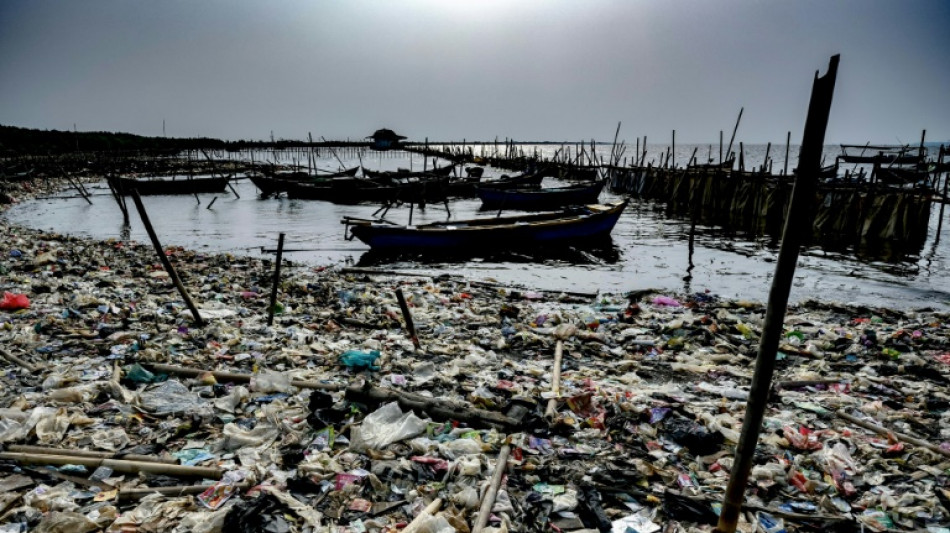
'Paradigm shift' needed on plastics health risk: researchers / Photo: BAY ISMOYO - AFP/File
A "paradigm shift" is needed on the risks posed to human health by plastics, researchers said Wednesday, warning of huge gaps in scientific understanding of the issue.
So little research is currently available that regulators should shift from an assumption that plastics are safe, to insisting on rigorous testing before products are approved for use, the researchers added.
The call came as a new database mapping existing scientific studies was unveiled by the Minderoo Foundation, an Australian nonprofit.
The Plastic Health Map attempts to collate all research on the issue since the 1960s, when plastic production and pollution began ramping up.
"While as authors we fully expected gaps in research, the extent of those gaps shocked us," said Sarah Dunlop, Minderoo Foundation's head of plastics and human health.
"We call for a paradigm shift in chemical regulation whereby new plastic chemicals are rigorously tested for safety before being introduced in consumer products," Dunlop and co-researchers said in a study published alongside the new database.
There should also be "ongoing post-introduction biomonitoring of their levels in humans and health effects throughout individuals' life span", they added in the research published in the journal Environment International.
The database created by the project collects peer-reviewed primary human studies published between 1960 and 2022 that focused on the health effects of exposure to plastic chemicals and particles.
It looked for work that measured or detected plastics in human bio-samples, rather than in animal or laboratory models.
It found a range of black holes in knowledge, including little research on populations in poorer countries, where weak waste management and fewer non-plastic alternatives increase exposure.
And not a single study was found on the effect of micro and nanoplastics on human health -- a field that has gained increasing urgency as the tiny particles have been found throughout the human body.
There was also little work on "substitution" chemicals, which have replaced formulas already known to cause harm, the role of paternal plastics exposure on infants, or the health impacts on older adults.
- Plastic production on course to triple -
Of 1,500 chemicals considered, just 30 percent had been studied at all for their effect on human health, the researchers said.
The mapping exercise had some limitations, the researchers acknowledged, including searching just two major portals and excluding research on plastics in medical settings, like IV lines.
It also focused on a select number of chemicals, based largely on which plastics people are most likely to encounter in daily life.
The database was launched ahead of fresh negotiations on a global plastics pollution deal, in Nairobi next month.
A draft deal published last month will guide discussions, but it contains a range of pathways, from more to less ambitious, and campaigners fear a weak final treaty full of loopholes could emerge.
There have been calls for reductions in the production of so-called virgin plastic, as well as a possible plastic tax.
That is strongly opposed by industry, as well as some major plastic-producing nations, which have focused on more reuse and recycling, even though less than 10 percent of the world's plastic is recycled.
On current trends, annual production of fossil-fuel-based plastics will nearly triple by 2060 to 1.2 billion tonnes, while waste will exceed one billion tonnes.
Negotiations will continue in Canada in April next year, with the goal of reaching a final deal in South Korea in late 2024.
R.Bernasconi--NZN