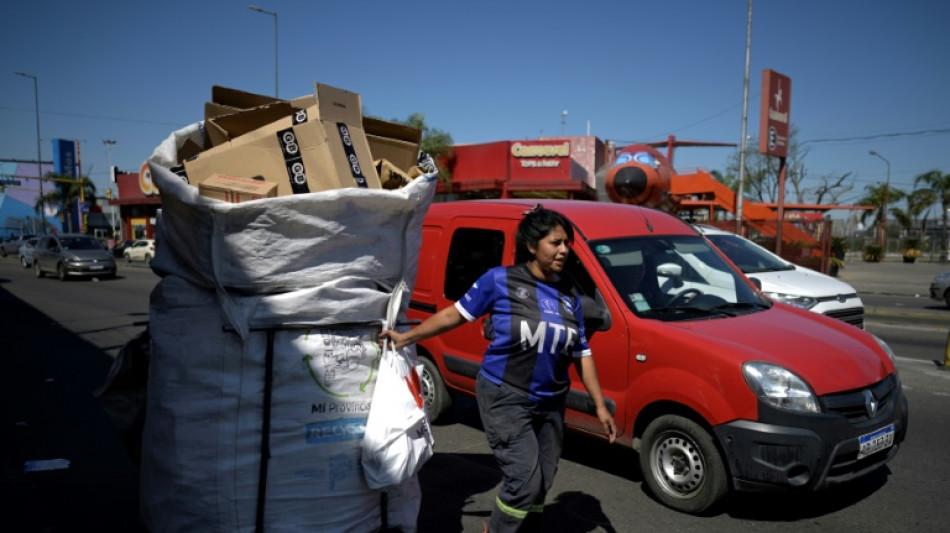
In Argentina, trash is a lifeline for army of recyclers / Photo: JUAN MABROMATA - AFP
Ayelen Torres weaves her trolley expertly through the streets on the outskirts of Argentina's capital, stopping every few steps to sift through trash in search of recyclable cardboard or plastic.
She is part of an army of "cartoneros" -- tens of thousands of poor Argentines who scour the streets for material to sell and put food on the table.
Since the pandemic, and an economic crisis that has seen annual inflation hit 138 percent and pushed poverty levels to 40 percent, the numbers of those turning to the informal recycling industry have exploded.
"I think it's a very denigrated job but, at the same time, it's a beautiful job... what picking things up means, how it helps the environment. The strength you have to have, the courage, because in the street you encounter many things," said Torres, 25.
She has little hope that Sunday's presidential election will change anything for her.
"Whoever wins, I will still have to wake up at six in the morning" to go hunt for things to recycle, said Torres.
The mother-of-two works in a team alongside Sabrina Sosa, who continues to lug around heavy bags even though she is three months pregnant.
In a few hours, the women gather 76 kilograms (167 pounds) of material. On a good day, they can double that amount, and their pay.
- 'Our daily bread' -
The "cartonero" movement began in Argentina after the economic implosion of 2001 when a financial crisis led authorities to freeze bank deposits, and deadly social unrest erupted.
They faced fierce resistance from authorities and residents of the capital who didn't want them picking through their trash.
Twenty years later, there is a federation, Faccyr, with 20,000 individual collectors who work for 145 cooperatives that buy the material and sell it on to the recycling industry.
With different rates for glass, cardboard, paper, or plastic, the co-operative pays between 10 and 90 pesos per kilo.
In a good month, and counting a small government subsidy, Torres and Sosa earn about 132,000 pesos (360 dollars) each -- almost the minimum wage.
Sosa began doing the job to make ends meet between other casual gigs -- babysitting here, waitressing there, always working off the books. In Argentina, almost 47 percent of jobs are informal or partially regulated.
Since joining the co-operative Construyendo desde Abajo (Building from Below), the two women are in the first registered jobs of their lives.
"Cardboard is our daily bread," said Sosa.
According to Faccyr, more than 150,000 people work as "cartoneros."
"The number keeps growing," said Santiago Britez, 42, who used to collect recyclables and now manages a few dozen workers at the co-operative.
During the pandemic "there was a whole sector of society that had no resources. Many who had informal jobs lost everything."
As Argentina's perennial economic malaise has deepened in recent years, "entire families have appeared, with children," into open dumps, looking for goods to sell and even food, said Jackie Flores, an environmental official in Buenos Aires province who once worked as a "cartonera" herself.
"It's an enormous challenge," she added.
Torres and Sosa take pride in their work, which has been praised by Pope Francis, an Argentine himself, as a "necessary ecological job."
"For the first time I have a dignified job," said Torres.
"On Labor Day, my daughter drew a picture of me for school with my cardboard-filled trolley and wrote on it: 'My mom works for the environment'."
F.E.Ackermann--NZN