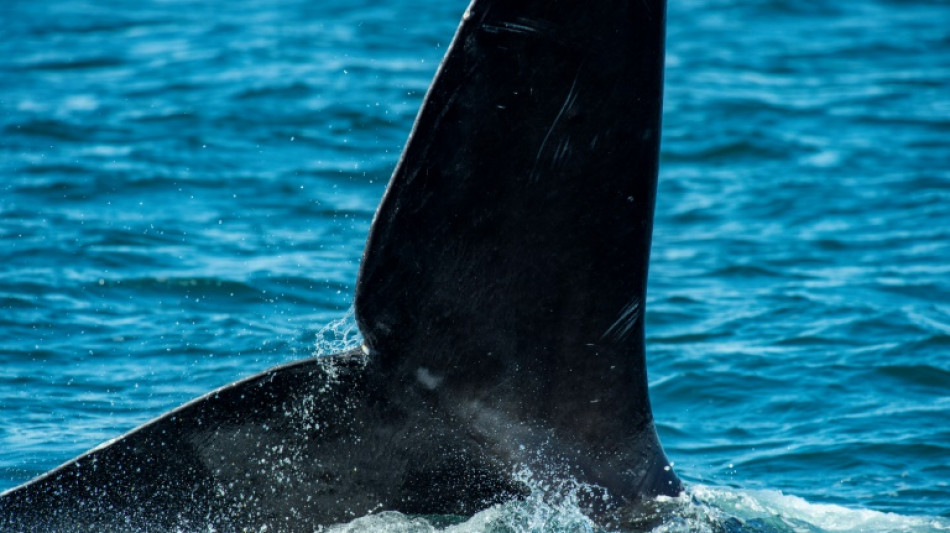
An endangered whale species is speeding towards extinction / Photo: Joseph Prezioso - AFP/File
They're one of the most endangered mammals in the world, and a species you may never have even heard of: North Atlantic right whales.
American conservationists are hoping a proposed federal rule change to expand speed restrictions for vessels along the US East Coast will save the marine giants, which number fewer than 350, from extinction.
Lined up against the proposal are conservative lawmakers who have introduced several bills in Congress that seek to stop President Joe Biden's administration from enacting the amendments.
"Sadly, most of the right whales I've seen have been dead," Katie Moore, a marine biologist for the International Fund for Animal Welfare said at a hearing at Capitol Hill on Thursday in which whale advocates sought to sway congressional staffers about what they say are misconceptions surrounding the plans.
The situation is dire. North Atlantic right whales have been experiencing an "unusual mortality event" since 2017; there are fewer than 70 breeding females left, calving rates are down as a result of stressors on mothers, and the species could be functionally extinct by 2035.
The most recent documented killing from a boat strike was in February, when a 20-year-old male washed ashore with a broken spine in Virginia Beach in the mid-Atlantic. With the population already so tiny, any new deaths can drive a downward spiral.
- The 'right' whale to hunt -
Approaching 60 feet (18 meters) in length and with lifespans similar to humans, North Atlantic right whales are thought to have once numbered up to 20,000 before commercial whaling decimated their population.
They were considered the "right whale" to hunt by whalers who sought their blubber for oil and their baleen plates, which the whales use to filter their food, as a strong, flexible material used in the pre-plastic era.
Whaling was eventually banned in 1935, leading to a recovery and a peak of 483 individuals by 2010, before the current decline.
Ship strikes and entanglements with lines used for fishing lobster and crabs are the species' two leading causes of death, and the situation is compounded by climate change which is shifting the distribution of the zooplankton they feed on.
The National Oceanic and Atmospheric Administration (NOAA)'s changes would broaden the boundaries and timing of seasonal speed restrictions along the East Coast, and expand mandatory speed restrictions of 10 knots or less from vessels over 65-feet to those over 35-feet.
The news has provoked an outcry from the boating and fishing industries, who worry it will harm small businesses.
On the other hand, say conservation groups, fewer than four percent of recreational vessels along the Atlantic Coast are 35 feet or longer. They liken whale speed restrictions to slowing down in school zones where kids are most at risk from cars.
- Technology solutions? -
NOAA has said it plans to finalize its draft rule by December, after reviewing more than 90,000 comments.
Even if it does, enforcement remains a concern. A new report published Thursday by the nonprofit Oceana found more than 80 percent of 65-feet and longer boats off the US East Coast are surpassing the current mandatory and suggested 10-knot slow zones designed to protect the whales from deadly collisions.
Notably, for the 9,358 vessel trips over the speed limit made from November 2021 through July 2022, NOAA issued fines in only 46 cases.
Kathleen Collins, senior marine campaigns manager for IFAW told AFP she was heartened on this front by recently allocated funds from the Inflation Reduction Act, President Biden's signature climate and conservation investment law, which allocated $82 million towards saving the species, including technologies to assist with compliance.
On the other hand, say conservationists, technology can't solve it all: real-time monitoring of the entire population -- as proposed in a bill introduced though not yet passed by Senator Joe Manchin -- is a non-starter.
Right whales can't be permanently tagged and tracked, they say. Doing so causes infection risks, while the whales succeed in dislodging the devices within weeks.
Jane Davenport, a senior attorney with Defenders of Wildlife, recalled that a group of conservative lawmakers previously succeeded in preventing NOAA from implementing until 2028 a court order demanding better fishing gear to reduce rope entanglements, the other main threat to the species.
"The only lever we have to pull is on vessel strikes right now," she said. "We cannot save this species if Congress refuses to let the agency do what it needs to do."
T.L.Marti--NZN