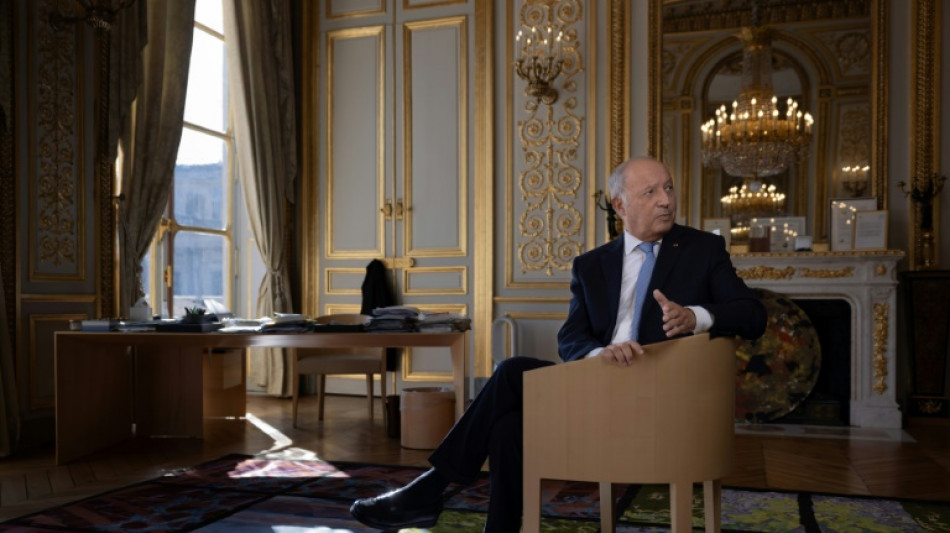
How to run a climate COP, according to the grandfather of the Paris deal / Photo: JOEL SAGET - AFP
Paris, 2015 and the warnings of climate breakdown were growing ever louder.
But after decades of dithering, it was far from clear that world leaders gathering for UN climate talks in the French capital would pull together to sign what is now seen as the defining international accord to curb global warming.
From the outset an ambitious agreement was "by no means a foregone conclusion", said Laurent Fabius, who was at the time France's minister of foreign affairs and president of that COP21 meeting.
The draft text had "1,600 passages in brackets", he said. In other words, 1,600 disagreements to resolve.
It was his job to navigate the often clashing demands of nearly 200 countries -- from the world's richest emitters of planet-heating fossil fuel pollution to the nations most vulnerable to devastating climate impacts.
"It's a race against time. Because while all these discussions are taking place, emissions are continuing," he told AFP in an interview in Paris.
"And what people sometimes don't realise is that once greenhouse gases have been emitted into the atmosphere, they take years, decades, sometimes centuries, to dissipate."
Two weeks of frantic negotiations resulted in the now famous Paris Agreement, where countries pledged to keep warming "well below" two degrees Celsius since the pre-industrial era and to work towards the more ambitious limit of 1.5C warming.
The lessons Fabius draws from that landmark deal could help his successor at crucial COP28 talks, starting in the United Arab Emirates next month, which come as those ominous warnings of 2015 are starting to come to pass.
- 'Life or death' -
Perhaps the most important piece of advice for COP28's incoming president is to work hard to forge consensus, without giving the impression that a final text has been preordained and discussions are "for show".
Late-night sessions with negotiators in Paris included powerful testimony from a representative from the Marshall Islands, one of many low-lying island states at risk of being swallowed by rising seas.
For this representative the difference between 1.5C and 2C was not "a question of quality of life, it was a condition of life".
The testimony was so powerfully delivered, Fabius said, that it was impossible for other governments to dismiss the argument that 1.5C was a safer target.
"It was life or death!" he said.
After proposing two initial attempts at a final text, France put forward a third version with language on limiting warming to 1.5C if possible, on the very last night.
"I made the final compromises in the middle of the night because the text had not been finalised," said Fabius, who now chairs the French Constitutional Council.
It was accepted.
"As is often the case in international conferences, the aim was to find a wording that would allow a degree of ambiguity so that people with different opinions could find common ground," Fabius said, acknowledging that this can then pose its own problems.
This year, countries are under pressure to agree to tougher targets on reducing the world's reliance on fossil fuels, boosting efficiency and renewable energies, as well as more ambitious goals to slash emissions this decade.
Carbon pollution needs to fall by 43 percent from 2019 levels by 2030. But emissions ticked up again in 2022, and are on track to do the same this year.
With tensions between Washington and Beijing, the Russian invasion of Ukraine and the war between Israel and Hamas, the geopolitical situation is thornier now than it was eight years ago.
But Fabius said so far the international community has not created anything more effective than the yearly UN Conference of the Parties (COP), so negotiators will just have to roll up their sleeves and find a solution.
"If we don't have the COPs, what do we have?" he said.
D.Smith--NZN