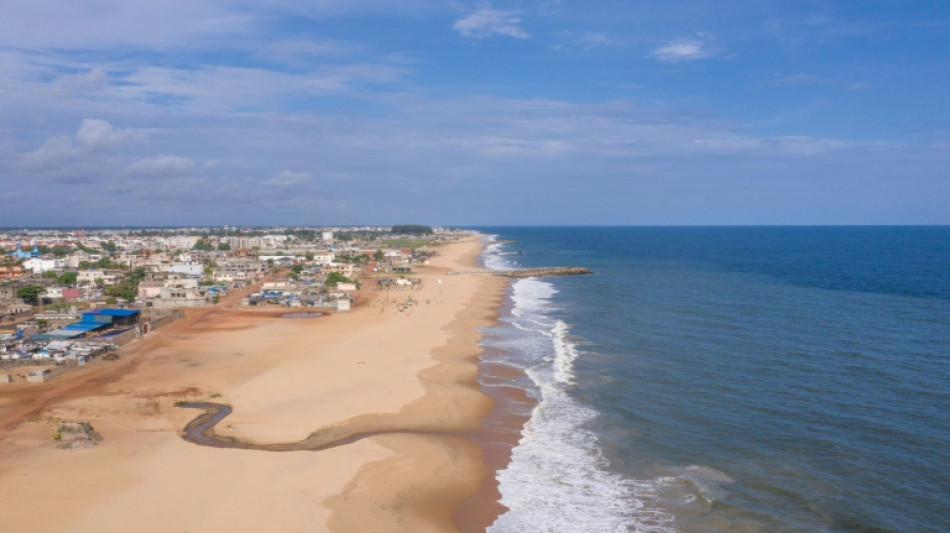
Benin struggles in battle to halt coastal erosion / Photo: YANICK FOLLY - AFP
Along its Atlantic coast, Benin's government has spent millions of dollars to protect coastal communities from sea erosion. But Doris Alapini can only watch as waves tirelessly eat away at her land and the large seaside restaurant she built.
The ocean is slowly winning the battle.
"The sea is advancing a lot. We have to do dredging or else block it, otherwise it will keep advancing," Alapini said as she walked along Cotonou's long sandy beach.
"I have seen how many times it has destroyed and invaded the neighbourhood."
She has lived for 27 years in the Jak district, one of the oldest and most chic in the economic capital of Benin. Every year, sea waters overflow into her area.
"The neighbourhood is under threat every day," she said.
"No one here has any guarantees. If there is a big wave, it will demolish the entire neighbourhood."
Not all coastal erosion is linked to climate change. But since 2002, Benin has lost kilometres (miles) of coastline, said Esquill Outiclissou, executive of the government's general directorate of environment and climate.
"The state has not remained idle," he said, pointing to protective structures, stone groynes and other installations, particularly to the east of Cotonou.
According to Outiclissou, nearly 100 billion CFA francs ($160 million) have been injected into the protection of Beninese coasts in recent years and the investment helped slow down the ocean's advance.
Africa often finds itself on the front line of climate change impact despite the continent contributing the least to greenhouse gas emissions globally.
Still, Benin and its littoral West African neighbours Togo and Ghana are, just like Pacific islands and coastal South Asian cities, at risk of shore erosion's impact on communities.
With global warming affecting sea levels, coastal erosion will be one of the subjects leaders will address when they meet for COP28 in Dubai in December.
- Race against time -
Raymond Mekpe, a 40-year-old fisherman, cannot believe the erosion losses.
Born in Cotonou, Mekpe might not be a climate expert but has his own indicators to illustrate the sea's unbridled advance.
"The homes of my grandparents and my parents were there," he said, pointing out to sea.
"We played somewhere there in our childhood," he added, gesturing towards another area where big waves crash.
Benin loses approximately 30 metres (yards) of its coastline every year, according to oceanographer Cossi Georges Degbe.
"It's really serious. And if nothing is done, within a few years we will lose the Cotonou Porto-Novo interstate road," the 51-year-old warned, referring to the main coastal route to the capital city.
"When we put protective structures in a given place, we are just moving the phenomenon along," he said.
For Outiclissou, the government must respond segment by segment, but "the segments that are still vulnerable are under study and will be dealt with in due course".
Thirteen structures have been built east of Cotonou starting from the coastal lagoon, he said.
Since then, the waves of erosion have become noticeably weaker, he added.
As well as rising water levels, due to climate change, extreme weather phenomena are increasing, "with very high waves washing over our coasts", explained oceanographer Degbe.
Alain Tossounon, president of a network of media focusing on water, the climate and environment, agrees more needs to be done.
"Efforts have not been sufficient and populations have not yet become aware of the importance of this phenomenon in the years to come," he said.
- 'Sea advances, destroys' -
With Benin not the only country concerned, joining forces with neighbours could bring more results.
"We must consider a regional approach to slow down the advance of the waves," Tossounon said.
Benin and Togo have already started working together -- a protective groyne of 18 kilometres (11 miles) in Togo and 24 kilometres in Benin made it possible to slow the waves in the fishing villages of Hillacondji and Aneho.
But despite these actions, seaside restaurant owner Alapini cannot help but feel angry.
"When we have populations who live by the sea, we have to have forecasts for them, a line in the state budget," she said.
"I'm shocked. By the time it takes to get funding, the sea is moving forward and destroying things."
W.F.Portman--NZN