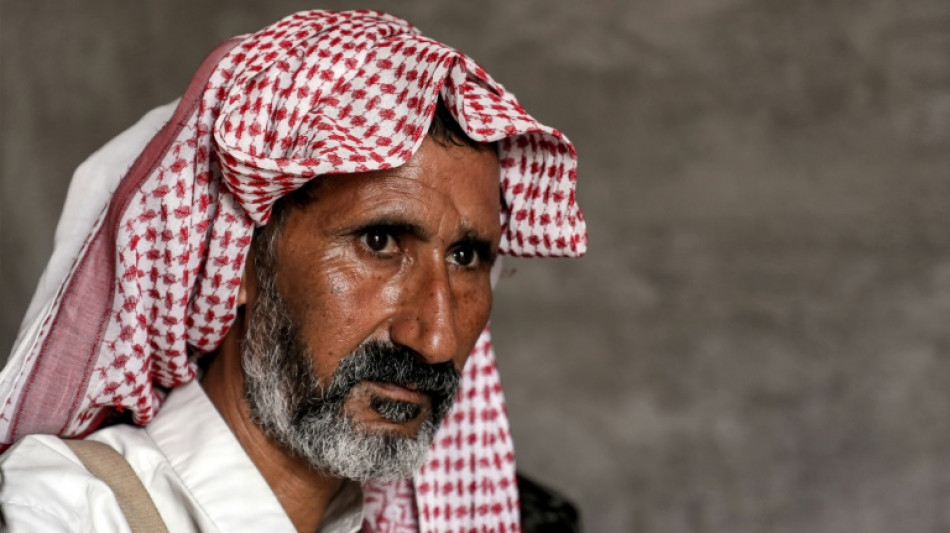
Iraqis displaced by climate change fall into poverty / Photo: Asaad NIAZI - AFP
For the past decade, Nasser Jabbar and his children have lived in a rundown house built of grey concrete blocks at a shantytown in southern Iraq.
Drought chased the father of 10 out of the countryside, where he had been a herder and farmer, and into a life of unemployment and urban poverty.
"We lost the land and we lost the water," said the father in his 40s, wearing a traditional white robe.
He spoke to AFP in his home on the edges of Nasiriyah, capital of Dhi Qar province.
Jabbar's neighbourhood typifies the extreme poverty that those displaced by climate change face in south and central Iraq.
With declining rainfall, the country has seen four consecutive years of drought.
In the shantytown where he lives, cracked streets lined with rubble and piles of rubbish snake between houses thrown together by their inhabitants.
On an empty lot surrounded by ramshackle buildings, sewers empty onto open ground as cows rest in the shadow of a low wall nearby.
Like Jabbar, many of the displaced who live here abandoned their villages after a life working in agriculture.
In the old days in Gateia, Jabbar's village in Dhi Qar, he farmed five hectares (just over 12 acres) of land with his brothers.
In winter, they harvested barley; in summer, vegetables.
Before leaving his fields behind for the last time, Jabbar did what he could for four years to combat the onward march of an increasingly inhospitable climate.
- $4 a day income -
He dug a well, but "little by little the water dropped", and he had to sell off his herd of 50 goats one by one.
Once in the city, he found work on construction sites carrying bricks or mixing concrete, but had to stop in the end because of back problems.
"I haven't worked for three years," he said.
Now two of his children, aged 17 and 18, support the family by carrying goods to market, earning a little less than four dollars a day.
Despite Iraq being an oil-rich country, poverty is common.
In addition to drought, the authorities blame upstream dams built by Iraq's powerful neighbours Iran and Turkey for dramatically lowering water levels in the Tigris and Euphrates rivers which have irrigated Iraq for millennia.
By mid-September, "21,798 families (130,788 individuals) remain displaced because of drought conditions across 12 governorates" in central and southern Iraq, an International Organization for Migration report said.
According to the IOM, 74 percent of climate refugees resettle in urban areas.
Dhi Qar's deputy governor in charge of planning, Ghassan al-Khafaji, noted "significant internal migration" in the province, sparked by water shortages.
In five years "3,200 housing units were built on the outskirts of the city" of Nasiriyah, as a result of an exodus from Iraq's famed southern marshes which have been assailed by drought.
Those houses account for "between 20,000 and 25,000 people", Khafaji added.
- Risk of unrest -
"This internal migration has put extra pressure on employment, with our young people already suffering from significant unemployment."
Iraq has been wracked by decades of conflict, and corruption has eroded public administration. Urban centres are no better off than the countryside.
Cities are "already confined in their ability to provide basic services to existing residents due to limited, ageing and underfunded infrastructure", Thomas Wilson, a climate and water specialist at the Norwegian Refugee Council, told AFP.
"Trends in rural to urban movement put an additional burden on failing infrastructure," he said.
He recommended "resource management plans, effective governance, and investment" in favour of the regions the displaced come from, in the framework of a "policy to reduce and mitigate forced migration".
In a country of 43 million people, nearly one Iraqi in five lives in an area suffering from water shortages.
In April, a UN-issued report noted the risk of "social unrest" because of climate factors.
"Limited economic opportunities for young people in crowded urban areas further risk reinforcing feelings of marginalisation, exclusion, and injustice," the report said.
"This could fuel tensions between different ethno-religious groups or increase grievances vis-a-vis state institutions," it added.
Qassem Jabbar, Nasser's 47-year-old brother, joined him in Nasiriyah three years ago.
"Since we left, I haven't been working", said Qassem, his waist strapped in a brace after he had a back operation he could only pay for with the help of donors.
Of his own 10 children, only two go to school. How could he possibly cover school fees for them all?
T.Gerber--NZN