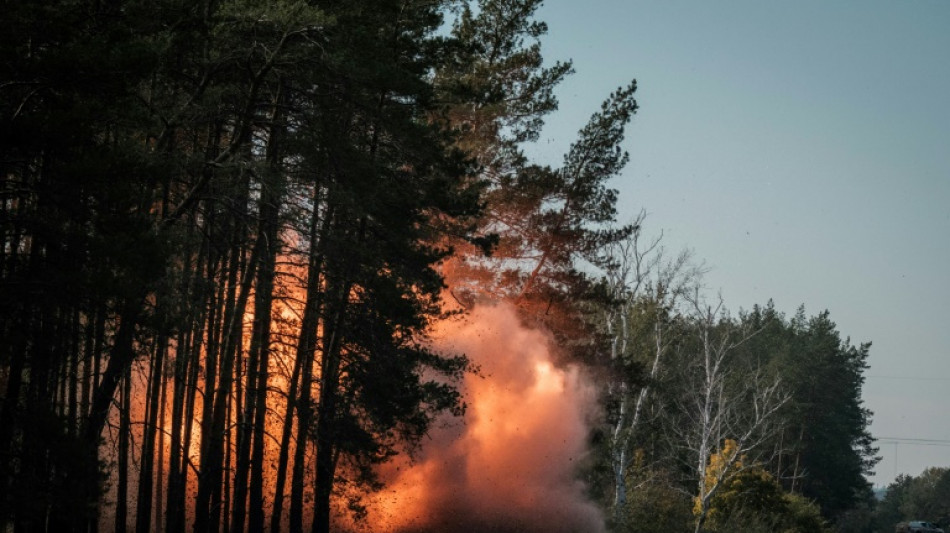
The environment: another victim of Russia's invasion / Photo: Yasuyoshi CHIBA - AFP
Ravaged forests, flooded towns and dead dolphins: after nearly two years of war in Ukraine, experts say environmental damage is becoming an "enormous" tragedy that will affect generations to come.
The invasion of Ukraine has been particularly devastating for nature, said Doug Weir, head of research at the Conflict and Environment Observatory, a British non-governmental organisation.
Unlike conflicts limited to particular areas, the front line in Ukraine is "incredibly long" -- stretching over hundreds of kilometres -- and the fighting is relentless, he said.
Along with intense artillery fire, there has also been an increase in pollution due to frequent attacks on energy infrastructure and vast amounts of debris generated by bombing in urban areas.
"The environment has been massively a victim of this war," Weir said.
The environmental cost was estimated in November at "a staggering $56 billion", said Jaco Cilliers, resident representative of the United Nations Development Programme (UNDP) in Ukraine.
"The scale of the tragedy is enormous," he said.
- 'Incomplete' picture -
In the east of the country, where the fighting has been particularly fierce, an oak forest that was more than 300 years old was "entirely destroyed by the war", said Bohdan Vykhor, director of environmental group WWF-Ukraine.
Ruslan Strilets, Ukraine's minister for environmental protection and natural resources, told AFP that around 30 percent of forests and 20 percent of national parks had been affected by the fighting.
The recovery could require decades and experts say even estimating the real extent of the damage might take years.
Large parts of Ukraine are inaccessible for environmental experts, either because they are under Russian occupation or are near the front line.
Scientists have to make approximations remotely based on satellite data or images posted on social media.
"The picture we have is always incomplete," Weir said.
It is impossible, for example, to work out the number of dolphins killed in the Black Sea, which has also become an important battleground.
"We have officially registered a thousand dolphin deaths," including many found beached after being disoriented by the sounds of military activity, Strilets said.
But, he added, experts put the real number in the "tens of thousands".
- Supporting the army -
Some of the destruction is well known, including the explosion of the Kakhovka dam that caused massive deadly flooding over the summer in southern Ukraine.
Yehor Hrynyk, an expert with the Ukrainian Nature Conservation Group, fears the conflict may also be having less visible effect.
For example, the need to pay for an expensive war may push the government towards "increased exploitation of natural resources" such as logging.
"Let's not forget that battles are won by armies, and wars are won by economies," said Strilets, though he promised that economic recovery would not come "at the expense of our environment".
Getting the environmental message out while bombs are falling is no easy task.
"It definitely got harder and harder to reach the attention of media, authorities, general society," Hrynyk said.
The activist said he is often told: "We need to come back to it after the war ends."
Weir said his organisation has received messages saying: "Why are you concerned about the environment in conflict when so many people are dying?"
His response: "If you want to breathe, if you want to eat, if you want to drink, then the environment is key to that."
Cilliers said there needed to be a better understanding "that environmental destruction carries enduring implications, impacting generations and reaching far beyond Ukraine's borders".
But even for an activist like Hrynyk, "the number one priority, including for the environment", is to support the army in defending Ukraine against Russia.
"The faster Russia is defeated, the faster we can go back to our normal life and bring the environment higher on the agenda."
O.Krasniqi--NZN