Dubai deal hailed as 'beginning of end' for fossil fuels / Photo: Giuseppe CACACE - AFP
The world for the first time on Wednesday approved a call to transition away from fossil fuels as UN negotiations in Dubai tackled the top culprit behind climate change, but at-risk countries said far more action was needed.
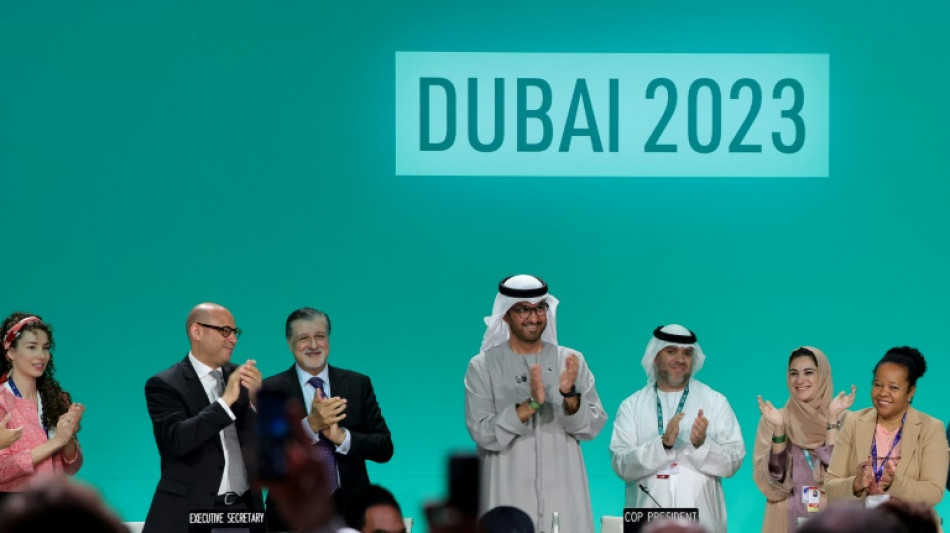
After 13 days of talks and several sleepless nights in a country built on oil wealth, the Emirati president of the COP28 summit quickly banged a gavel to signal consensus among 194 countries and the European Union.
"You did step up, you showed flexibility, you put common interest ahead of self-interest," said COP28 president Sultan Al Jaber, whose role as head of the United Arab Emirates' national oil company had raised suspicion among many environmentalists.
Describing the deal as bringing "transformational change", Jaber said: "We have helped restore faith and trust in multilateralism, and we have shown that humanity can come together."
EU climate chief Wopke Hoekstra called the agreement "long, long overdue", saying it had taken nearly 30 years of climate meetings to "arrive at the beginning of the end of fossil fuels".
But with the UN talks requiring consensus, Jaber carefully calibrated the text to bring onboard countries from islands that fear extinction from rising sea levels to oil giant Saudi Arabia, which led the charge to keep exporting its petroleum.
Toughening language from an earlier draft that was roundly denounced by environmentalists, the agreement calls for "transitioning away from fossil fuels in energy systems, in a just, orderly and equitable manner".
It asks for greater action "in this critical decade" and recommits to no net greenhouse gas emissions by 2050 in hopes of meeting the increasingly elusive goal of checking warming at 1.5 degrees (2.7 Fahrenheit) above pre-industrial levels.
The planet has already warmed by 1.2 degrees and scientists say 2023 was likely the warmest in 100,000 years, as storms, droughts and lethal wildfires expand around the world.
- Islanders still alarmed -
John Silk, the negotiator from the Marshall Islands, had warned that the earlier draft marked a "death warrant" for his Pacific archipelago, which is just 2.1 metres (seven feet) above sea level.
Silk likened the final agreement to a "canoe with a weak and leaky hull, full of holes" but added: "We have to put it into the water because we have no other option."
The small islands did not block the Dubai deal, but a representative from Samoa criticised the language as too weak after contending the group had not arrived yet in the room at Dubai's sprawling Expo City when Jaber declared consensus.
"We have made an incremental advancement over business as usual when what we really needed is an exponential step change in our actions," Samoan chief negotiator Anne Rasmussen said on behalf of the island nations, drawing a standing ovation and polite applause from Jaber.
US climate envoy John Kerry said that no side can ever achieve everything in negotiations and praised the deal as a sign a war-torn world can come together for the common good.
"I think everyone has to agree this is much stronger and clearer as a call on 1.5 than we have ever heard before, and it clearly reflects what the science says," Kerry said.
Seeking to avoid the geopolitical tensions that have strained cooperation on other issues, Kerry met ahead of COP28 with his counterpart from China, leading to a joint call by the world's two largest emitters to step up renewable energy.
A Chinese envoy said Wednesday that wealthy nations must still do more to help the developing world, a stance shared by Brazil, which will hold the 2025 climate talks in the Amazon.
But the Dubai summit at its opening reached an agreement on another major part of the accord -- setting up a loss and damage fund to compensate countries hit hard by climate change.
- 'Elephant in room' -
The text stopped short of backing appeals during the summit for a "phase-out" of oil, gas and coal, which together account for around three-quarters of the emissions responsible for the planetary crisis.
Environmentalists virtually all saw the agreement as a step forward, although many cautioned that there will still far more to do.
"We are finally naming the elephant in the room. The genie is never going back into the bottle and future COPs will only turn the screws even more on dirty energy," said Mohamed Adow, director of the Power Shift Africa think tank, referring to the annual UN climate meetings known as Conferences of the Parties.
"Some people may have had their expectations for this meeting raised too high, but this result would have been unheard of two years ago, especially at a COP meeting in a petrostate," he said.
The agreement also made more explicit the near-term goals in the goal of ending net emissions by 2050.
It called for the world to cut greenhouse gas emissions by 43 percent by 2030 compared with 2019 levels.
But Jean Su of the Center for Biological Diversity, while seeing progress, said there were still "cavernous loopholes" including recognition of a role for "transitional fuels" -- seen as code for natural gas.
The deal backs a phase-down of "unabated" coal power -- meaning it preserves a role for the dirty but politically sensitive energy source if there is use of carbon capture technology, panned by many environmentalists as unproven.
F.Carpenteri--NZN