Zürcher Nachrichten - Sharks killed at alarming rates despite regulations: study

EUR -
AED 4.304688
AFN 77.355324
ALL 96.579421
AMD 447.10003
ANG 2.098431
AOA 1074.764616
ARS 1698.533883
AUD 1.771797
AWG 2.112609
AZN 1.997128
BAM 1.95746
BBD 2.360802
BDT 143.347881
BGN 1.956252
BHD 0.441843
BIF 3469.249715
BMD 1.172044
BND 1.515285
BOB 8.099661
BRL 6.480587
BSD 1.172094
BTN 105.021364
BWP 16.48698
BYN 3.444921
BYR 22972.058926
BZD 2.357308
CAD 1.615018
CDF 2648.819464
CHF 0.931545
CLF 0.027232
CLP 1068.306688
CNY 8.252302
CNH 8.244344
COP 4474.19525
CRC 585.381385
CUC 1.172044
CUP 31.059161
CVE 110.356693
CZK 24.316218
DJF 208.296089
DKK 7.470824
DOP 73.420377
DZD 152.112583
EGP 55.772648
ERN 17.580657
ETB 182.087338
FJD 2.676601
FKP 0.875487
GBP 0.876027
GEL 3.153256
GGP 0.875487
GHS 13.46207
GIP 0.875487
GMD 86.149734
GNF 10245.42526
GTQ 8.981386
GYD 245.221656
HKD 9.120464
HNL 30.879184
HRK 7.535192
HTG 153.680312
HUF 386.28045
IDR 19588.075399
ILS 3.758804
IMP 0.875487
INR 104.961975
IQD 1535.502013
IRR 49372.346446
ISK 147.213174
JEP 0.875487
JMD 187.544226
JOD 0.831025
JPY 184.532486
KES 151.08862
KGS 102.495683
KHR 4703.807946
KMF 493.43086
KPW 1054.822384
KRW 1731.249821
KWD 0.360029
KYD 0.976828
KZT 606.5588
LAK 25385.875913
LBP 104961.714595
LKR 362.898427
LRD 207.460604
LSL 19.662669
LTL 3.460741
LVL 0.708958
LYD 6.353279
MAD 10.743597
MDL 19.843318
MGA 5330.383407
MKD 61.55124
MMK 2461.094974
MNT 4162.407764
MOP 9.394325
MRU 46.907574
MUR 54.090266
MVR 18.120241
MWK 2032.47139
MXN 21.098395
MYR 4.778468
MZN 74.905763
NAD 19.663173
NGN 1710.914853
NIO 43.135472
NOK 11.869118
NPR 168.034182
NZD 2.034147
OMR 0.450659
PAB 1.172049
PEN 3.947146
PGK 4.986228
PHP 68.641337
PKR 328.393552
PLN 4.206963
PYG 7863.365752
QAR 4.273114
RON 5.090308
RSD 117.397814
RUB 94.408949
RWF 1706.647134
SAR 4.396158
SBD 9.540574
SCR 17.72541
SDG 704.988668
SEK 10.85656
SGD 1.514433
SHP 0.879336
SLE 28.250554
SLL 24577.177236
SOS 668.64986
SRD 45.055127
STD 24258.940784
STN 24.520792
SVC 10.255433
SYP 12959.414354
SZL 19.660671
THB 36.80645
TJS 10.800882
TMT 4.113874
TND 3.430821
TOP 2.822001
TRY 50.15469
TTD 7.955542
TWD 36.945756
TZS 2924.24973
UAH 49.560324
UGX 4192.555035
USD 1.172044
UYU 46.018235
UZS 14090.587304
VES 327.250345
VND 30839.403086
VUV 142.286183
WST 3.269255
XAF 656.488457
XAG 0.017381
XAU 0.000269
XCD 3.167507
XCG 2.112437
XDR 0.815493
XOF 656.502472
XPF 119.331742
YER 279.474275
ZAR 19.614392
ZMK 10549.805058
ZMW 26.518808
ZWL 377.397633
  • SCS

    0.0200

    16.14

    +0.12%

  • RBGPF

    0.0000

    80.22

    0%

  • GSK

    0.5250

    48.815

    +1.08%

  • BCC

    -2.8600

    74.84

    -3.82%

  • CMSD

    0.0000

    23.28

    0%

  • CMSC

    -0.0500

    23.24

    -0.22%

  • RELX

    0.2350

    40.885

    +0.57%

  • RIO

    0.7300

    78.36

    +0.93%

  • RYCEF

    -0.1500

    15.25

    -0.98%

  • BCE

    0.0800

    22.93

    +0.35%

  • NGG

    0.3860

    76.776

    +0.5%

  • VOD

    0.0850

    12.885

    +0.66%

  • JRI

    -0.0100

    13.42

    -0.07%

  • AZN

    1.1150

    91.725

    +1.22%

  • BP

    0.6450

    33.955

    +1.9%

  • BTI

    -0.1060

    56.934

    -0.19%

Sharks killed at alarming rates despite regulations: study
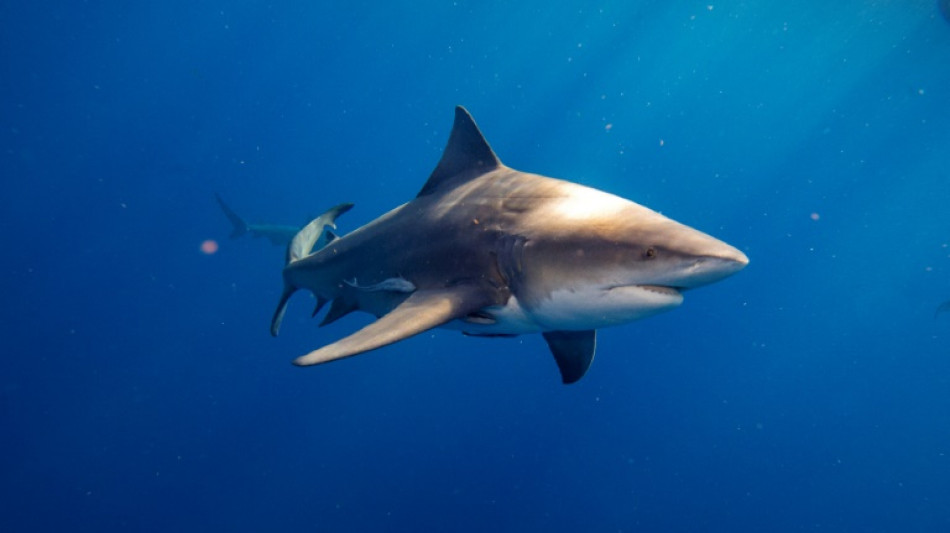
Sharks killed at alarming rates despite regulations: study / Photo: Joseph Prezioso - AFP/File

Sharks killed at alarming rates despite regulations: study

Global shark populations are plummeting despite worldwide efforts to curb mass killings for their fins, researchers said in a new report showing that more needs to be done to protect one of the ocean's apex species.

Text size:

Between 2012 and 2019, the number of sharks killed from fishing increased from some 76 million a year to more than 80 million, they reported in the journal Science.

At least 25 million were threatened species.

Sharks have prowled Earth's waters for 400 million years, but a growing appetite for their fins -- a valuable commodity in Asian markets -- has driven several species to the brink of extinction.

Today, 70 percent of countries and jurisdictions have implemented protective regulations to eliminate shark finning, where the top predators are tossed back into the ocean and left to die once fins are removed.

But some of these rules -- which first emerged in the 1990s -- have had unintended consequences that are costing even more sharks their lives, new data revealed.

Finning has marginally declined over the past two decades, but policies requiring fishers to land whole sharks inadvertently incentivised a market for shark meat.

"Anti-finning measures were not the silver bullet we hoped for," study author Laurenne Schiller told AFP.

Researchers spent three years collecting data on fishery regulations and shark mortality.

They were surprised to learn "how widespread the trade with shark meat, oil and cartilage is, and how sharks are showing up in a lot of products without consumers being aware," said lead author Boris Worm.

- Blood in the water -

Fisheries are now catching smaller sharks, including juveniles, more often, because of the decline in the fin trade and regional declines in the abundance of large sharks.

In hotspots where shark mortality is greatest, researchers found a higher use of gillnets -- walls of netting that hang in the water -- and trawls, which is heavy netting dragged along the ocean floor.

Despite being highly evolved ocean predators, sharks are incredibly vulnerable, Schiller said.

"Sharks have spent over 99% of their time on Earth in an ocean without humans, so in many ways, they were not prepared for us and the impacts of fishing."

As a keystone species, sharks are crucial for keeping oceans healthy.

"When we lose these species, it can throw off the balance of the marine ecosystem", she said.

Today, one in three shark species around the world is threatened with extinction.

On a more positive note, Worm emphasised that many nations and territories have already implemented shark fishing prohibitions and sanctuaries to safeguard one of the world's oldest species.

Implementing shark sanctuaries and no-take protected areas seem to keep shark mortality levels low, according to the study.

Still, the current risks for coastal sharks appear to be escalating globally, a conclusion supported by the International Union for the Conservation of Nature (IUCN).

"We need to take a more targeted approach to reducing shark mortality," Schiller said.

A.Ferraro--NZN