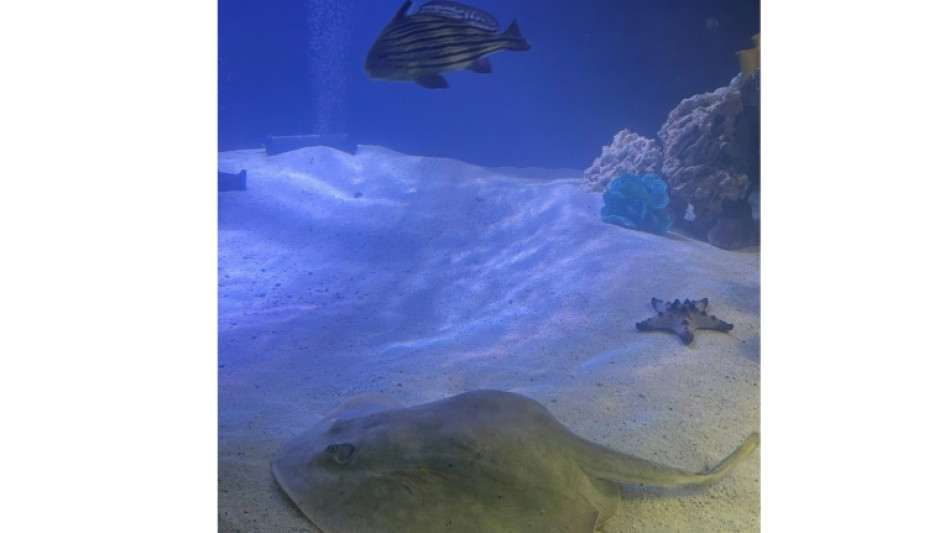
'Virgin' stingray expecting offspring in small-town US aquarium / Photo: HANDOUT - Aquarium & Shark Lab by Team ECCO/AFP
A stingray housed in a small-town aquarium in the United States is expecting offspring without ever having shared a tank with a male of her kind, making her not just a local sensation but a scientific curiosity.
Charlotte, who has been at the Aquarium & Shark Lab in Henderson, North Carolina for more than eight years, started showing an unusual growth on her body around late November. Staff were initially worried she might have a tumor.
"Her hump just started growing and growing, and we thought that it could be potentially cancer," Kinsley Boyette, the aquarium's assistant director and Charlotte's longtime caregiver, told AFP. Such cysts are known to sometimes form in the reproductive organs of rays when they don't mate.
The team performed an ultrasound and sent the results to scientists, who confirmed that Charlotte was carrying eggs. Subsequent scans even revealed tiny flapping tails.
Charlotte, a California round stingray thought to be 12- to 14-years-old, could give birth to her "pups" any day now (such virgin births being exceedingly rare, the gestation period might vary from the normal three to four months).
In any case, anticipation has been building in the local community.
After lengthy renovations, the aquarium reopened on Thursday, "and just about everybody coming through our door wanted to see Miss Charlotte -- it's very, very exciting," said Boyette.
- 'Loves the attention' -
Beyond her unusual pregnancy, Charlotte, who's around the size of a dinner plate and lives alongside five small sharks, charms members of the public with her winsome personality.
"I got in the tank with her this morning and she was just doing laps -- she was doing circles because we had a class here of kiddos and she absolutely loves the attention," said Boyette.
She said Charlotte would come up to the glass if approached and, when her favorite people enter the tank, enjoys cuddles.
She also loves crawfish -- an occasional treat -- along with her regular diet of shrimp, oysters and scallops.
"She's just a silly girl, she's very sweet," Boyette said.
Round stingrays hatch their eggs internally before giving birth to anywhere from one to four pups.
The odds of health issues and death rise in virgin births, experts say.
Charlotte now lives in a 2,200-gallon tank (8,300 liters) -- roughly the size of a small dumpster -- but since she is thought to be carrying up to four offspring, the aquarium hopes to be able to double the size of her tank if all goes well.
- Asexual reproduction -
The ability of breeding species to reproduce without male genetic contributions was long considered exceedingly rare, but in recent years has been documented in many vertebrates including birds, reptiles and fish -- though not mammals.
"To quote Jurassic Park, life finds a way," Bryan Legare, manager of the shark ecology program at the Center for Coastal Studies in Provincetown, Massachusetts told AFP.
Reproductively viable animals prevented from mating in captivity will sometimes undergo a process called parthenogenesis, he explained.
This means that small cells called "polar bodies," formed at the same time as eggs that normally disintegrate, instead go on to re-merge with the egg, providing the genetic material needed to create a viable embryo.
It's not clear how often it happens, Legare added: a case involving sharks or rays in aquariums gets reported every year or two. It may also happen in the wild, though this could not be confirmed without genetic testing.
Scientists note that while sexual reproduction is beneficial for evolution, it comes at the cost of first having to find a mate.
"With parthenogenesis, you see the advantage, you can be single on Valentine's Day," said Legare.
N.Fischer--NZN