Zürcher Nachrichten - World in grip of new major coral bleaching event, reefs at risk

EUR -
AED 4.330938
AFN 77.832669
ALL 96.602299
AMD 448.308258
ANG 2.111018
AOA 1081.405926
ARS 1712.281766
AUD 1.683491
AWG 2.122717
AZN 2.011969
BAM 1.952352
BBD 2.385487
BDT 144.854178
BGN 1.98046
BHD 0.444593
BIF 3523.311312
BMD 1.179287
BND 1.505609
BOB 8.213494
BRL 6.173331
BSD 1.184408
BTN 108.30872
BWP 15.600156
BYN 3.391411
BYR 23114.031108
BZD 2.381993
CAD 1.612735
CDF 2541.363858
CHF 0.917604
CLF 0.025732
CLP 1016.049951
CNY 8.19192
CNH 8.177927
COP 4279.633617
CRC 588.120153
CUC 1.179287
CUP 31.251113
CVE 110.070608
CZK 24.316784
DJF 210.907524
DKK 7.469871
DOP 74.866187
DZD 153.292081
EGP 55.426182
ERN 17.68931
ETB 184.766832
FJD 2.595906
FKP 0.863817
GBP 0.863125
GEL 3.178225
GGP 0.863817
GHS 12.987064
GIP 0.863817
GMD 86.679113
GNF 10400.833668
GTQ 9.08795
GYD 247.792382
HKD 9.214933
HNL 31.289151
HRK 7.535878
HTG 155.34618
HUF 380.604318
IDR 19774.289471
ILS 3.641857
IMP 0.863817
INR 106.493127
IQD 1551.553277
IRR 49677.477759
ISK 145.005151
JEP 0.863817
JMD 186.104935
JOD 0.836112
JPY 183.85502
KES 152.423113
KGS 103.128449
KHR 4772.274622
KMF 492.941585
KPW 1061.343532
KRW 1709.471372
KWD 0.362501
KYD 0.986953
KZT 598.108773
LAK 25471.016518
LBP 105583.598595
LKR 366.770704
LRD 219.701992
LSL 18.962411
LTL 3.482129
LVL 0.713339
LYD 7.482785
MAD 10.800625
MDL 20.051588
MGA 5285.631848
MKD 61.645314
MMK 2476.644764
MNT 4208.203103
MOP 9.528032
MRU 47.067395
MUR 54.117259
MVR 18.220542
MWK 2055.212701
MXN 20.433806
MYR 4.637552
MZN 75.179503
NAD 18.962572
NGN 1643.820395
NIO 43.616812
NOK 11.426404
NPR 173.429011
NZD 1.954946
OMR 0.453443
PAB 1.184408
PEN 3.989155
PGK 5.079035
PHP 69.680557
PKR 331.782131
PLN 4.222208
PYG 7875.092072
QAR 4.329654
RON 5.095662
RSD 117.416885
RUB 90.476221
RWF 1732.876805
SAR 4.422659
SBD 9.502817
SCR 16.389742
SDG 709.342365
SEK 10.551968
SGD 1.498998
SHP 0.884771
SLE 28.863016
SLL 24729.064203
SOS 677.426358
SRD 44.842382
STD 24408.866168
STN 24.476076
SVC 10.363653
SYP 13042.416233
SZL 18.967656
THB 37.188904
TJS 11.062064
TMT 4.139298
TND 3.417065
TOP 2.839441
TRY 51.295343
TTD 8.018906
TWD 37.243063
TZS 3050.273424
UAH 51.045558
UGX 4230.52861
USD 1.179287
UYU 45.948851
UZS 14479.428382
VES 438.270999
VND 30663.828412
VUV 140.969154
WST 3.21511
XAF 655.310907
XAG 0.013545
XAU 0.000239
XCD 3.187083
XCG 2.134521
XDR 0.814972
XOF 654.800579
XPF 119.331742
YER 281.112568
ZAR 18.879387
ZMK 10615.001017
ZMW 23.242951
ZWL 379.73003
  • SCS

    0.0200

    16.14

    +0.12%

  • RBGPF

    0.1000

    82.5

    +0.12%

  • BCC

    0.9400

    81.75

    +1.15%

  • BCE

    -0.0300

    25.83

    -0.12%

  • RIO

    1.4900

    92.52

    +1.61%

  • AZN

    1.3100

    188.41

    +0.7%

  • BTI

    0.3100

    60.99

    +0.51%

  • CMSC

    -0.0100

    23.75

    -0.04%

  • GSK

    0.8700

    52.47

    +1.66%

  • NGG

    -0.6600

    84.61

    -0.78%

  • CMSD

    0.0300

    24.08

    +0.12%

  • RELX

    -0.2700

    35.53

    -0.76%

  • RYCEF

    0.2800

    16.95

    +1.65%

  • JRI

    0.0700

    13.15

    +0.53%

  • VOD

    0.2600

    14.91

    +1.74%

  • BP

    -0.1800

    37.7

    -0.48%

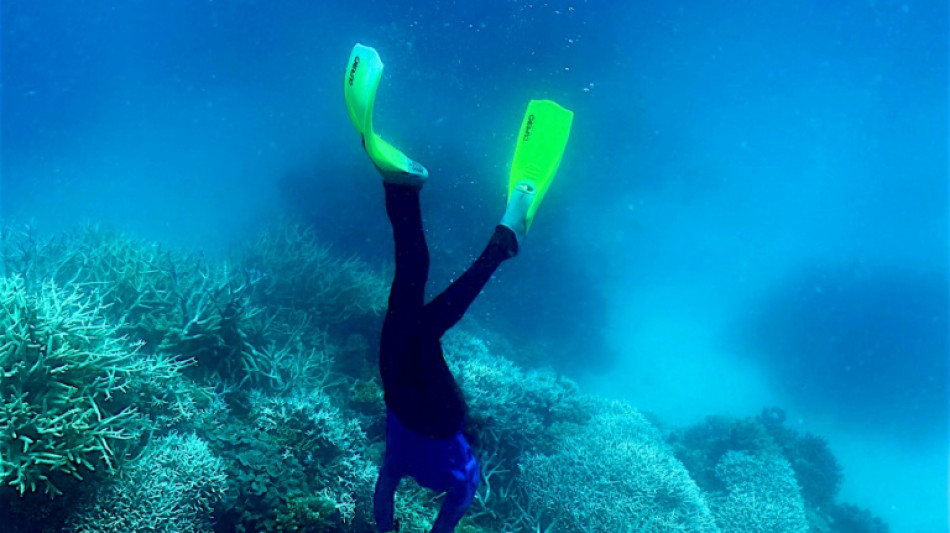
World in grip of new major coral bleaching event, reefs at risk
World in grip of new major coral bleaching event, reefs at risk / Photo: Glenn NICHOLLS - AFP/File

World in grip of new major coral bleaching event, reefs at risk

The world is currently experiencing the second major coral bleaching event in 10 years, with reef systems from Australia to Florida at risk of dying following months of record-breaking ocean heat, a US agency announced Monday.

Text size:

The consequences of coral bleaching are far-reaching, affecting not only the health of oceans but also the livelihoods of people, food security, and local economies.

Severe or prolonged heat stress leads to corals dying off, but there is hope for recovery if temperatures drop and other stressors such as overfishing and pollution are reduced.

"From February 2023 to April 2024, significant coral bleaching has been documented in both the Northern and Southern Hemispheres of each major ocean basin," said Derek Manzello of the US National Oceanic and Atmospheric Administration (NOAA).

NOAA's heat-stress monitoring is based on satellite measurements from 1985 to the present day. The current bleaching event is the fourth on record, with previous events in 1998, 2010 and 2016.

Since early 2023, mass bleaching of coral reefs has been confirmed throughout the tropics, including in Florida in the United States, the Caribbean, Brazil, and the eastern Tropical Pacific.

Australia’s Great Barrier Reef, the largest coral reef system in the world and the only one visible from space, has also been severely impacted, as have wide swathes of the South Pacific, the Red Sea and the Gulf.

"We know the biggest threat to coral reefs worldwide is climate change. The Great Barrier Reef is no exception," Australia's Environment Minister Tanya Plibersek said last month.

- 'More frequent and severe' -

Repeated mass bleaching events have threatened to rob the tourist drawcard of its wonder, turning banks of once-vibrant corals into a sickly shade of white.

Coral, marine invertebrates made up of individual animals called polyps, have a symbiotic relationship with the algae that live inside their tissue and provide their primary source of food.

When the water is too warm, coral expel their algae and turn white, an effect called "bleaching" that leaves them exposed to disease and at risk of dying off.

"As the world's oceans continue to warm, coral bleaching is becoming more frequent and severe," Manzello said.

"When these events are sufficiently severe or prolonged, they can cause coral mortality, which hurts the people who depend on the coral reefs for their livelihoods."

Pepe Clarke of the nonprofit WWF added: "If we need a specific, visual, contemporary case of what's at stake with every fraction of a degree warming, this is it. The scale and severity of the mass coral bleaching is clear evidence of the harm climate change is having right now."

A.Ferraro--NZN