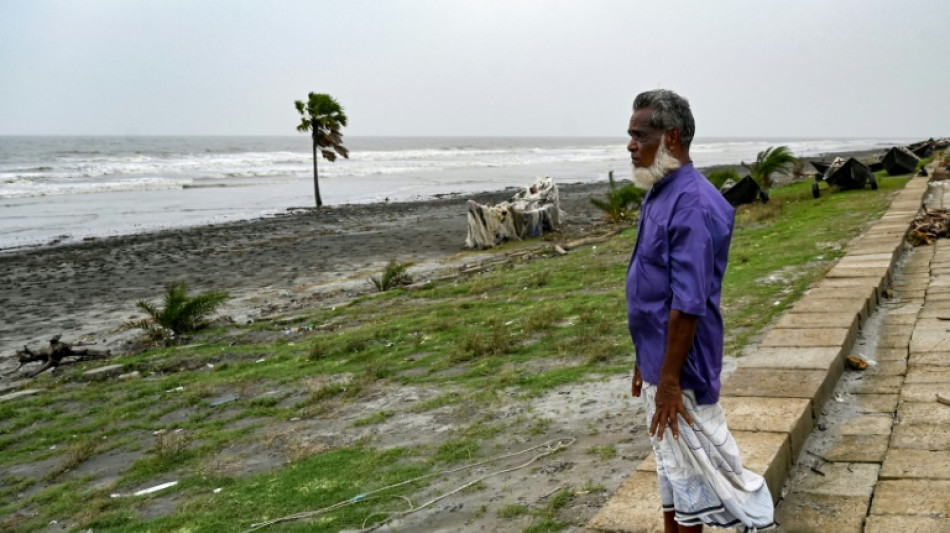
Sea swamps Bangladesh at one of world's fastest rates / Photo: Munir UZ ZAMAN - AFP
After cyclone gales tore down his home in 2007, Bangladeshi fisherman Abdul Aziz packed up what was left of his belongings and moved about half a kilometre inland, further away from storm surge waves.
A year later, the sea swallowed the area where his old home had been.
Now, 75-year-old Aziz fishes above his submerged former home and lives on the other side of a low earth and concrete embankment, against which roaring waves crash.
"The fish are swimming there in the water on my land", he told AFP, pointing towards his vanished village. "It is part of the advancing ocean."
Government scientists say rising seas driven by climate change are drowning Bangladesh's densely populated coast at one of the fastest global rates, and at least a million people on the coast will be forced to relocate within a generation.
"Few countries experience the far-reaching and diverse effects of climate change as intensely as Bangladesh," Abdul Hamid, director general of the environment department, wrote in a report last month.
The three-part study calculated the low-lying South Asian nation was experiencing a sea level rise in places more than 60 percent higher than the global average.
By 2050, at present rates of local sea level rise, "more than one million people may have to be displaced", it read, based on a quarter of a century of satellite data from the US space agency NASA and its Chinese counterpart CNSA.
- 'Closing in' -
Sea levels are not rising at the same rate around the world, due chiefly to Earth's uneven gravity field and variations in ocean dynamics.
Study lead A.K.M Saiful Islam said Bangladesh's above-average increases were driven by melting ice caps, water volumes increasing as oceans warm, and the vast amounts of river water that flow into the Bay of Bengal every monsoon.
The study provides "a clear message" that policymakers should be prepared for "mitigation and adaptation", he said.
Islam, a member of the UN's IPCC climate change assessment body, examined the vast deltas where the mighty Himalayan rivers of the Ganges and Brahmaputra reach the sea.
"In recent decades, the sea level rose 3.7 millimetres (0.14 inches) each year globally," Islam added.
"In our study, we saw that the sea level rise is higher along our coast... 4.2 millimetres to 5.8 millimetres annually."
That incremental rise might sound tiny. But those among the estimated 20 million people living along Bangladesh's coast say the destruction comes in terrifying waves.
"It is closing in," said fisherman Aziz about the approaching sea. "Where else can we escape?"
- 'Bodies can't endure this' -
The threat is increasing.
Most of the country's coastal areas are a metre or two above sea level, and storms bring seawater further inland, turning wells and lakes salty and killing crops on once fertile land.
"When the surge is higher, the seawater intrudes into our houses and land," said Ismail Howladar, a 65-year-old farmer growing chilli peppers, sweet potatoes, sunflowers and rice.
"It brings only loss for us."
Cyclones -- which have killed hundreds of thousands of people in Bangladesh in recent decades -- are becoming more frequent as well as growing in intensity and duration due to the impact of climate change, scientists say.
Shahjalal Mia, a 63-year-old restaurant owner, said he watches the sea "grasp more land" each year.
"Many people have lost their homes to the sea already," he said. "If there is no beach, there won't be any tourists."
He said he had experienced cyclones and searing heatwaves grow worse, with temperatures soaring above 40 degrees Celsius (104 Fahrenheit).
"We are facing two, three, even four cyclones every year now," he said.
"And I can't measure temperatures in degrees but, simply put, our bodies can't endure this".
-'Too late' -
Bangladesh is among the countries ranked most vulnerable to disasters and climate change, according to the Global Climate Risk Index.
In April, the nation of around 170 million people experienced the hottest month, and the most sustained heatwave temperatures, in its history.
Last month, a cyclone that killed at least 17 people and destroyed 35,000 homes, was one of the quickest-forming and longest-lasting seen, the government's meteorological department said.
Both events were pinned on rising global temperatures.
Ainun Nishat, from Brac University in the capital Dhaka, said that the poorest were paying the price for carbon emissions from wealthier nations.
"We cannot do anything for Bangladesh if other nations, notably rich countries, do not do anything to fight emissions," he said.
Bangladesh is running out of time, Nishat added.
"It is becoming too late to prevent disasters," he said. "We are unequipped to bring change."
S.Scheidegger--NZN