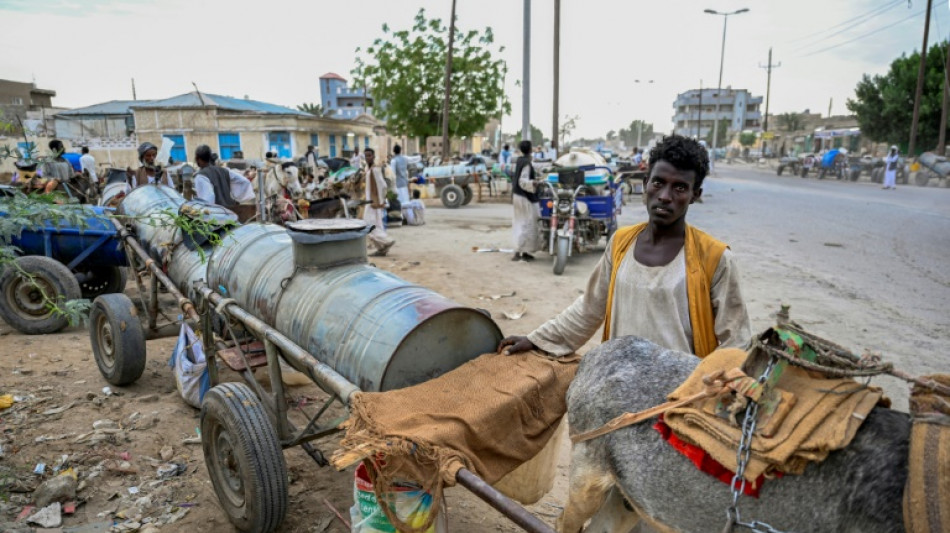
Water crisis batters war-torn Sudan as temperatures soar / Photo: - - AFP/File
War, climate change and man-made shortages have brought Sudan -- a nation already facing a litany of horrors -- to the shores of a water crisis.
"Since the war began, two of my children have walked 14 kilometres (nine miles) every day to get water for the family," Issa, a father of seven, told AFP from North Darfur state.
In the blistering sun, as temperatures climb past 40 degrees Celsius (104 degrees Fahrenheit), Issa's family -- along with 65,000 other residents of the Sortoni displacement camp -- suffer the weight of the war between Sudan's army and the paramilitary Rapid Support Forces (RSF).
When the first shots rang out more than a year ago, most foreign aid groups -- including the one operating Sortoni's local water station -- could no longer operate. Residents were left to fend for themselves.
The country at large, despite its many water sources including the mighty Nile River, is no stranger to water scarcity.
Even before the war, a quarter of the population had to walk more than 50 minutes to fetch water, according to the United Nations.
Now, from the western deserts of Darfur, through the fertile Nile Valley and all the way to the Red Sea coast, a water crisis has hit 48 million war-weary Sudanese who the US ambassador to the United Nations on Friday said are already facing "the largest humanitarian crisis on the face of the planet."
- No fuel, no water -
Around 110 kilometres east of Sortoni, deadly clashes in North Darfur's capital of El-Fasher, besieged by RSF, threaten water access for more than 800,000 civilians.
Medical charity Doctors Without Borders (MSF) on Friday said fighting in El-Fasher had killed at least 226.
Just outside the city, fighting over the Golo water reservoir "risks cutting off safe and adequate water for about 270,000 people", the UN children's agency UNICEF has warned.
Access to water and other scarce resources has long been a source of conflict in Sudan.
The UN Security Council on Thursday demanded that the siege of El-Fasher end.
If it goes on, hundreds of thousands more people who rely on the area's groundwater will go without.
"The water is there, but it's more than 60 metres (66 yards) deep, deeper than a hand-pump can go," according to a European diplomat with years of experience in Sudan's water sector.
"If the RSF doesn't allow fuel to go in, the water stations will stop working," he told AFP, requesting anonymity because the diplomat was not authorised to speak to media.
"For a large part of the population, there will simply be no water."
Already in the nearby village of Shaqra, where 40,000 people have sought shelter, "people stand in lines 300 metres long to get drinking water," said Adam Rijal, spokesperson for the civilian-led General Coordination for Displaced Persons and Refugees in Darfur.
In photos he sent to AFP, some women and children can be seen huddled under the shade of lonely acacia trees, while most swelter in the blazing sun, waiting their turn.
- Dirty water -
Sudan is hard-hit by climate change, and "you see it most clearly in the increase in temperature and rainfall intensity," the diplomat said.
This summer, the mercury is expected to continue rising until the rainy season hits in August, bringing with it torrential floods that kill dozens every year.
The capital Khartoum sits at the legendary meeting point of the Blue Nile and White Nile rivers -- yet its people are parched.
The Soba water station, which supplies water to much of the capital, "has been out of service since the war began," said a volunteer from the local resistance committee, one of hundreds of grassroots groups coordinating wartime aid.
People have since been buying untreated "water off of animal-drawn carts, which they can hardly afford and exposes them to diseases," he told AFP, requesting anonymity for fear of reprisal.
Entire neighbourhoods of Khartoum North "have gone without drinking water for a year," another local volunteer told AFP, requesting to be identified only by his first name, Salah.
"People wanted to stay in their homes, even through the fighting, but they couldn't last without water," Salah said.
- Parched and displaced -
Hundreds of thousands have fled the fighting eastward, many to the de facto capital of Port Sudan on the Red Sea -- itself facing a "huge water issue" that will only get "worse in the summer months," resident al-Sadek Hussein worries.
The city depends on only one inadequate reservoir for its water supply.
Here, too, citizens rely on horse- and donkey-drawn carts to deliver water, using "tools that need to be monitored and controlled to prevent contamination," public health expert Taha Taher told AFP.
"But with all the displacement, of course this doesn't happen," he said.
Between April 2023 and March 2024, the health ministry recorded nearly 11,000 cases of cholera -- a disease endemic to Sudan, "but not like this" when it has become "year-round," the European diplomat said.
The outbreak comes with the majority of Sudan's hospitals shut down and the United States warning on Friday that a famine of historic global proportions could unfold without urgent action.
"Health care has collapsed, people are drinking dirty water, they are hungry and will get hungrier, which will kill many, many more," the diplomat said.
J.Hasler--NZN