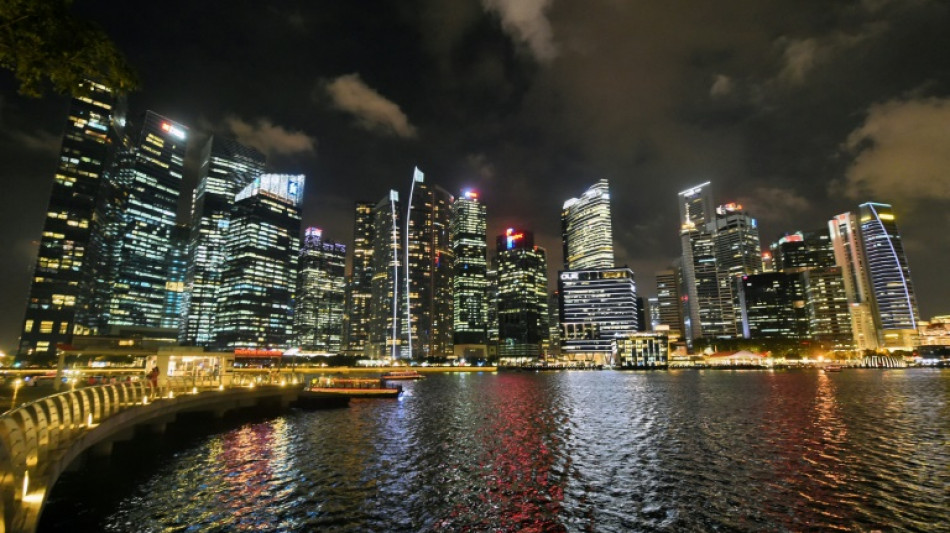
Energy-hungry Singapore eyes deserts, forest for renewables / Photo: ROSLAN RAHMAN - AFP
With huge data centres set to drive up already outsized energy demand, the tiny city-state of Singapore is looking to Australia's deserts and Malaysia's rainforests for clean power.
This week Australia announced a massive solar farm that it hopes will eventually offer two gigawatts (GW) of power to Singapore via undersea cable.
Singapore aims to peak carbon emissions by 2030 and reach net zero by 2050, but it relies heavily on imported oil and gas.
The city lacks the conditions to produce either wind or hydropower, and while it aims to generate two gigawatts from locally installed solar by 2030, it does not have space for large solar farms.
Demand, meanwhile, is only set to rise, particularly from data centres, which already account for seven percent of Singapore's electricity consumption.
That is projected to grow to 12 percent by 2030.
To meet that demand, Singapore's Energy Market Authority has already granted conditional approvals to import 1GW from Cambodia, 2GW from Indonesia and 1.2GW from Vietnam.
Those are from a mix of solar, wind and hydropower, a popular but sometimes controversial energy source in the region, where it has been associated with deforestation and environmental degradation linked to dams.
- 'Many challenges' -
Renewable imports are expected to account for at least 30 percent of Singapore's electricity by 2035, according to think tank Ember.
But there are "many challenges", warned Niels de Boer, chief operating officer at Nanyang Energy Research Institute, including transmission distances, energy losses and intermittency.
The plans envisage 4,300 kilometres (2,670 miles) of undersea cable and the project still needs sign-offs from Singapore's energy regulators, Indonesia's government and Australian Indigenous communities.
The city-state is already seeing some of those play out in complications over hydropower transmission from Laos via Thailand and Malaysia, said Ong Shu Yi, ESG research analyst at banking group OCBC in Singapore.
There can be "disagreements over how the energy will be transmitted through different countries, as well as competition among economies for access to renewable energy".
Singapore currently relies on imported fossil fuel, but that can be purchased on the open market.
"A large-scale bilateral agreement for renewable energy imports limits Singapore's strategic flexibility," said Zhong Sheng, senior research fellow at the National University of Singapore's Energy Studies Institute.
In cases of disruption, "there may be few alternative renewable sources to compensate".
That makes it key for Singapore to diversify its sources of renewable energy.
"The more one can diversify the better in terms of energy security," said Euston Quah, director of the Economic Growth Centre at Nanyang Technological University in Singapore.
"Having this additional Australian source of energy supply can only be a good thing."
Singapore can also mitigate risk by involving regional bodies like ASEAN, experts said.
- 'Global trend' -
The city is in some ways unique, with an increasingly high power demand that is five times the regional average.
But it is far from alone in looking abroad to meet its needs, said Bradford Simmons, senior director for energy, climate and resources at Bower Group Asia.
Thailand already imports 12 percent of its electricity, generated from coal and hydropower, according to the International Energy Agency.
The "mismatch" between countries that can produce renewable energy and those with huge demand "will only accelerate the incentives for international electricity trade", Simmons said.
"Singapore is merely part of a broader global trend."
Demand from Singapore also holds promise for the region's "massive untapped renewable energy" potential, said Dinita Setyawati, senior Southeast Asia electricity policy analyst at Ember.
It could "drive a clean energy transition in the region and pump up heightened renewable energy ambitions", she told AFP.
Officials from Laos to Malaysia's Sarawak region specifically reference Singapore's demand when discussing plans to bolster renewable generation.
And the city-state's appetites and financial resources could help cut through obstacles, said Zhong.
"The urgency and scale of efforts are often influenced by domestic policies, resource endowments, financial capabilities, and technological capabilities," he told AFP.
"Singapore's leadership in this area could inspire more coordinated regional efforts in low-carbon energy transition."
L.Rossi--NZN