China's solar sector blazes trail in commitment to renewables / Photo: GREG BAKER - AFP
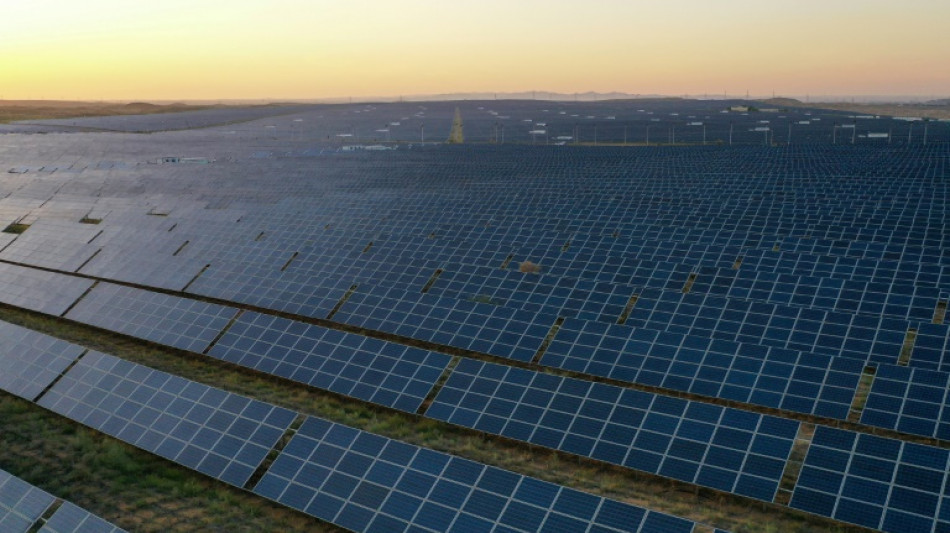
Hundreds of rows of gleaming panels blanket swathes of scrubby sand at sunset in a remote northern Chinese desert -- once the biggest solar farm in the world.
On the edge of the forbidding Tengger desert, the solar park produces 1.5 gigawatts of power -- but it has since been eclipsed and the largest is now further west with more than double the capacity.
China, the world's biggest emitter of greenhouse gases, is building almost twice as much wind and solar capacity as every other country combined.
Last week, its wind and solar capacity overshot a target set by President Xi Jinping nearly six years ahead of schedule.
The vast solar arrays in the Ningxia region are a testament to a state-led industrial policy that has driven that breakneck growth.
South of the regional capital Yinchuan, huge lorries roar down a highway flanked by photovoltaic panels and wind turbines stretching to the horizon.
Ningxia, like much of China's northwest, is sparsely populated and sun-soaked, pockmarked with small farms, vineyards and hulking power stations.
This geography makes it a prime location for generating solar power, which is then sent to China's eastern and southern provinces where electricity demand is highest.
"China's solar energy is developing at an unprecedented pace and scale," said analyst Wu Di from Peking University's Institute of Energy.
The country increased its installed solar capacity by more than 55 percent last year, according to the National Energy Administration.
China now accounts for over 40 percent of the total installed capacity worldwide, said Wu.
- 'Need for coal waning' -
Beijing aims to bring emissions of planet-heating carbon dioxide to a peak by 2030 and to net zero by 2060, part of its commitments under the Paris climate accord that seeks to limit global warming to 1.5 degrees Celsius above pre-industrial levels.
"Carbon can't peak unless incremental consumption demand is covered entirely by incremental growth in clean energy," said David Fishman, a senior manager at the Lantau Group specialising in China's power sector.
"Incremental solar capacity growth is an important part of making sure all power demand growth is met by clean sources."
The government only permitted around nine gigawatts of new coal power in the first half of 2024, a year-on-year reduction of 83 percent, according to a report published this month by the Centre for Research on Energy and Clean Air.
"With new renewable energy installations now capable of meeting all incremental power demand in China, the need for new coal is waning," the Finland-based independent research group said.
But it also warned that construction continued on existing coal projects, potentially slowing Beijing's energy transition.
- Industry shake-out -
The blistering pace at which extra solar capacity has been added has not quite been matched by developments in the power grid, causing some energy to be lost -- a phenomenon known as curtailment.
In May, Fitch Ratings said this could continue to rise in the near term, with the solar curtailment rate for the first quarter of 2024 increasing to four percent.
"In the future, in order to control the solar curtailment ratio within a reasonable range, China still has lots of work to do," said Wu.
Transferring power from west to east is also "not the most cost-effective approach", said Gao Yuhe from environmental group Greenpeace East Asia.
Besides the behemothic parks in the north, China's solar revolution has also relied on distributed solar energy -- smaller panels set onto rooftops in residential and commercial areas, which reduce transmission losses.
But even this smaller-scale infrastructure needs upgrading to cope with recent increased capacity, said Wu.
Long backed by generous government subsidies, China's domestic solar-panel industry is struggling with a global oversupply crisis that has driven down prices and pushed some firms into bankruptcy.
Fishman, of the Lantau Group, said the intense competition "is good news for builders, who continue to benefit from the cheapest panels the world has ever seen".
"Once a few of them go toes-up because they can't endure the competition, the market should stabilise," he added.
Chinese subsidies have also created friction with global trading partners, with the EU launching an investigation to discern whether the subsidies have helped homegrown firms undercut European rivals.
Beijing denies that its industrial policies are unfair and has initiated a series of probes into European imports in apparent retaliation.
I.Widmer--NZN