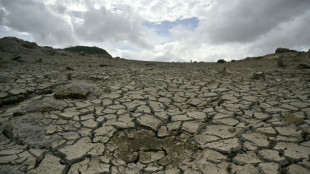
June-August 2024 were hottest ever recorded: EU monitor / Photo: ETIENNE LAURENT - AFP
The 2024 northern summer saw the highest global temperatures ever recorded, beating last year's record and making this year likely Earth's hottest ever, the EU's climate monitor said Friday.
The data from the Copernicus Climate Change Service followed a season of heatwaves around the world that scientists said were intensified by human-driven climate change.
"During the past three months of 2024, the globe has experienced the hottest June and August, the hottest day on record, and the hottest boreal summer on record," Samantha Burgess, deputy director of Copernicus, said in a report.
"This string of record temperatures is increasing the likelihood of 2024 being the hottest year on record."
The average global temperature at the Earth's surface was 16.82C in August, according to Copernicus, which draws on billions of measurements from satellites, ships, aircraft and weather stations.
The June and August global temperature broke through the level of 1.5C above the pre-industrial average -- a key threshold for limiting the worst effects of climate change.
Human-caused greenhouse gas emissions are warming the planet, raising the likelihood and intensity of climate disasters such as droughts, fires and floods.
Heat was exacerbated in 2023 and early 2024 by the cyclical weather phenomenon El Nino, though Copernicus scientist Julien Nicolas told AFP its effects were not as strong as they sometimes are.
Meanwhile the contrary cyclical cooling phenomenon, known as La Nina, has not yet started, he said.
- Emissions reductions -
Against the global trend, regions such as Alaska, the eastern United States, parts of South America, Pakistan and the Sahel desert zone in northern Africa had lower than average temperatures in August, the report said.
But others such as Australia -- where it was winter -- parts of China, Japan and Spain experienced record warmth in August.
Globally, August 2024 matched that month's previous global temperature record from one year earlier, while this June was hotter than last, Copernicus data in the report showed.
July was slightly hotter in 2023 than this year, but on average the three-month period broke the record in 2024.
Governments have targets to reduce their countries' planet-heating emissions to try to keep the rise below 1.5C under the 2015 Paris Agreement.
Scientists will not consider that threshold to be definitively passed until it has been observed being breached over several decades. The average level of warming is currently about 1.2C, according to the World Meteorological Organisation.
Copernicus said the 1.5C level has been passed in 13 of the past 14 months.
- Wildfires, hurricanes -
The oceans are also heating to record levels, raising the risk of more intense storms.
Copernicus said that outside of the poles, the average sea surface temperature in August was just under 21C, the second-highest level on record for that month.
It said August "was drier than average over most of continental Europe" -- noting the wildfires that struck countries such as Greece.
But places such as western Russia and Turkey were wetter than normal, with floods in some places.
The eastern United States had more rain than usual, including areas lashed by Hurricane Debby.
"The temperature-related extreme events witnessed this summer will only become more intense, with more devastating consequences for people and the planet unless we take urgent action to reduce greenhouse gas emissions," Copernicus's deputy director Burgess said.
Some researchers say that emissions in some of the biggest countries may have peaked or will soon do so, partly as a result of the drive towards low-carbon energy.
H.Roth--NZN