Zürcher Nachrichten - Chinese rover finds signs of ancient ocean on Mars

EUR -
AED 4.320028
AFN 77.928084
ALL 96.687666
AMD 448.756226
ANG 2.106084
AOA 1078.684404
ARS 1707.727186
AUD 1.767836
AWG 2.120313
AZN 1.99668
BAM 1.960338
BBD 2.368683
BDT 143.712693
BGN 1.955745
BHD 0.443478
BIF 3474.521948
BMD 1.176318
BND 1.517468
BOB 8.143333
BRL 6.513252
BSD 1.176022
BTN 105.434944
BWP 15.510919
BYN 3.420517
BYR 23055.835989
BZD 2.365205
CAD 1.61652
CDF 3009.613322
CHF 0.932109
CLF 0.027265
CLP 1069.520366
CNY 8.282397
CNH 8.271776
COP 4495.288096
CRC 586.239695
CUC 1.176318
CUP 31.172431
CVE 110.520854
CZK 24.31926
DJF 209.418571
DKK 7.468215
DOP 73.600384
DZD 152.590849
EGP 55.835473
ERN 17.644772
ETB 182.262816
FJD 2.690651
FKP 0.882373
GBP 0.874175
GEL 3.158405
GGP 0.882373
GHS 13.436706
GIP 0.882373
GMD 85.871073
GNF 10280.799931
GTQ 9.011325
GYD 246.042264
HKD 9.150655
HNL 30.999764
HRK 7.535512
HTG 153.981885
HUF 388.511425
IDR 19729.090593
ILS 3.770894
IMP 0.882373
INR 105.344055
IQD 1540.666625
IRR 49522.99459
ISK 147.604497
JEP 0.882373
JMD 187.714557
JOD 0.834032
JPY 184.697835
KES 151.652879
KGS 102.868451
KHR 4717.620449
KMF 494.054045
KPW 1058.68631
KRW 1740.721521
KWD 0.361595
KYD 0.98004
KZT 606.425825
LAK 25473.21226
LBP 105310.57833
LKR 364.102059
LRD 208.14859
LSL 19.643775
LTL 3.473362
LVL 0.711543
LYD 6.381556
MAD 10.766123
MDL 19.9105
MGA 5298.107417
MKD 61.620122
MMK 2470.635456
MNT 4177.368481
MOP 9.424136
MRU 46.877521
MUR 54.310303
MVR 18.173692
MWK 2039.190687
MXN 21.141202
MYR 4.79701
MZN 75.173363
NAD 19.643775
NGN 1716.247918
NIO 43.277981
NOK 11.887854
NPR 168.689759
NZD 2.028261
OMR 0.4523
PAB 1.176048
PEN 3.960468
PGK 5.003583
PHP 69.092249
PKR 329.437542
PLN 4.21803
PYG 7946.395813
QAR 4.298752
RON 5.088394
RSD 117.390647
RUB 92.537782
RWF 1712.739289
SAR 4.411456
SBD 9.583169
SCR 16.378651
SDG 707.55429
SEK 10.847665
SGD 1.515809
SHP 0.882543
SLE 28.29024
SLL 24666.808023
SOS 670.910374
SRD 45.178263
STD 24347.410991
STN 24.556849
SVC 10.290823
SYP 13008.17495
SZL 19.637877
THB 36.629991
TJS 10.819525
TMT 4.117114
TND 3.440064
TOP 2.832292
TRY 50.367873
TTD 7.995271
TWD 37.047549
TZS 2924.304577
UAH 49.502598
UGX 4237.810481
USD 1.176318
UYU 46.096713
UZS 14108.661385
VES 331.909521
VND 30984.220406
VUV 141.867944
WST 3.279358
XAF 657.459449
XAG 0.017116
XAU 0.000266
XCD 3.179059
XCG 2.119544
XDR 0.818516
XOF 657.479056
XPF 119.331742
YER 280.434128
ZAR 19.632756
ZMK 10588.278855
ZMW 26.577833
ZWL 378.773968
  • SCS

    0.0200

    16.14

    +0.12%

  • CMSC

    0.0300

    23.2

    +0.13%

  • BCC

    -0.0900

    74.68

    -0.12%

  • NGG

    0.1200

    76.23

    +0.16%

  • CMSD

    0.0650

    23.315

    +0.28%

  • BCE

    -0.1750

    22.665

    -0.77%

  • GSK

    0.0000

    48.61

    0%

  • RIO

    1.8500

    80.17

    +2.31%

  • JRI

    -0.0700

    13.31

    -0.53%

  • AZN

    0.3610

    91.721

    +0.39%

  • RYCEF

    -0.1100

    15.5

    -0.71%

  • BTI

    0.3800

    56.83

    +0.67%

  • RBGPF

    0.7800

    81

    +0.96%

  • VOD

    0.0400

    12.88

    +0.31%

  • RELX

    0.2750

    41.005

    +0.67%

  • BP

    0.4750

    34.415

    +1.38%

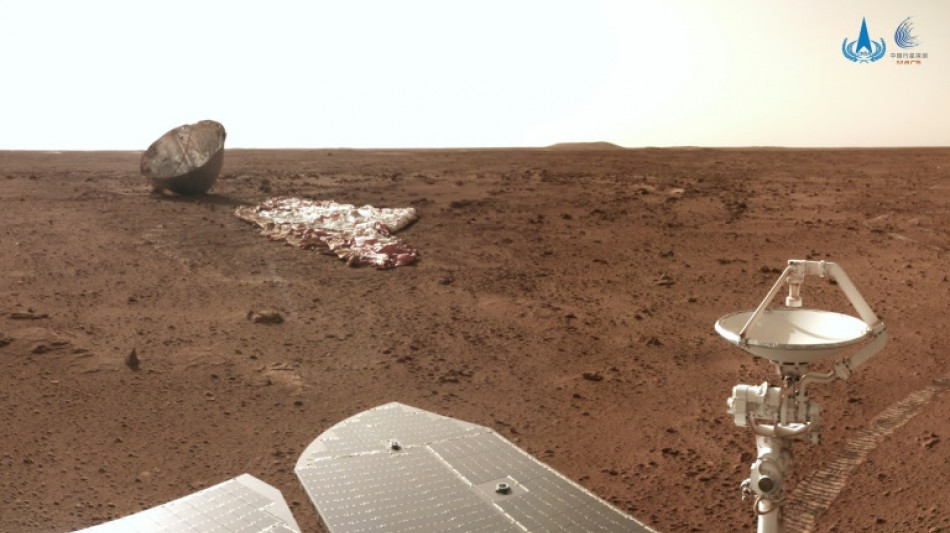
Chinese rover finds signs of ancient ocean on Mars
Chinese rover finds signs of ancient ocean on Mars / Photo: HANDOUT - China National Space Administration (CNSA)/AFP/File

Chinese rover finds signs of ancient ocean on Mars

A Chinese rover has found new evidence to support the theory that Mars was once home to a vast ocean, including tracing some ancient coastline where water may once have lapped, a study said Thursday.

Text size:

The theory that an ocean covered as much as a third of the Red Planet billions of years ago has been a matter of debate between scientists for decades, and one outside researcher expressed some scepticism about the latest findings.

In 2021, China's Zhurong rover landed on a plain in the Martian northern hemisphere's Utopia region, where previous indications of ancient water had been spotted.

It has been probing the red surface ever since, and some new findings from the mission were revealed in the new study in the journal Nature.

Lead study author Bo Wu of The Hong Kong Polytechnic University told AFP that a variety of features suggesting a past ocean had been spotted around Zhurong's landing area, including "pitted cones, polygonal troughs and etched flows".

Previous research has suggested that the crater-like pitted cones could have come from mud volcanoes, and often formed in areas where there had been water or ice.

Information from the rover, as well as satellite data and analysis back on Earth, also suggested that a shoreline was once near the area, according to the study.

The team of researchers estimated that the ocean was created by flooding nearly 3.7 billion years ago.

Then the ocean froze, etching out a coastline, before disappearing a little 3.4 billion ago, according to their scenario.

Bo emphasised that the team does "not claim that our findings definitively prove that there was an ocean on Mars".

That level of certainty will likely require a mission to bring back some Martian rocks to Earth for a closer look.

- The coast is always changing -

Benjamin Cardenas, a scientist who has analysed other evidence of a Martian ocean, told AFP he was "sceptical" of the new study.

He felt the researchers did not take enough into account how much the strong Martian wind had blown around sediment and worn down rocks over the past few billion years.

"We tend to think of Mars of being not very active, like the Moon, but it is active!" said Cardenas of Pennsylvania State University in the United States.

He pointed to past modelling research which suggested that "even the slow Martian erosion rates" would destroy signs of a shoreline over such a long period.

Bo acknowledged that wind might have worn down some rocks, but said the impact of meteors hitting Mars can also "excavate underground rock and sediment to the surface from time to time".

While the overall theory remains contentious, Cardenas said he tended "to think there was an ocean on Mars".

Finding out the truth could help unravel a greater mystery: whether Earth is alone in the Solar System in being capable of hosting life.

"Most scientists think life on Earth sprung up either under the ocean where hot gases and minerals from the subsurface came to the seafloor, or very close to the interface of water and air, in little tidal pools," Cardenas said.

"So, evidence for an ocean makes the planet appear more hospitable."

O.Krasniqi--NZN