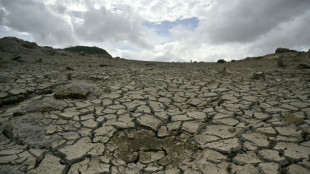
Scientists struggle to explain record surge in global heat / Photo: MARIO TAMA - GETTY IMAGES NORTH AMERICA/AFP
The world has been getting hotter for decades but a sudden and extraordinary surge in heat has sent the climate deeper into uncharted territory -- and scientists are still trying to figure out why.
Over the past two years, temperature records have been repeatedly shattered by a streak so persistent and puzzling it has tested the best-available scientific predictions about how the climate functions.
Scientists are unanimous that burning fossil fuels has largely driven long-term global warming, and that natural climate variability can also influence temperatures one year to the next.
But they are still debating what might have contributed to this particularly exceptional heat surge.
Experts think changes in cloud patterns, airborne pollution, and Earth's ability to store carbon could be factors, but it would take another year or two for a clearer picture to emerge.
"Warming in 2023 was head-and-shoulders above any other year, and 2024 will be as well," said Gavin Schmidt, director of the NASA Goddard Institute for Space Studies, in November.
"I wish I knew why, but I don't," he added.
"We're still in the process of assessing what happened and if we are seeing a shift in how the climate system operates."
- 'Uncharted territory' -
When burned, fossil fuels emit greenhouse gases like carbon dioxide that trap heat near the Earth's surface.
As fossil fuel emissions have risen to record highs in 2023, average sea surface and air temperatures have curved upwards in a consistent, decades-long warming trend.
But in an unprecedented streak between June 2023 and September 2024, global temperatures were unlike anything seen before, said the World Meteorological Organization -- and sometimes by a considerable margin.
The heat was so extreme it was enough to make 2023 -- and then 2024 -- the hottest years in history.
"The record global warmth of the past two years has sent the planet well into uncharted territory," Richard Allan, a climate scientist from the UK's University of Reading, told AFP.
What occurred was "at the limit of what we would expect based on existing climate models", Sonia Seneviratne, a climatologist from ETH Zurich in Switzerland, told AFP.
"But the overall long-term warming tendency is not unexpected" given the amount of fossil fuels being burned, she added.
- 'Difficult to explain' -
Scientists said that climate variability could go some way to explaining what happened.
2023 was preceded by a rare, three-year La Nina phenomenon that had a strong cooling effect on the planet by pushing excess heat into the deep oceans.
This energy was released back to the surface when an opposite, warming El Nino event took over in mid-2023, boosting global temperatures.
But the heat has lingered even after El Nino peaked in January.
Temperatures have not fallen as fast as they rose, and November was still the second-warmest on record.
"It is difficult to explain this at the moment," said Robert Vautard, a member of the UN's climate expert panel IPCC. "We lack a bit of perspective.
"If temperatures do not drop more sharply in 2025, we will really have to ask ourselves questions about the cause," he told AFP.
- Jury out -
Scientists are looking for clues elsewhere.
One theory is that a global shift to cleaner shipping fuels in 2020 accelerated warming by reducing sulphur emissions that make clouds more mirror-like and reflective of sunlight.
In December, another peer-reviewed paper looked at whether a reduction in low-lying clouds had let more heat reach Earth's surface.
At the American Geophysical Union conference this month, Schmidt convened scientists to explore these theories and others, including whether solar cycles or volcanic activity offered any hints.
There are concerns that without a more complete picture, scientists could be missing even more profound and transformational shifts in the climate.
"We cannot exclude that some other factors also further amplified the temperatures... the verdict is still out," said Seneviratne.
Scientists this year warned that Earth's carbon sinks -- such as the forests and oceans that suck CO2 from the atmosphere -- had suffered an "unprecedented weakening" in 2023.
This month, the US National Oceanic and Atmospheric Administration said the Arctic tundra, after locking away C02 for millennia, was becoming a net source of emissions.
Oceans, which have acted as a massive carbon sink and climate regulator, were warming at a rate scientists "cannot fully explain", said Johan Rockstrom of the Potsdam Institute for Climate Impact Research.
"Could this be a first sign of a planet starting to show a loss of resilience? We cannot exclude it," he said last month.
P.E.Steiner--NZN