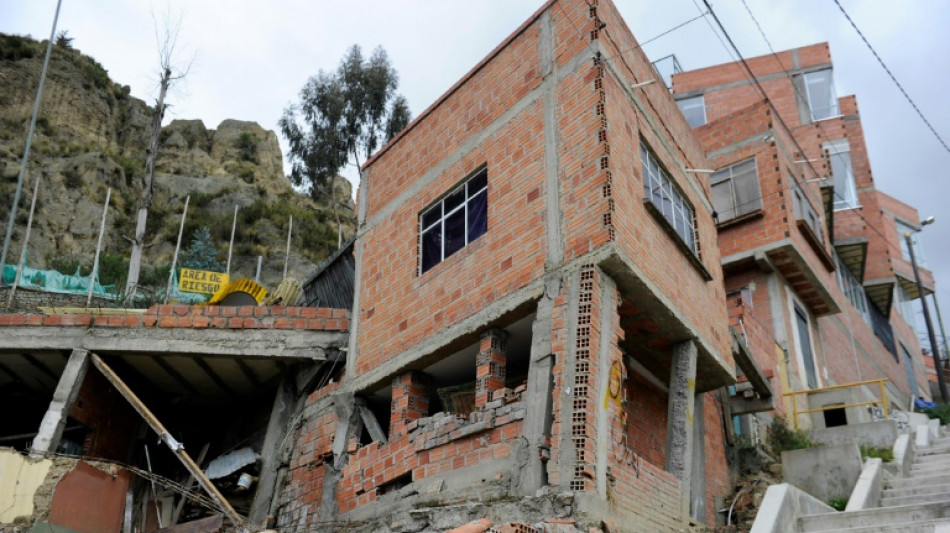
'Afraid to live here': urban Bolivia's death-defying homes / Photo: JORGE BERNAL - AFP
Bolivian shopkeeper Cristobal Quispe's humble brick home teeters precariously on the slope of an unstable hillside in La Paz, near the edge of a collapsed road.
The landscape around him is littered with the debris left behind after hundreds of structures were swept away by a mudslide in 2011, including his former house.
Quispe, 74, built a new home not far from where his original had stood.
The abode looks out on half of a park where children used to play. The other half disappeared as the landscape it was built on shifted.
Every year now during the rainy season from November to March, Quispe watches the skies over the world's highest city with trepidation.
"We are afraid to live here. When it rains... there can be a mudslide," Quispe told AFP of life in the Valle de las Flores neighborhood, whose impoverished residents mainly belong to the Aymara Indigenous group.
Despite the municipality declaring the area a perilous "red zone," Quispe and others say they have no choice but to stay there.
Most have lived there all their lives, and many have received title rights from authorities to the land they occupy -- land they hope will be valuable one day.
- 'Highly vulnerable' -
Nestled between the mountains at an altitude of more than 11,500 feet (3,500 meters), La Paz is crisscrossed by more than 300 rivers and streams, making the soil unstable.
Nearly one in five registered properties are in areas of "high" or "very high" risk, according to the municipality, many of them in shanty towns.
Since last November, the government says 16 Bolivians have died in landslides and floods caused by heavy rains.
The problem is not unique to Bolivia, say experts, who blame poor urban planning and a lack of investment in resilience to natural disasters.
"Latin America is highly vulnerable compared to other regions of the world" with "very vulnerable ecosystems," urban development specialist Ramiro Rojas of Bolivia's Univalle private university told AFP.
This, in turn, is "amplified by socioeconomic vulnerability, that is, inequalities and high rates of poverty" that force people to live in unsafe areas.
In the last ten years, at least 13,878 people died in natural disasters in Latin America and the Caribbean, according to data from the Catholic University of Leuven, Belgium.
Urban planner Fernando Viviescas of the National University of Colombia told AFP the threats posed by worsening natural disasters caused by climate change were not taken into account when Latin America's cities were constructed.
Nearly 83 percent of Latin Americans now live in cities, according to the Economic Commission for Latin America and the Caribbean (ECLAC).
- Nowhere to go -
Some 10 minutes by foot from the Valley of the Flowers, on a rocky hill, Cristina Quispe -- no relation to Cristobal -- sells groceries from her home.
Several of the 48-year-old's neighbors recently had to leave as a deluge of mud swallowed up their homes. Like hers, Quispe's neighbor's house was left standing, but now leans at a precarious angle.
"I'm not afraid. I'm calm. Anyway, it's not like I have somewhere else to go," Quispe told AFP.
Elsewhere in La Paz, in a settlement on the banks of the Irpavi river, mechanic Lucas Morales, 62, said he recently lost part of his property to flooding.
"As you can see, one day everything is fine, the next it's destroyed," he said, gesturing around him.
"That's the thing. They gave us the green light to build, but then the river flows through here."
According to Stephanie Weiss, an environmental engineer with the Bolivian Institute of Urbanism, La Paz faces a massive deficit of affordable, safe housing.
And a drive to give ownership of land to disadvantaged people who had long occupied it illegally, has had an unintended consequence of keeping them in unsafe places, she said.
Owning property is viewed as a way for poor people to save for the future, explained Weiss, and many cling to the idea of having their "own home, even if it is on the edge of a cliff."
F.Schneider--NZN