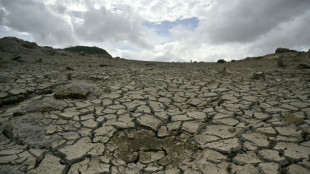
January sets 'surprising' heat record: EU monitor / Photo: Patrick T. Fallon - AFP
Last month was the hottest January on record, Europe's climate monitor said Thursday, despite expectations that cooler La Nina conditions might quell a streak of record-breaking global temperatures.
The Copernicus Climate Change Service said January was 1.75C hotter than pre-industrial times, extending a persistent run of history-making highs over 2023 and 2024, as human-caused greenhouse gas emissions crank up the global thermostat.
Climate scientists had expected this exceptional spell to subside after a warming El Nino event peaked in January 2024 and conditions gradually shifted to an opposing, cooling La Nina phase.
But the heat has lingered at record or near record levels ever since, sparking debate among scientists about what other factors could be driving heating to the top end of expectations.
"This is what makes it a bit of a surprise... you're not seeing this cooling effect, or temporary brake at least, on the global temperature that we were expecting to see," Julien Nicolas, a climate scientist from Copernicus, told AFP.
La Nina is expected to be weak and Copernicus said prevailing temperatures in parts of the equatorial Pacific Ocean suggested "a slowing or stalling of the move towards" the cooling phenomenon.
Nicolas said it could disappear completely by March.
- Ocean warmth -
Last month, Copernicus said that global temperatures averaged across 2023 and 2024 had exceeded 1.5 degrees Celsius for the first time.
This did not represent a permanent breach of the long-term 1.5C warming target under the Paris climate accord -- but a clear sign that the limit was being tested.
Scientists warn that every fraction of a degree of warming above 1.5C increases the intensity and frequency of extreme weather events like heatwaves, heavy rainfall and droughts.
Copernicus said Arctic sea ice in January hit a monthly record low, virtually tied with 2018. Analysis from the US this week put it at the second-lowest in that dataset.
Overall, 2025, is not expected to follow 2023 and 2024 into the history books: scientists predict it will rank the third hottest year yet.
Copernicus said it would be closely monitoring ocean temperatures throughout 2025 for hints about how the climate might behave.
Oceans are a vital climate regulator and carbon sink, and cooler waters can absorb greater amounts of heat from the atmosphere, helping to lower air temperatures.
They also store 90 percent of the excess heat trapped by humanity's release of greenhouse gases.
"This heat is bound to resurface periodically," said Nicolas.
"I think that's also one of the questions -- is this what has been happening over the past couple of years?"
Sea surface temperatures have been exceptionally warm over 2023 and 2024, and Copernicus said readings in January were the second highest on record.
"That is the thing that is a little puzzling -- why they remain so warm," Nicolas said.
- Debate -
Scientists are unanimous that burning fossil fuels has largely driven long-term global warming, and that natural climate variability can also influence temperatures one year to the next.
But natural warming cycles like El Nino could not alone explain what had taken place in the atmosphere and seas, and answers were being sought elsewhere.
One theory is that a global shift to cleaner shipping fuels in 2020 accelerated warming by reducing sulphur emissions that make clouds more mirror-like and reflective of sunlight.
In December, another peer-reviewed paper looked at whether a reduction in low-lying clouds had let more heat reach Earth's surface.
"It's really still a matter of debate," said Nicolas.
The EU monitor uses billions of measurements from satellites, ships, aircraft and weather stations to aid its climate calculations.
Its records go back to 1940, but other sources of climate data -- such as ice cores, tree rings and coral skeletons -- allow scientists to expand their conclusions using evidence from much further in the past.
Scientists say the period being lived through right now is likely the warmest the Earth has been for the last 125,000 years.
T.L.Marti--NZN