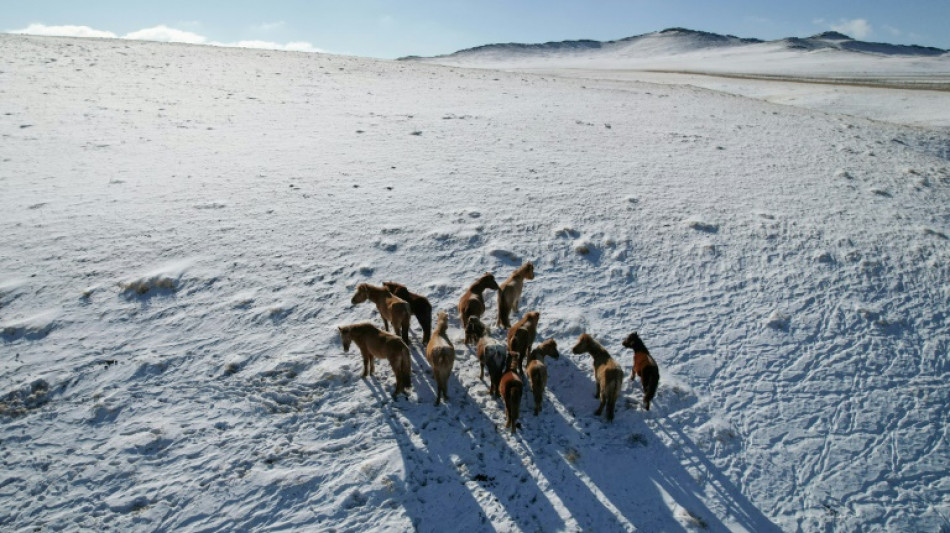
On the Mongolian steppe, climate change pushes herders to the brink / Photo: Jade GAO - AFP
Over a year after a devastating winter wiped out virtually his entire sheep flock, herder Zandan Lkhamsuren is still reckoning with the damage wrought by Mongolia's increasingly erratic extreme weather.
The vast country is one of the most affected by climate change, by some counts warming three times faster than the global average.
The link between rising temperatures and extreme weather –- ranging from droughts and floods to heatwaves and cold snaps –- is well-established.
In Mongolia the effects are stark.
Among other consequences, deep freezes like the one that killed Zandan's herd -- known as dzuds -- have been growing more frequent and intense.
"Last year's winter was the hardest I've ever known," the 48-year-old told AFP, describing daytime temperatures of minus 32 degrees Celsius (minus 25.6 degrees Fahrenheit) that plunged to minus 42C at night.
Heavy snowfall and frozen ground meant his sheep could not find food, and all except two of his 280-strong flock perished.
Across Mongolia, more than seven million animals were killed, over a tenth of the country's total.
"Our livestock used to cover all of our expenses, and we used to live very nicely," Zandan told AFP as he served hot salted milk tea in his traditional ger home.
But the loss of his animals and the loans he took out to keep feeding a smaller, hardier herd of goats mean he now struggles to make ends meet.
Both his daughters were supposed to start university in the capital Ulaanbaatar last year, but the family could not afford their tuition fees.
"Now my strategy is just to focus on what I have left," Zandan said.
Next to the ger's coal burner, a persistent bleating came from a box containing a sickly week-old goat.
- 'Difficult to predict' -
As the setting sun cast long shadows over the steppe, Zandan pulled on a thick green brocade jacket and strode outside, whistling as he shepherded his indignant charges into a shelter for the night.
He said he was keeping a positive mindset -- if he could boost his goat numbers, he might be able to fund his daughters' studies further down the line.
"It's just one downside of herders' lives," he said stoically. "But I'm sure we can recover."
The problem for Zandan -- and other agricultural workers that make up a third of Mongolia's population -- is that dzuds are happening more often.
They used to occur about once every 10 years, but there have been six in the last decade or so, according to the United Nations.
And while overgrazing has long contributed to desertification on the steppe, climate change is making things even worse.
Droughts in the summers have made it harder to fatten animals and stockpile fodder for winter.
"Like many other herder men, I always look at the sky and try to predict the weather," Zandan told AFP.
"But it's been getting difficult," he said. "Climate change is happening."
- Uncertain future -
His motorbike kicking up clouds of dust, 36-year-old Enebold Davaa shared those concerns as he chased his herd across the plain.
Enebold's family lost more than 100 goats, 40 sheep and three cows last winter.
"It's our main source of income, so we felt very heavy, it was very hard for us," he said.
This year's milder winter had allowed the family to recover some of their losses, but Enebold said he viewed the future with trepidation.
"Of course we are anxious, but there's nothing we can predict now," he said.
Local official Gankhuyag Banzragch told AFP most families in the district lost 30 to 40 percent of their livestock last winter.
As herding became more difficult, many families were moving away, he added.
A quarter of Mongolians still lead nomadic lives, but in recent decades hundreds of thousands have left the steppe for urban centres, particularly the capital.
As she boiled horsemeat dumplings, Enebold's wife said they too might consider a move if they lost more livestock.
"The main challenge is accessibility of education for our children in the city," she said.
Her husband had a more fundamental reason for staying.
"I want to keep herding my livestock," he said. "I want to keep the same lifestyle as now."
T.L.Marti--NZN