Zürcher Nachrichten - EU urged to act on forests' faltering absorption of carbon

EUR -
AED 4.275912
AFN 76.945742
ALL 96.507033
AMD 443.502545
ANG 2.084172
AOA 1067.669546
ARS 1669.615862
AUD 1.754156
AWG 2.095752
AZN 1.979584
BAM 1.95493
BBD 2.344656
BDT 142.426589
BGN 1.95493
BHD 0.438905
BIF 3439.568645
BMD 1.164307
BND 1.508029
BOB 8.044418
BRL 6.33336
BSD 1.164082
BTN 104.665401
BWP 15.466114
BYN 3.34681
BYR 22820.40996
BZD 2.341258
CAD 1.610277
CDF 2598.732168
CHF 0.936687
CLF 0.027361
CLP 1073.35122
CNY 8.231765
CNH 8.230635
COP 4422.730924
CRC 568.646829
CUC 1.164307
CUP 30.854126
CVE 110.21593
CZK 24.208254
DJF 207.297707
DKK 7.468805
DOP 74.506828
DZD 151.014766
EGP 55.297703
ERN 17.464599
ETB 180.565709
FJD 2.631857
FKP 0.872874
GBP 0.873789
GEL 3.137823
GGP 0.872874
GHS 13.242104
GIP 0.872874
GMD 84.994444
GNF 10115.496406
GTQ 8.91703
GYD 243.551567
HKD 9.063324
HNL 30.660349
HRK 7.534581
HTG 152.392152
HUF 381.731319
IDR 19431.753727
ILS 3.767358
IMP 0.872874
INR 104.724139
IQD 1525.021034
IRR 49031.867707
ISK 149.007685
JEP 0.872874
JMD 186.327044
JOD 0.825436
JPY 180.689329
KES 150.582958
KGS 101.819216
KHR 4660.924876
KMF 491.33727
KPW 1047.875385
KRW 1715.96691
KWD 0.357407
KYD 0.970168
KZT 588.717893
LAK 25243.761042
LBP 104246.887486
LKR 359.070136
LRD 204.88878
LSL 19.729516
LTL 3.437895
LVL 0.704277
LYD 6.328183
MAD 10.751913
MDL 19.807182
MGA 5192.688126
MKD 61.612569
MMK 2444.575233
MNT 4130.230657
MOP 9.335044
MRU 46.422332
MUR 53.640008
MVR 17.932029
MWK 2018.601284
MXN 21.162059
MYR 4.786443
MZN 74.410886
NAD 19.729516
NGN 1688.338127
NIO 42.840926
NOK 11.772625
NPR 167.464442
NZD 2.014838
OMR 0.446781
PAB 1.164182
PEN 3.913058
PGK 4.939801
PHP 68.653379
PKR 326.360799
PLN 4.229232
PYG 8006.435397
QAR 4.243211
RON 5.091044
RSD 117.347755
RUB 89.441675
RWF 1693.745915
SAR 4.36976
SBD 9.582933
SCR 15.771732
SDG 700.335953
SEK 10.943923
SGD 1.508534
SHP 0.873532
SLE 27.599807
SLL 24414.925724
SOS 664.104329
SRD 44.975958
STD 24098.796527
STN 24.489097
SVC 10.186465
SYP 12873.549183
SZL 19.714223
THB 37.112262
TJS 10.680845
TMT 4.086716
TND 3.41488
TOP 2.803371
TRY 49.55243
TTD 7.891487
TWD 36.43004
TZS 2840.6353
UAH 48.871442
UGX 4118.166521
USD 1.164307
UYU 45.529729
UZS 13926.799548
VES 296.376506
VND 30691.122782
VUV 141.301541
WST 3.246799
XAF 655.665087
XAG 0.019914
XAU 0.000277
XCD 3.146597
XCG 2.098066
XDR 0.815437
XOF 655.665087
XPF 119.331742
YER 277.745094
ZAR 19.719145
ZMK 10480.15708
ZMW 26.914017
ZWL 374.90626
  • RBGPF

    0.0000

    78.35

    0%

  • RELX

    -0.2200

    40.32

    -0.55%

  • AZN

    0.1500

    90.18

    +0.17%

  • BTI

    -1.0300

    57.01

    -1.81%

  • NGG

    -0.5000

    75.41

    -0.66%

  • BP

    -1.4000

    35.83

    -3.91%

  • CMSC

    -0.0500

    23.43

    -0.21%

  • GSK

    -0.1600

    48.41

    -0.33%

  • SCS

    -0.0900

    16.14

    -0.56%

  • RIO

    -0.6700

    73.06

    -0.92%

  • RYCEF

    -0.0500

    14.62

    -0.34%

  • BCC

    -1.2100

    73.05

    -1.66%

  • CMSD

    -0.0700

    23.25

    -0.3%

  • JRI

    0.0400

    13.79

    +0.29%

  • BCE

    0.3300

    23.55

    +1.4%

  • VOD

    -0.1630

    12.47

    -1.31%

EU urged to act on forests' faltering absorption of carbon
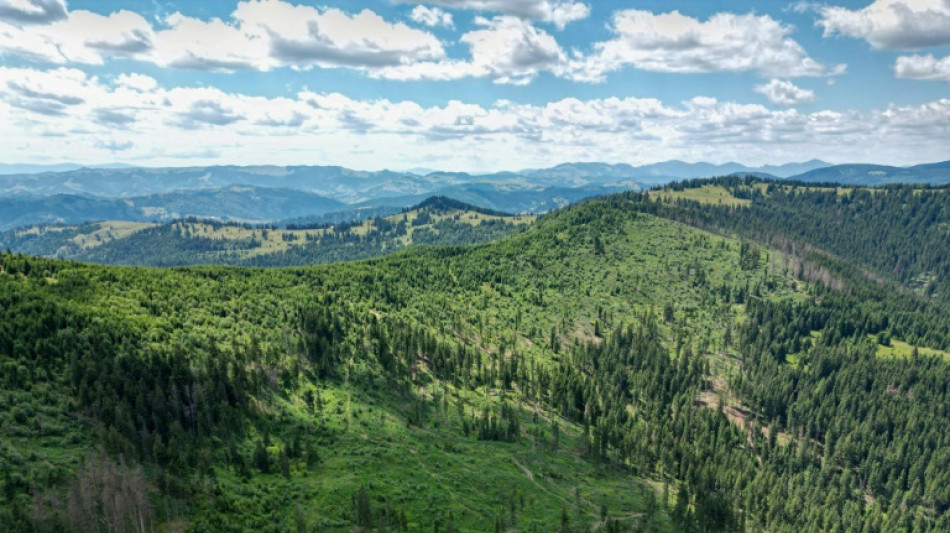
EU urged to act on forests' faltering absorption of carbon / Photo: Ionut IORDACHESCU - AFP/File

EU urged to act on forests' faltering absorption of carbon

The amount of carbon dioxide absorbed by European forests has reduced dramatically in recent years putting the EU's climate targets at risk, researchers said Wednesday, calling for urgent action to halt the decline.

Text size:

Forests, which cover 40 percent of the European Union's territory, are expected to play a crucial role in efforts to meet targets for overall reductions of the bloc's emissions of planet-warming gases.

But human and climate pressures, from logging to extreme weather and insect attacks, means their ability to absorb CO2 is "rapidly declining", according to an article, led by the European Commission's Joint Research Centre.

"Reversing the decline in European forests' ability to store carbon is essential -- and still possible -- with bold, science-based action today," said co-author Giacomo Grassi, who is a member of the UN's IPCC expert task force on greenhouse gas inventories.

Solutions include rapid reductions in carbon emissions, combined with efforts to improve management to make forests more resilient to climate impacts, and comprehensive monitoring.

Many European countries still rely on periodic inventories, which cannot keep up with rapid changes to forest health.

The authors emphasize the need to better understand forest dynamics.

They call in particular for better measuring of carbon flows between the soil, vegetation, and atmosphere, as well as improving predictions of how extreme weather will affect carbon sinks in the future.

- 'Steeper decline' -

The research looked at official 2024 data showing that the amount carbon absorbed by Europe's forests, ecosystems and changes to land use plummeted by around a third in the 2020 to 2022 period, compared to 2010 to 2014.

The authors said 2025 figures "suggest an even steeper decline".

"This trend, combined with the declining climate resilience of European forests, indicates that the EU's climate targets, which rely on an increasing carbon sink, might be at risk," the authors said.

Earlier this week another study in the Nature journal Communications Earth & Environment found that land accounts for a quarter of global emissions reductions in countries' climate plans and warned that a lack of funding and conservation focus was putting these in jeopardy.

Piers Forster, Director of the Priestley Centre for Climate Futures at Leeds University, who was not involved in Wednesday's study said it underscores the urgent need to slash emissions across the board.

"We can't bet our future on carbon removal -- either from planting more trees, from protecting forests, or from emerging technologies such as direct air capture and storage -- without understanding what is already happening to the land and natural systems," he said.

Scientists have warned that it is still unclear how carbon sinks might behave as the planet warms in future, and exactly how much heat-trapping carbon dioxide they might soak up from the atmosphere.

In April, research by Climate Analytics, a policy institute that independently assesses countries' climate plans, warned that major economies are overstating how much carbon their forests can absorb in a climate accounting fudge that could allow them to use even more fossil fuels.

E.Schneyder--NZN