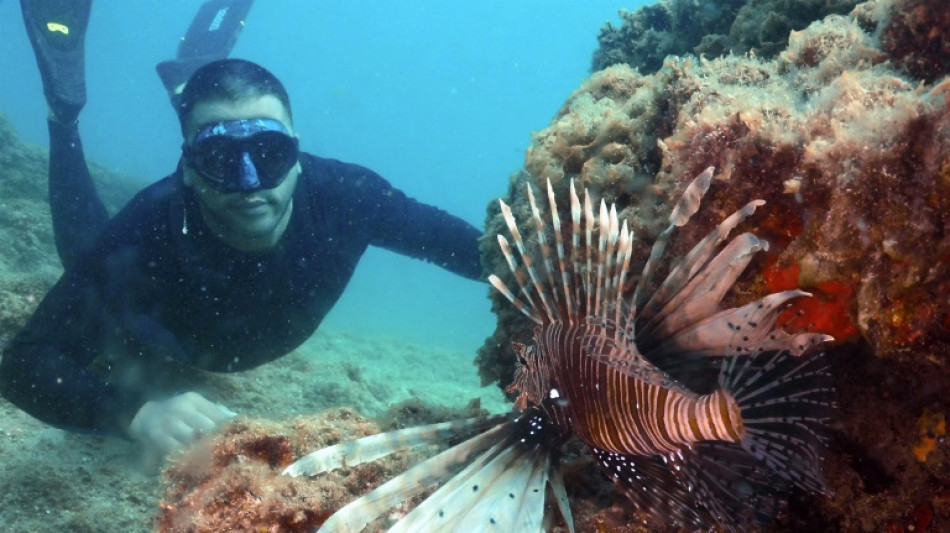
With waters at 32C, Mediterranean tropicalisation shifts into high gear / Photo: IBRAHIM CHALHOUB - AFP
When Murat Draman went scuba diving off the coast of the southern Turkish province of Antalya and saw the temperature in the depths was pushing 30C, it didn't surprise him.
"We were at a depth of 30 metres (100 feet) this morning and the water was 29C," said Draman, a diving instructor in an area which is experiencing firsthand the rapid "tropicalisation" of the Mediterranean Sea.
Encouraged by increasingly warm waters, hundreds of species native to the Red Sea have moved through the Suez Canal and into the eastern Mediterranean, disrupting ecosystems, scientists say.
The threat is facing the entire Mediterranean, one of the fastest-warming seas, which this year saw its hottest June and July on record, figures from the Mercator Ocean International research centre show.
Draman, who remembers when the water temperatures were 25C in August in the early 2000s, said he had seen dozens of Red Sea species colonising the clear waters of Antalya, where surface temperatures reached nearly 32C this week.
The striking but highly venomous lionfish (Pterois miles) with its long spotted fins that measure around 26 centimetres (10 inches), is now at home in such warm temperatures and wreaking havoc in the local ecosystem.
"About a decade ago, we saw one or two of them. Now we're talking about 15 or 20 per dive -- even more than when we go to the Red Sea," Draman told AFP.
"They are big predators. Small fish like gobies suffer a lot, we hardly see them anymore.
- 'A warning' -
Such invasive species are disrupting ecosystems across the eastern Mediterranean, the warmest area of the sea and the area that is heating up fastest, explained Professor Gil Rilov, a researcher at the Israel Oceanographic and Limnological Research institute (IOLR), who also lectures at Haifa University.
"The invasion started almost immediately after the opening of the Suez Canal in 1869," he said.
"But now it's getting warmer, and also (in 2015), the canals got deeper and wider, so more and more new species move in every year," the marine biologist told AFP, admitting some new arrivals could also be beneficial in waters that are becoming too warm for the native species.
And many of these species -- which have become ubiquitous off the coasts of Turkey, Lebanon and Israel -- are now moving further west, he said, pointing to the rabbitfish (Siganus rivulatus) which has recently colonised the waters off Malta, more than 1,700 kilometres (over 1,000 miles) from the Suez Canal.
What is happening in the eastern Mediterranean, where many native species have already disappeared, "is a warning", Rilov added, pointing to two possible causes for their disappearance: excessively warm waters and fierce competition with these invasive species.
"What is happening here will happen in five, 10 or 20 years in the north and west of the Mediterranean," he predicted.
Last week, Mercator figures showed the sea had registered its warmest July on record with an average surface temperature of 26.68C -- a figure that is worrying experts.
- 'Absence of predators' -
This "tropicalisation" could also occur in the coming years through the Strait of Gibraltar at the far end of the Mediterranean basin, according to a study published in the prestigious US science journal PNAS (Proceedings of the National Academy of Sciences) in April 2024.
In it, the authors warned that even in an intermediate climate scenario, the warming of the Atlantic Ocean could see certain species migrate from the southern coasts of west Africa to the western Mediterranean by 2050.
A more pessimistic scenario could even see the Mediterranean "entirely tropicalised" by 2100, they warned.
Faced with such a threat, Draman said invasive species must be kept as far as possible from protected marine areas "in order to preserve biodiversity".
"It is clear that with the absence of Mediterranean predators, species such as lionfish are very comfortable here and their population is increasing year on year," he said.
"In the Red Sea, lionfish have predators. There are sharks and barracudas. Here, we have none of that."
T.Furrer--NZN