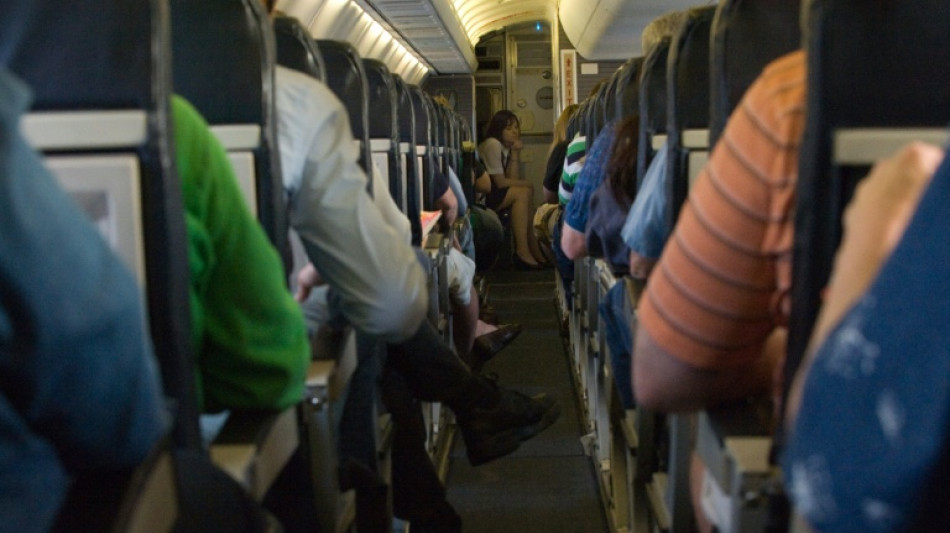
Bumpy skies: How climate change increases air turbulence / Photo: PAUL J. RICHARDS - AFP/File
The seatbelt sign pings on, trays rattle, drinks slosh in their glasses.
For many flyers, air turbulence can be an unnerving experience -- and in a world warming under the effects of climate change, it is only set to worsen, according to a growing body of scientific evidence.
Here are the key things to know during another searing summer in 2025.
- Why turbulence matters -
Beyond making people uneasy, turbulence is also the leading cause of in-flight weather accidents, according to official data.
The numbers remain relatively small: there were 207 reported injuries on US commercial flights between 2009 and 2024. But high-profile incidents have thrust the issue into the spotlight.
These include an Air Europa flight last year, in which 40 passengers were hurt, and a Singapore Airlines flight where one elderly passenger died and dozens were injured.
"Typically injuries (are) to unbelted passengers or cabin crew rather than structural damage," John Abraham, a mechanical engineering professor at the University of St. Thomas told AFP.
"Modern aircraft withstand turbulence, so the main risk is occupant injury, not loss of the plane."
Still, planes must be inspected after "severe" encounters with turbulence -- about 1.5 times the normal force of Earth's gravity -- which occur some 5,000 times a year over the US, said Robert Sharman, a senior scientist emeritus at the National Center for Atmospheric Research.
Turbulence also increases fuel consumption when pilots must leave optimal altitudes, alter routes or change speeds, Abraham added.
- How climate change is making it worse -
Mohamed Foudad, an atmospheric scientist at the University of Reading in the UK, explained there are three main types of turbulence: convective, mountain wave and clear-air turbulence (CAT).
Convective turbulence is linked to rising or sinking air currents from clouds or thunderstorms that can be detected visually or by onboard radar, while mountain wave turbulence occurs over mountain ranges.
CAT, by contrast, is invisible -- and therefore the most dangerous.
It generally arises from jet streams: fast-moving westerly winds in the upper atmosphere at the same altitude as commercial jets, about 10–12 kilometers up.
With climate change, the tropics are warming faster at cruising altitude than higher latitudes.
That increases the temperature difference between the higher- and lower-latitudes, driving up jet stream velocity and wind shear -- volatile shifts in vertical air currents that trigger CAT.
Foudad and colleagues published a paper last year in the Journal of Geophysical Research: Atmospheres analyzing data from 1980 to 2021.
"We find a clear, positive trend -- an increase in turbulence frequency over many regions, including the North Atlantic, North America, East Asia, the Middle East and North Africa," he told AFP, with increases ranging from 60 to 155 percent.
Further analysis attributed the rising turbulence in certain regions to increased greenhouse gas emissions.
- What happens next? -
A 2023 paper led by Isabel Smith at the University of Reading found that for every degree Celsius of near-surface warming, winters would see an increase of about nine percent in moderate CAT in the North Atlantic, and summers a rise of 14 percent.
Winter has historically been the roughest season for turbulence, but warming is now amplifying CAT in summer and autumn, closing the gap.
Jet stream disruption is not the only concern: climate change is also fueling stronger storms.
"Climate change may also increase the frequency and severity of thunderstorms under future scenarios, and turbulence encounters near thunderstorms are a major component of turbulence accidents," Sharman told AFP.
In terms of mitigation strategies, Foudad is working on two studies: optimizing flight routes to avoid turbulence hotspots and improving forecasting accuracy.
Some airlines are moving towards strategies involving passengers wearing seatbelts more often, such as ending cabin service earlier.
Promising technologies are also being tested, says Sharman, including onboard LIDAR, which beams lasers into the atmosphere to detect subtle shifts in air density and wind speed.
Ultimately, cutting greenhouse gas emissions will be essential, Foudad added.
Aviation is responsible for about 3.5 percent of human-caused warming. Airlines are exploring cleaner fuels to help reduce the industry's footprint, though progress has been "disappointingly slow," according to the International Air Transport Association.
A.Wyss--NZN