Deadpool: US mega drought spells trouble at Hoover Dam / Photo: Patrick T. FALLON - AFP
Millions of gallons of Colorado River water hurtle through the Hoover Dam every day, generating electricity for hundreds of thousands of homes.
But the mega drought affecting the western United States is sending reservoir levels plummeting towards deadpool -- the point at which the dam can no longer produce power.
"We are 23rd year of drought here in the Colorado River Basin and Lake Mead has dropped down to 28 percent," explains Patti Aaron of the US Bureau of Reclamation, which operates the dam. She was referring to the vast lake created by the building of the dam.
"There isn't as much head so there isn't as much pressure pushing the water into the turbines, so there's less efficiency and we aren't able to produce as much power."
Hoover Dam was a feat of American hope and engineering.
Construction began in 1931 as the country was withering under the Great Depression.
Thousands of workers toiled 24 hours a day to build what was then the largest hydroelectricity facility in the world.
The dam stopped up the Colorado River, creating Lake Mead, the biggest reservoir in the United States.
At its height, the lake surface sits over 1,200 feet (365 meters) above sea level. But after more than two decades of drought it is now less than 1,050 feet -- the lowest since the lake was filled, and falling about a foot a week.
If it drops to 950 feet, the intakes for the dam will no longer be under water and the turbines will stop.
"We're working very hard for that not to happen," said Aaron. "It's just not an option to not produce power or not deliver water."
- Melting snowpack -
The Colorado River rises in the Rocky Mountains and snakes its way through Colorado, Utah, Arizona, Nevada, California and northern Mexico, where it empties into the Gulf of California.
It is fed chiefly by the huge snowpack that gets dumped at high altitudes, melting slowly throughout the warmer months.
But reduced precipitation and the higher temperatures caused by humanity's unchecked burning of fossil fuels means less snow is falling, and what snow there is, is melting faster.
As a consequence, there is not as much in a river that supplies water to tens of millions of people and countless acres of farmland.
Boaters on Lake Mead, many of whom come from Las Vegas and its surrounding towns, say they are doing their part to protect supplies.
They point to the drought-tolerant landscapes they have installed instead of lawns, and the high percentage of indoor water that is recycled in desert towns.
"But you've got farmers in California growing almonds for export," said Kameron Wells, who lives in nearby Henderson, Nevada.
Householders in southern California have grumbled about the fate of their luscious lawns since being ordered to limit their outdoor watering to one or two days a week at the start of the summer.
But there, like in the desert periphery of Las Vegas, there is plenty of new construction, with huge houses being put up in the resort settlement of Lake Las Vegas.
And from the air, the vibrant green of dozens of golf courses mark an otherwise dust bowl landscape.
- 'Out of sight, out of mind' -
Climatologist Steph McAfee of the University of Nevada, Reno, says the US west has always been something of an improbability.
"The average precipitation in Las Vegas is something like four inches (10 centimeters) a year," she told AFP.
"And to make it possible to have cities like Las Vegas and Phoenix and Los Angeles we rely on water that falls in the mountains as snow in parts of the West that are obviously much, much wetter."
The last two decades of drought are not, McAfee says, actually that unusual in climatic terms, according to tree ring reconstructions.
But "what's going on now is that we're having a drought, and temperatures are much warmer and when temperatures are high, things dry out faster.
"That is a consequence of climate change... driven by human greenhouse gas emissions."
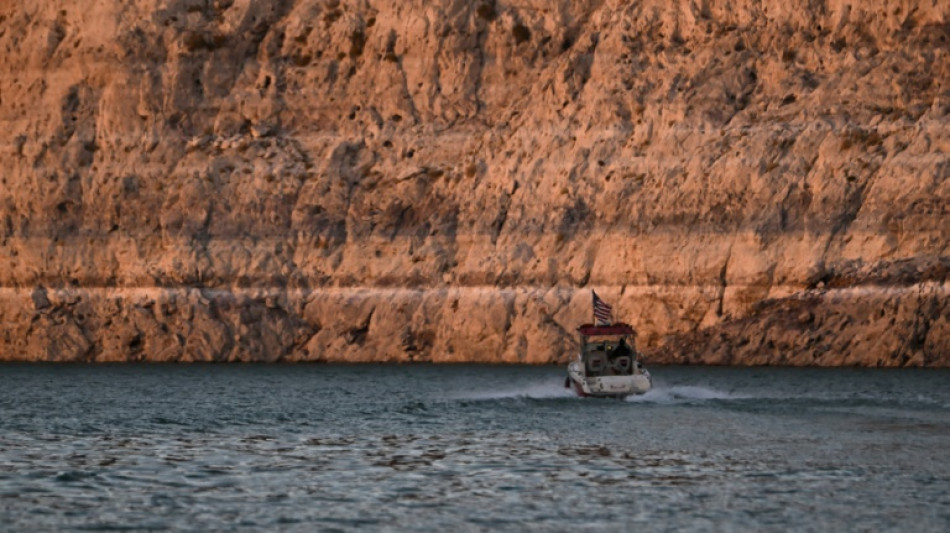
On Lake Mead, boat seller Jason Davis manoeuvers his craft towards Hoover Dam, where thousands of tonnes of concrete loom over the water in graceful modernist lines, and a ring of mineral deposits shows where the water level used to be.
For him, the lake is not just a battery for the huge generators in the dam, but a waterscape whose beauty and peacefulness are worth protecting.
"You know, people who haven't been here don't appreciate it," he says as a sunset rages in the desert sky above.
"It's like, out of sight, out of mind. Hey, we're using too much water.
"Well, if you if you haven't seen these rings, you don't quite comprehend.
"Hopefully it's not too late."
Y.Keller--NZN