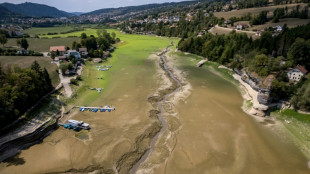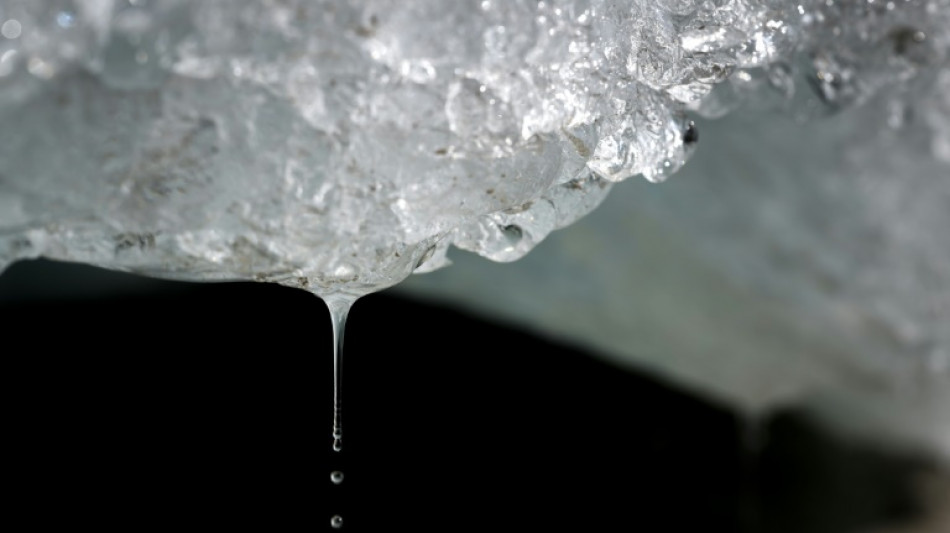
Swiss glaciers shrank by a quarter in past decade: study / Photo: Fabrice COFFRINI - AFP
Switzerland's glaciers, which are disproportionately impacted by climate change, have lost a quarter of their volume in the past decade alone, a study warned Wednesday, heightening concerns over accelerating melting.
In 2025, glacial melting in the Alpine nation was once again "enormous", the Glacier Monitoring in Switzerland (GLAMOS) network said, adding that it was close to the record set in 2022.
A winter with little snow combined with summer heatwaves in June and August saw Switzerland's glaciers lose three percent of their volume.
That marks the fourth-largest level of shrinkage since measurements began, trailing only 2022, 2023 and 2003, according to GLAMOS's annual report.
Glaciers across the Alps have been retreating for more than a century.
But in recent decades, the process has sped up as the climate warms, driven by humanity's burning of fossil fuels.
"Since about 20 years, all glaciers in Switzerland are losing ice, and the rate of this loss is accelerating," GLAMOS chief Matthias Huss told AFP.
Between 2015 and 2025 alone, the glaciers shed 24 percent of their volume, Wednesday's report said, compared to 10 percent between 1990 and 2000.
- Melting away -
GLAMOS researchers did extensive measurements at around 20 reference glaciers in September, and extrapolated the findings to Switzerland's 1,400 glaciers.
Europe's Alpine region has been hard-hit by climate change, with warming in Switzerland progressing at twice the pace of the global average, according to the Swiss Federal Office of Meteorology and Climatology.
Other Alpine countries are also seeing glaciers retreat, and researchers highlight that those in Switzerland -- whose mountain peaks are higher than in neighbouring Austria -- may have a better chance of surviving the increasingly hot summers.
Even so, scientists warn that Switzerland's glaciers could all but disappear by the end of this century without more action to rein in global warming.
"We can't avoid the glacier melting overall," GLAMOS head Huss said, but "we can slow it down... with globally coordinated climate action".
If carbon dioxide emissions "are brought to zero within 30 years... we could still save about one-third of the Swiss glaciers", Huss added.
Since the early 1970s, more than 1,100 Swiss glaciers have disappeared completely, according to GLAMOS.
- 'Destabilising' mountains -
Overlooking the Rhone Glacier, near Gletsch village, Huss said the giant ice mass had lost more than 100 metres (330 feet) in height in the last 20 years.
"It's really a devastation of the ice," he said.
Argentine tourist Wincho Ponte, 29, agreed.
It was "really sad that it's melting so quickly", Pointe said.
Water reserves have meanwhile been dwindling as the glaciers retreat, causing increasing problems in the summer months.
Huss cautioned that this could hit "water availability not only up here in the mountains but also all the way down to the Mediterranean Sea".
"The continuous diminishing of glaciers also contributes to the destabilising of mountains", he warned, pointing to the Swiss village of Blatten, which was wiped out by a dramatic glacier collapse in May.
GLAMOS determined that Swiss glacier volume will total 45.1 cubic kilometres (10.8 cubic miles) at the end of this year -- or 30 km3 less than in 2000.
At present, the surface area of Swiss glaciers covers 755 square kilometres -- a decline of 30 percent over the past 25 years.
This year, Switzerland's second-hottest June on record contributed to snow melting rapidly, even at the highest altitudes.
August brought a fresh heatwave, pushing the freezing line as high as 5,000 metres above sea level -- well above the peak of western Europe's highest mountain, Mont Blanc.
Only a rather cool and damp July "provided some relief and prevented an even worse outcome", GLAMOS said, with a few cold fronts resulting in individual days with fresh snow at higher altitudes.
The overall summer melt this year was therefore only 15 percent above the 2010-2020 average -- its lowest level in the past four years.
J.Hasler--NZN