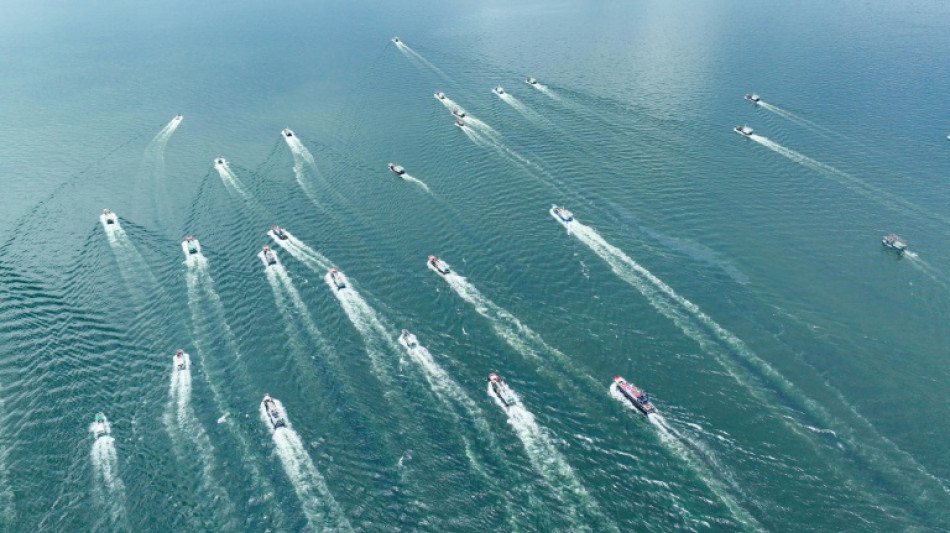
UN high-seas biodiversity treaty struggles to leave port / Photo: STR - AFP/File
A two-week negotiating session on a treaty to protect the high seas wraps up Friday, with UN observers holding their breath that the long-stalled deal can cross the finish line.
After 15 years, including four prior formal sessions, negotiators have yet to reach a legally binding agreement to address the growing environmental and economic challenges involving the high seas, also known as international waters -- a zone which encompasses almost half the planet.
Many had hoped that this fifth session, which began on August 15 at the United Nations headquarters in New York, would be the last and yield a final text on "the conservation and sustainable use of marine biodiversity beyond national jurisdiction," or BBNJ for short.
The High Ambition Coalition, a group of some 50 countries led by the European Union, had even called for a comprehensive BBNJ deal to be finalized by the end of the year.
But according to international environmental group Greenpeace, the talks are on the brink of failure because of what it considers "the greed of countries in the High Ambition Coalition and others like Canada and the United States."
One of the most sensitive issues revolves around the sharing of possible profits gained from developing genetic resources in international waters, where pharmaceutical, chemical and cosmetic companies hope to find miracle drugs, products or cures.
Such costly research at sea is largely the prerogative of rich nations, but developing countries do not want to be left out of potential windfall profits drawn from marine resources that belong to no one.
A draft text published a few days ago seemed to side with the developing nations, with a requirement that two percent of all future sales be redistributed.
But since then, there has been "a big step backwards," said Greenpeace's Will McCallum, who accuses the EU of rejecting the proposal.
"It's not even real money. It's just hypothetical money one day. That is why it is really frustrating," he told AFP.
The EU pushed back on that characterization, with one European negotiator telling AFP: "We are willing to contribute to the BBNJ agreement through various funding sources, which in our view shall include a fair sharing of benefits from marine genetic resources globally."
Similar issues of equity between the Global North and South arise in other international negotiations, such as on climate change, where developing nations feel outsized harms of global warming and try in vain to get wealthier nations to help pay to offset those impacts.
- 'Too close to fail' -
Though Greenpeace might be very pessimistic, others still hope for an agreement on Friday.
"It is slow but there is still a lot of will inside the room to get it done," said Liz Karan with the NGO Pew Charitable Trusts.
"I wouldn't call it a failure yet but the clock is ticking," she added.
Jihyun Lee, a youth ambassador with conservation group the High Seas Alliance, said a deal was possible, but added it would be necessary for countries, "especially those who claim themselves as ocean champions, to show more ambitions and flexibility so we can get the treaty done."
"We cannot afford to water down the high seas treaty and we don't have any time to waste," she told a press conference. "We're too close to fail."
The high seas begin at the border of nations' exclusive economic zones (EEZs) -- which by international law reach no more than 200 nautical miles (370 kilometers) from each country's coast -- and are under no state's jurisdiction.
Sixty percent of the world's oceans fall under this category.
And while healthy marine ecosystems are crucial for the future of humanity, particularly to limit global warming, only one percent of international waters are protected.
One of the key pillars of an eventual BBNJ treaty is to allow the creation of marine protected areas, which many nations hope will cover 30 percent of the Earth's ocean by 2030.
"Without establishing protections in this vast area, we will not be able to meet our ambitious and necessary 30 by 30 goal," said US State Department official Maxine Burkett at a press conference.
But delegations still disagree on the process for creating these protected areas, as well as on how to implement a requirement for environmental impact assessments before new activity on the high seas.
"I think they have made a lot of progress in the last two weeks on issues that were very controversial," said Klaudija Cremers, a researcher at the IDDRI think tank, which like multiple other NGOs has a seat with observer status at the negotiations.
She told AFP that the final talks Friday "could be the push to get an agreement."
L.Muratori--NZN